Enterprise AI M&A technical due diligence in 2026 requires corporate acquirers and institutional investors to look beyond top-line recurring revenue and audit whether target companies possess legally transferable data rights, clean model ownership, and economically viable inferencing unit economics. In technology transactions, traditional software audits evaluate source code repositories, open-source licenses, and cloud hosting architecture; however, artificial intelligence companies introduce complex risk profiles where proprietary value is tied to model weights, training datasets, and multi-tenant agent execution pipelines. A critical finding from market research reveals that while 66% of M&A dealmakers report discussing AI technical debt during transaction planning, only 33% systematically prioritize AI and technical debt audits during pre-deal evaluation. Failing to conduct rigorous technical due diligence risks acquiring assets that violate copyright laws, contain contaminated open-weights licenses, or carry unsustainable compute liabilities that destroy post-closing valuation.
Why Does Traditional Software Due Diligence Fail AI Acquisitions?
In conventional software acquisitions, technical due diligence centers on source code originality, architecture scalability, security vulnerabilities, and open-source software (OSS) copyleft compliance under licenses like GPL or AGPL. If a target company incorporates an incompatible open-source library, engineering teams can generally refactor the codebase, replace the module with an alternative dependency, or rewrite the offending functions within a predictable remediation budget.
In artificial intelligence companies, technical debt and intellectual property liabilities do not reside solely within code files:
- Model Weights Are Inseparable from Training Lineage: If an acquired target trained its primary frontier model or proprietary adapter on scraped data lacking valid licenses, commercial consent, or opt-out compliance, the resulting model weights represent derivative works tainted by copyright infringement. Code can be refactored, but a tainted model cannot be mathematically disentangled; the entire model must be decommissioned, purged, and retrained from scratch at catastrophic expense.
- "Thin Wrapper" Vulnerabilities Disguised as Proprietary IP: Many venture-backed targets present themselves as proprietary AI platforms while operating as uninsulated API wrappers around commercial foundation models. If a target’s intellectual property consists primarily of system prompts and basic retrieval-augmented generation (RAG) orchestration, it possesses virtually no defensible technological moat or enterprise switching barrier.
- Hidden Compute and Cloud Commitments: Targets frequently negotiate multi-year minimum GPU cloud commitments or heavily subsidized foundation model API pricing during venture-backed growth phases. Upon a corporate acquisition or change-of-control event, those preferential enterprise discounts frequently expire, exposing the acquirer to structural gross-margin deterioration.
What Are the Four Pillars of AI Technical Due Diligence?
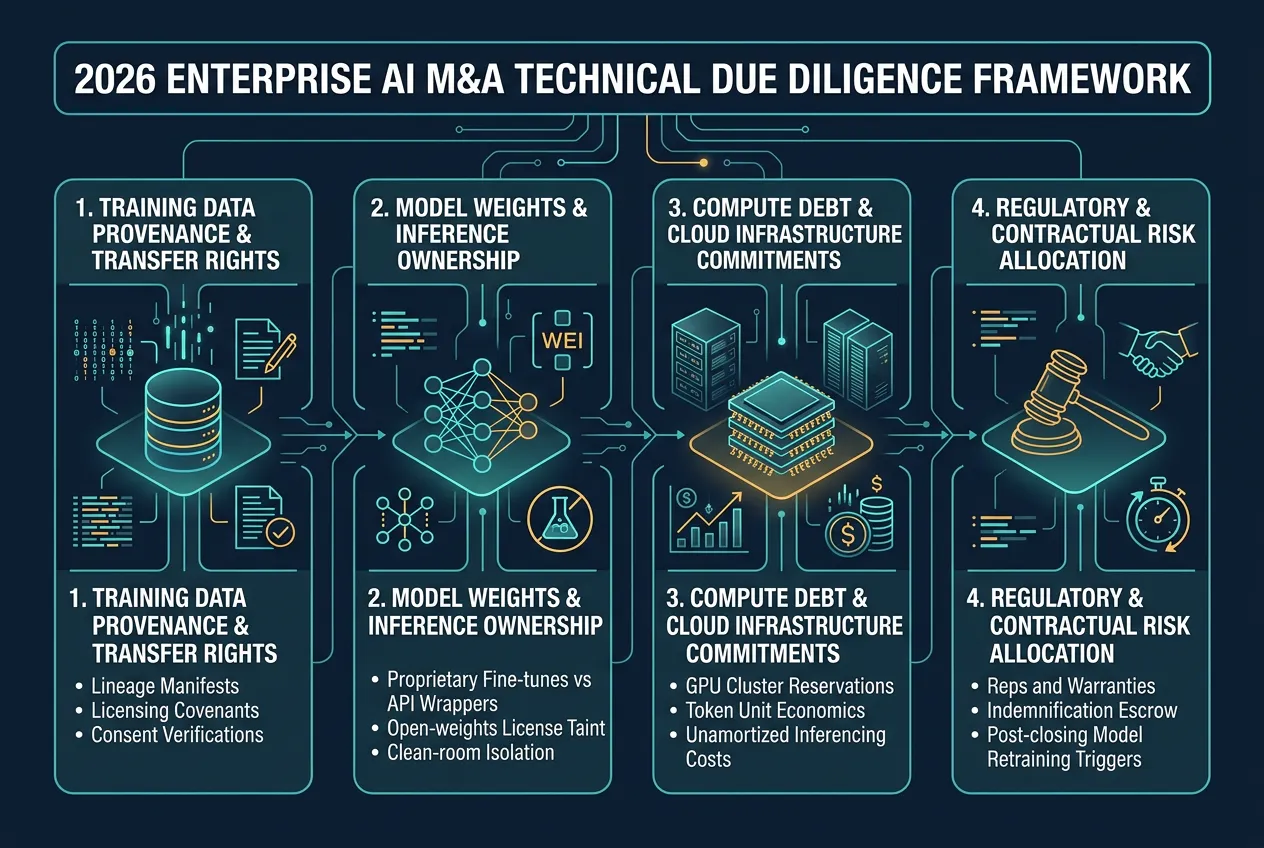
Institutional buyers and corporate corporate development teams must structure their pre-acquisition technical audit across four core operational pillars:
1. Training Data Provenance and Transferability Rights
The value of an AI asset is fundamentally bounded by the legality of its underlying data lineage. Diligence teams must audit:
- Contractual Data Ingestion Rights: Full chain-of-title verification for all pre-training, fine-tuning, and reinforcement learning datasets. Acquirers must verify that customer terms of service, vendor agreements, and data partnership contracts explicitly permitted model training rather than mere transactional data processing.
- Customer Data Opt-In/Opt-Out Clauses: Reviewing whether the target trained shared foundation models on private customer inputs without express consent. Under regulatory scrutiny and emerging legal standards, unauthorized enterprise data utilization can trigger mandatory data deletion and model disgorgement orders.
- Synthetic Data Lineage and Contamination: Auditing whether synthetic training corpora were generated using foundation models whose commercial terms prohibit competitive model training. Acquirers must ensure data sets are anchored with cryptographic provenance manifests such as C2PA or W3C PROV-O metadata.
2. Model Weight Ownership and License Taint
Acquirers must map the precise technical lineage of every production model weight:
- Foundation Model Licensing and Distribution Restrictions: Identifying whether the target’s fine-tuned models depend on base open-weights releases governed by restrictive community licenses (such as commercial revenue caps, non-compete clauses, or mandatory reciprocal sharing).
- Clean-Room Training Verification: Demanding comprehensive training runbooks, hyperparameter configurations, and validation checkpoints to verify that target models were developed independently without exposure to proprietary competitor weights or illicit extraction attacks.
- Weights vs. API Access: Determining whether the company holds physical custody of fine-tuned LoRA adapters and model weights in an immutable OCI-compliant registry, or merely accesses fine-tuned endpoints hosted within a third-party vendor's cloud console.
3. Compute Debt and Inferencing Unit Economics
Acquirers must dissect the true unit economics of the target’s inference workloads:
- Token Cost Attribution and Gross Margin Sustainability: Calculating the fully loaded cost of goods sold (COGS) per user query or agentic workflow step. Acquirers must measure whether customer contract pricing covers multi-turn token consumption, context-window expansions, and speculative decoding overhead.
- Reserved Cloud Capacity and Take-or-Pay Commitments: Auditing multi-year GPU cloud hosting agreements, cluster lease agreements, and take-or-pay minimum spending commitments to quantify unamortized balance-sheet liabilities.
- Model Efficiency and Optimization Runway: Evaluating whether the target utilizes quantization (e.g., INT4/FP8), KV-cache optimization, and semantic caching architectures, or whether its platform relies on brute-force, high-cost inference configurations.
4. Regulatory, Privacy, and Security Controls
Compliance risks must be evaluated against modern AI governance frameworks, including the NIST AI Risk Management Framework (NIST AI RMF 1.0 / NIST AI 600-1) and international standards:
- NIST AI RMF Governance Integration: Assessing how the target operationalizes the Govern, Map, Measure, and Manage functions across its development lifecycle, verifying accountability assignments and formal AI risk registries.
- Data Privacy and Cross-Border Transfers: Ensuring inference and retrieval architectures comply with zero data retention (ZDR) requirements, HIPAA Business Associate Agreements, and European Union AI Act post-market surveillance obligations.
- Adversarial Resilience and Security Telemetry: Auditing penetration testing records, prompt-injection defense mechanisms, and OpenTelemetry GenAI distributed tracing logs to verify that agentic tool executions maintain strict privilege boundaries.
How Should Buyers Structure Acquisition Agreements for AI Assets?
Technical diligence findings must be directly translated into transaction documents to safeguard deal valuation and allocate legal risk:
| Transaction Mechanism | Standard Software Practice | Enterprise AI Diligence Enhancement |
|---|---|---|
| Representations & Warranties | Standard IP non-infringement and open-source copyleft representations. | Specific reps confirming lawful training data rights, absence of training-data copyright infringement, clean synthetic data provenance, and compliance with foundation model terms of service. |
| Special Indemnity & Escrow | Standard tax and litigation indemnification escrows. | Dedicated AI indemnity escrows covering potential copyright claims from rights holders, model disgorgement orders, or regulatory fines arising from pre-closing training activities. |
| Closing Conditions | Delivery of source code repositories and IP assignments. | Verification of physical delivery of model weights, LoRA adapter checkpoints, training runbooks, evaluation holdout datasets, and cloud registry access credentials. |
| Post-Closing Retraining Covenant | Standard software integration and bug-fix commitments. | Contractual covenants requiring sellers to fund retraining procedures and supply substitute verified datasets if target models are challenged or ordered decommissioned post-closing. |
How does AI technical debt differ from conventional software technical debt?
Conventional technical debt consists of suboptimal code design, legacy frameworks, and unrefactored modules that can be incrementally rewritten by software engineers. In contrast, AI technical debt encompasses tainted training data, unversioned model weights, cascading non-deterministic prompt dependencies, and unamortized GPU compute commitments. Remediating AI technical debt frequently requires complete model retraining rather than targeted codebase refactoring.
What is model disgorgement, and why is it a primary transaction risk?
Model disgorgement is a regulatory or judicial remedy whereby a company is legally compelled to destroy not only improperly acquired training data, but also all algorithmic models, weights, and derivative parameters trained on that data. For corporate acquirers, an unexpected model disgorgement order effectively destroys the core technological asset purchased in the acquisition.
How does the NIST AI Risk Management Framework assist M&A due diligence?
The voluntary NIST AI RMF provides institutional acquirers with a structured evaluation blueprint across four functions: Govern (accountability, policies, and risk tolerance), Map (system context, data lineage, and deployment risks), Measure (empirical testing, bias, robustness, and drift metrics), and Manage (remediation protocols, incident monitoring, and contingency plans).
What documents should acquirers request on day one of an AI transaction?
Acquirers should request: (1) an exhaustive model and agent inventory; (2) dataset lineage registers and data license agreements; (3) foundation model commercial terms and API agreements; (4) model evaluation benchmarks and validation scorecards; (5) GPU cloud infrastructure commitments and token unit economic models; and (6) penetration testing and security audit logs.
For related strategic frameworks on enterprise procurement and deployment governance, explore our analysis on Enterprise AI Acceptance Testing: Contractual Procurement Benchmarks in 2026, review our breakdown of Enterprise AI Model Deprecation Covenants: Version Pinning in 2026, and examine governance architectures in Enterprise AI Governance Charter: CAIO Mandates and Decision Rights in 2026.