Law firms adopting generative artificial intelligence face an urgent regulatory reality: ethics regulators across state bars and the American Bar Association are establishing strict disciplinary boundaries around legal fees and client confidences. Under ABA Formal Opinion 512 and state bar frameworks—including the New York State Bar Association’s October 31, 2026 Legal Ethics Guidelines for Lawyers’ Use of Artificial Intelligence, California’s COPRAC Practical Guidance, and Florida Bar Opinion 24-1—attorneys must adhere to definitive operational standards governing legal ethics for AI billing and confidentiality.
Why Can’t Law Firms Bill Clients for "Time Saved" by AI?
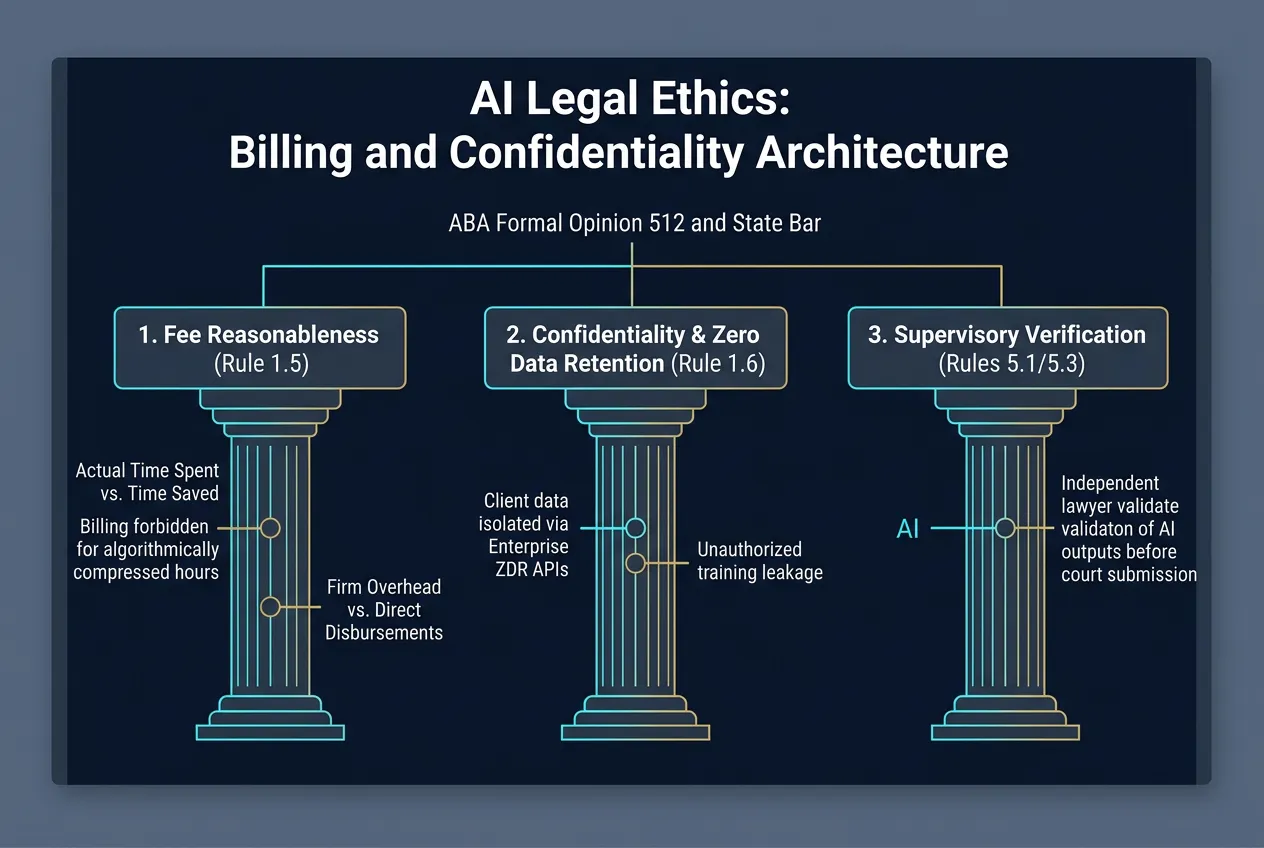
Under Model Rule 1.5 and parallel state ethics rules, the billable hour requires reporting actual time expended, not imputed historical value. When an automated workflow compresses an eight-hour research memorandum into thirty minutes of prompt execution and forty-five minutes of attorney review, the firm may only bill for the one hour and fifteen minutes of actual human effort.
Both ABA Formal Opinion 512 and NYSBA Guideline 5A explicitly forbid billing clients for "phantom time" or efficiency gains:
"In an hourly billing representation, a lawyer who uses generative AI to draft a document in 15 minutes cannot bill the client for the two hours it would have taken to draft the document without AI. A lawyer who bills for time not actually spent engages in an unreasonable and deceptive fee practice."
*ABA Formal Opinion 512 (July 2024)*
The same prohibition applies to professional development: attorneys cannot bill clients for the time required to learn an AI application or train on general prompting techniques, unless the client specifically directed the firm to master that custom tool for their specific engagement.
Overhead vs. Direct Disbursements: What Can Be Passed Through?
State bar guidelines draw a clean line between institutional software overhead and allowable matter disbursements:
- General Enterprise Overhead: General AI subscriptions, seat licenses, API gateway base costs, and hardware infrastructure are standard law firm overhead expenses that cannot be surcharged or billed as separate disbursements.
- Matter-Specific Disbursements: Dedicated AI tooling charges (such as project-specific eDiscovery predictive coding or specialized transactional diligence datasets) may only be passed through if they represent actual, out-of-pocket costs without markup, and the client consented to the expense arrangement in advance in writing under Model Rule 1.5(b).
How Does Model Rule 1.6 Restrict AI Prompting and Model Training?
Model Rule 1.6(a) prohibits knowingly revealing confidential client information without informed consent, while Rule 1.6(c) mandates reasonable efforts to prevent inadvertent or unauthorized disclosure. When inputting client facts, financial records, or litigation strategy into an external model, attorneys must ensure that client confidences do not cross the firm's security boundary.
NYSBA Guidelines 6A and 6B, alongside California State Bar COPRAC guidance, enforce three mandatory technical controls:
- Zero Data Retention (ZDR): Commercial consumer AI tools that retain inputs for model retraining or human feedback review violate Model Rule 1.6 by default. Law firms must execute enterprise service agreements that contractually guarantee zero data retention and prohibit the model provider from utilizing client inputs for secondary training.
- Cross-Matter Context Isolation: Multi-tenant architectures and shared prompt caches create cross-matter leakage risks. Firms must verify tenant isolation so that confidential facts from one client matter cannot surface in completions or context windows generated for another client.
- Informed Client Consent: Where the utilization of an AI tool poses material risks of disclosure or fundamentally alters the nature of representation, boilerplate engagement-letter clauses are legally insufficient. Lawyers must provide specific, unbundled disclosures regarding data storage, processing jurisdictions, and third-party vendor handling under Rule 1.4.
What Supervisory Duties Apply Under Model Rules 5.1 and 5.3?
Law firm partners and managing attorneys possess affirmative duties under Model Rules 5.1 and 5.3 to establish internal compliance policies ensuring that subordinates, staff, and nonlawyer assistance conform to professional conduct rules. In the generative AI era, this supervisory mandate extends to autonomous software agents and vendor integrations.
Attorneys cannot delegate ultimate legal judgment to an algorithmic system. Every AI-generated brief, contract redline, or discovery index must undergo rigorous, independent factual and citation verification by a licensed human practitioner before filing or delivery. Failure to independently verify citations exposes counsel to mandatory sanctions under Federal Rule of Civil Procedure 11 and disciplinary referrals for violating the duty of competence under Model Rule 1.1.
How Does Model Rule 1.4 Require Disclosure to Clients?
Client communication duties under Model Rule 1.4 require keeping clients reasonably informed about the means by which their objectives are accomplished. While routine administrative uses—such as AI-assisted spellcheck, document formatting, or automated calendaring—do not trigger mandatory client disclosures, substantive legal drafting or strategic analysis frequently does.
Firms should disclose AI deployment when:
- The tool's operational parameters or third-party vendor terms materially affect confidentiality or client data sovereignty.
- The use of AI alters the billing structure, rate basis, or anticipated scope of staffing.
- The client has issued outside counsel guidelines requiring advance written approval or prohibiting generative AI deployment.
Frequently Asked Questions
Can a law firm charge value-based or fixed fees for AI-accelerated work?
Yes. Model Rule 1.5 requires only that the total fee be reasonable. Fixed-fee, milestone, and alternative fee arrangements (AFAs) allow law firms to capture the economic value of AI efficiency without violating the strict "actual time spent" rule governing hourly billing.
Does inputting anonymized facts into a public AI tool satisfy Model Rule 1.6?
Rarely. Even if direct names and addresses are scrubbed, unique factual patterns, corporate structures, or niche transaction terms can easily be re-identified through external data linkage. Unless the tool operates under enterprise Zero Data Retention agreements, inputting matter details creates unacceptable privilege waiver and confidentiality risks.
What happens if an AI tool cites a non-existent case in a court filing?
The attorney who signed the filing is personally liable for Rule 11 sanctions, court fines, and potential referral to state disciplinary authorities under Model Rule 3.3 (Candor Toward the Tribunal) and Model Rule 1.1 (Competence). Generative AI outputs cannot substitute for licensed attorney cite-checking.