Enterprise AI outside counsel billing is fundamentally reshaping legal department procurement in 2026, forcing corporate law firms to abandon traditional billable hour models in favor of structured alternative fee arrangements (AFAs). Corporate clients are refusing to pay hourly rates for synthetic research, automated drafting, or AI overhead, while enforcing strict Zero Data Retention and model disclosure requirements.
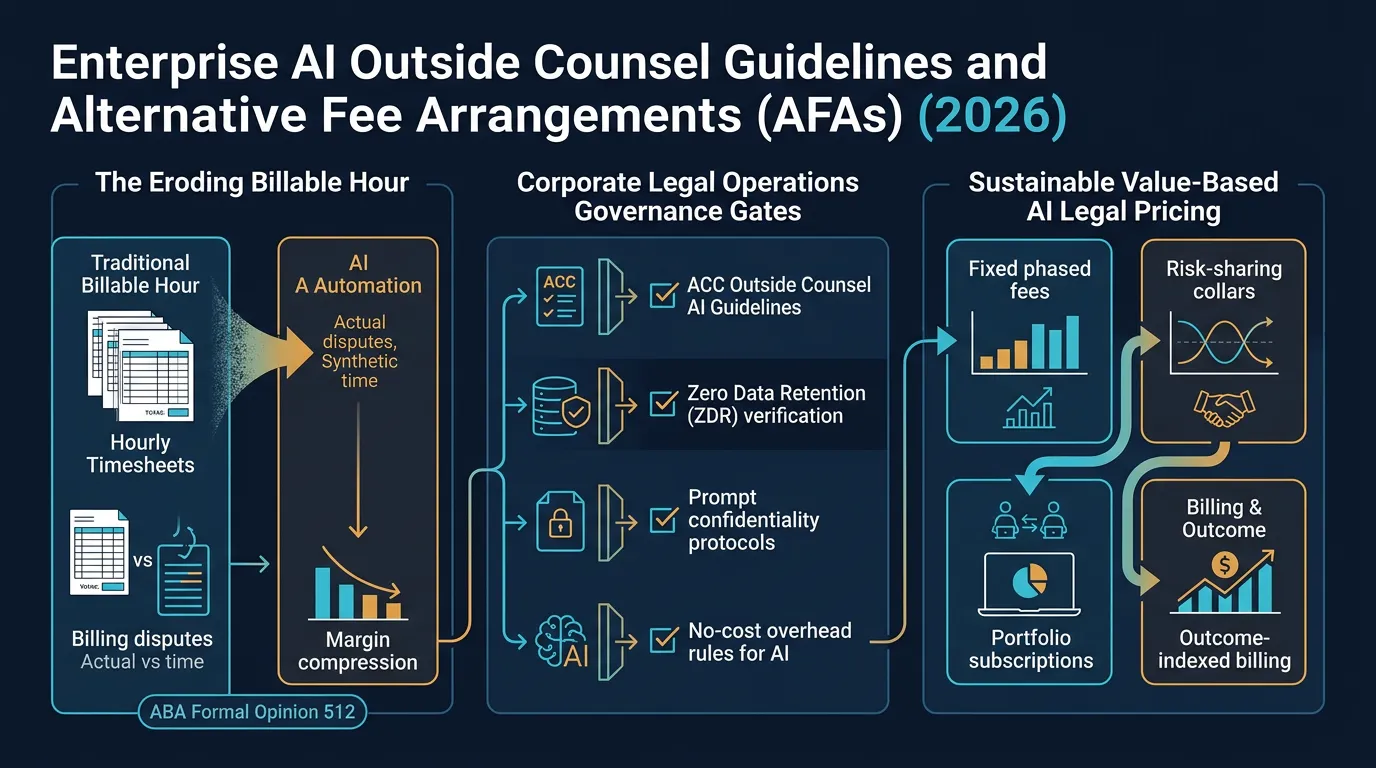
Why Is the Billable Hour Collapsing Under Enterprise AI?
The billable hour relies on a linear relationship between legal effort and professional output: a research memorandum that historically consumed ten associate hours generated ten billable hours of revenue. Enterprise AI collapses that duration to thirty minutes of agentic synthesis followed by forty-five minutes of senior attorney verification.
When applied to high-volume discovery, due diligence, and regulatory compliance, this significant order-of-magnitude compression in drafting time directly undermines law firm revenue under straight hourly billing models.
Furthermore, ethical constraints prevent firms from billing "synthetic time." Under American Bar Association (ABA) Formal Opinion 512, attorneys operating in 2026 are strictly bound by Model Rule 1.5 (Fees):
- Actual Time Only: Counsel may bill only for the hours actually spent supervising, prompting, and reviewing AI systems, never the hypothetical hours the task would have taken manually.
- AI Tooling as Overhead: Enterprise AI licenses and drafting assistants are categorized as general practice overhead. Unless a specialized third-party tool is incurred as a direct, out-of-pocket per-matter expense and disclosed in advance, law firms cannot pass subscription software costs through to clients with markups.
- No Billing for Onboarding: Time spent training attorneys to operate AI systems or testing foundational models constitutes general business education and cannot be billed to corporate clients.
With 62% of corporate legal departments reporting that generative AI efficiencies must drive structural fee reductions, general counsel are revising their Outside Counsel Guidelines (OCGs) to eliminate hourly billing for standard deliverable archetypes.
What Do 2026 Corporate Outside Counsel AI Guidelines Require?
Corporate legal operations leaders, aligned with standards from the Association of Corporate Counsel (ACC), now mandate specific generative AI riders before executing engagement agreements. Corporate procurement teams routinely reject master service agreements that fail to satisfy four core operational requirements:
1. Mandatory Pre-Use Disclosure and Approved Tool Registries
Law firms must disclose every generative AI system deployed on corporate matters. Firms must maintain an authenticated registry of client-approved tools, prohibiting the use of unvetted consumer platforms or open-web AI interfaces.
2. Contractual Zero Data Retention (ZDR) and Non-Training Guarantees
Outside counsel must warrant that all client data, deposition transcripts, litigation work product, and confidential emails processed through AI APIs remain strictly exempt from vendor training loops. Model providers must operate under enterprise zero-retention service agreements to prevent waiver of attorney-client privilege.
3. Verification Accountability and Non-Delegation
Outside counsel remains fully accountable under Federal Rule of Civil Procedure 11 and state ethical rules for every citation, factual assertion, and statutory interpretation generated by AI. General counsel guidelines explicitly state that AI-generated hallucinations are treated as direct attorney misconduct, resulting in immediate fee disgorgement.
4. Billing Line-Item Transparency
Time entries must itemize AI-assisted tasks, identifying the tool utilized, the primary operator, and the exact supervisory duration. Vague block-billing entries containing phrases like "drafted summary with AI" are routinely rejected by corporate automated billing engines.
Which Alternative Fee Arrangements (AFAs) Are Replacing Hourly Rates?
To maintain sustainable operating margins while delivering AI efficiency gains, leading law firms and corporate legal departments are negotiating four primary alternative fee structures in 2026:
| Fee Structure Archetype | Operational Mechanics | Client Advantage | Firm Advantage |
|---|---|---|---|
| Phased Fixed Pricing | Fixed milestone pricing per litigation or transaction phase (e.g., initial pleadings, eDiscovery, summary judgment). | Predictable budget caps; complete immunity from associate learning curves. | Firms capture margin gains from proprietary agentic workflows that finish phases early. |
| Portfolio Subscriptions | Predictable monthly or quarterly retainers covering all recurring commercial contracts or employment advice. | Standardized cash outflows and automated SLA tracking. | Recurring baseline revenue; incentivizes continuous deployment of automated intake agents. |
| Capped Collared Fees | Baseline fee estimate coupled with a symmetric risk-sharing corridor ($\pm 15%$). | Protection against runaway hourly overages. | Mitigates financial exposure if unanticipated regulatory complexity requires deep manual intervention. |
| Outcome-Indexed Holdbacks | Discounted base fee ($75%$) paired with a success premium ($25%$ to $50%$) tied to objective KPIs. | Directly aligns counsel compensation with business outcomes rather than activity duration. | High upside rewards for elite strategic positioning and swift, favorable settlements. |
Corporate legal operations data indicates that across digital procurement platforms like PERSUIT, over 80% of awarded enterprise matters in 2026 now leverage fixed, phased, or value-indexed fee structures rather than unconstrained hourly billing.
How Should Law Firms and Corporate Legal Teams Adapt?
Transitioning to AI-native fee structures requires legal organizations to realign their internal staffing, technology investments, and client communication practices:
- Benchmark Workflow Velocity: Firms must measure empirical cycle times for AI-assisted contract review, brief drafting, and deposition indexing. Real historical baseline data is required to price fixed-fee proposals competitively without destroying realization rates.
- Modernize Engagement Letters: Update standard retainer agreements to clearly distinguish billable attorney review from non-billable AI infrastructure, referencing enterprise AI pricing models and outcome economics.
- Enforce Strict Privilege Boundaries: Implement firm-wide AI gateway controls to ensure confidential client records stay protected under verified data protection boundaries and inference security.
- Coordinate Across Executive Leadership: Formalize outside counsel AI governance under an established enterprise AI governance charter to unify legal, compliance, and procurement priorities.
Can law firms bill clients for the cost of enterprise AI software subscriptions?
Under ABA Formal Opinion 512, general enterprise AI software licenses and drafting assistants are classified as law firm overhead and cannot be billed to clients unless the engagement agreement explicitly authorizes pass-through costs. Only direct, out-of-pocket expenses incurred specifically for a client's individual matter (such as dedicated, per-gigabyte document review hosting) may be passed through at actual cost with zero surcharge.
How do corporate outside counsel guidelines enforce Zero Data Retention?
Corporate guidelines require outside counsel to execute enterprise business agreements with model providers that legally prohibit using client prompts, attachments, or completions for model retraining, while guaranteeing that prompt data is purged from provider servers immediately after inference execution.
What is the most common alternative fee arrangement for AI-assisted litigation?
Phased fixed pricing is the dominant structure in 2026. Litigation is broken down into discrete procedural stages—such as Rule 26(f) conferences, motion to dismiss practice, and ESI protocol execution—with each stage carrying a fixed fee regardless of how many hours AI automation saves the legal team.