In federal litigation, proposed Federal Rule of Evidence 707 establishes a comprehensive reliability gateway for machine-generated artificial intelligence evidence offered without an accompanying human expert witness. Under the Advisory Committee on Evidence Rules’ working framework, when AI output would be subject to Rule 702 if rendered by a human witness, the proponent must establish under Rule 104(a) by a preponderance of the evidence that the machine output is helpful, grounded in sufficient facts or training data, produced by reliable principles, and reliably applied to the case facts.
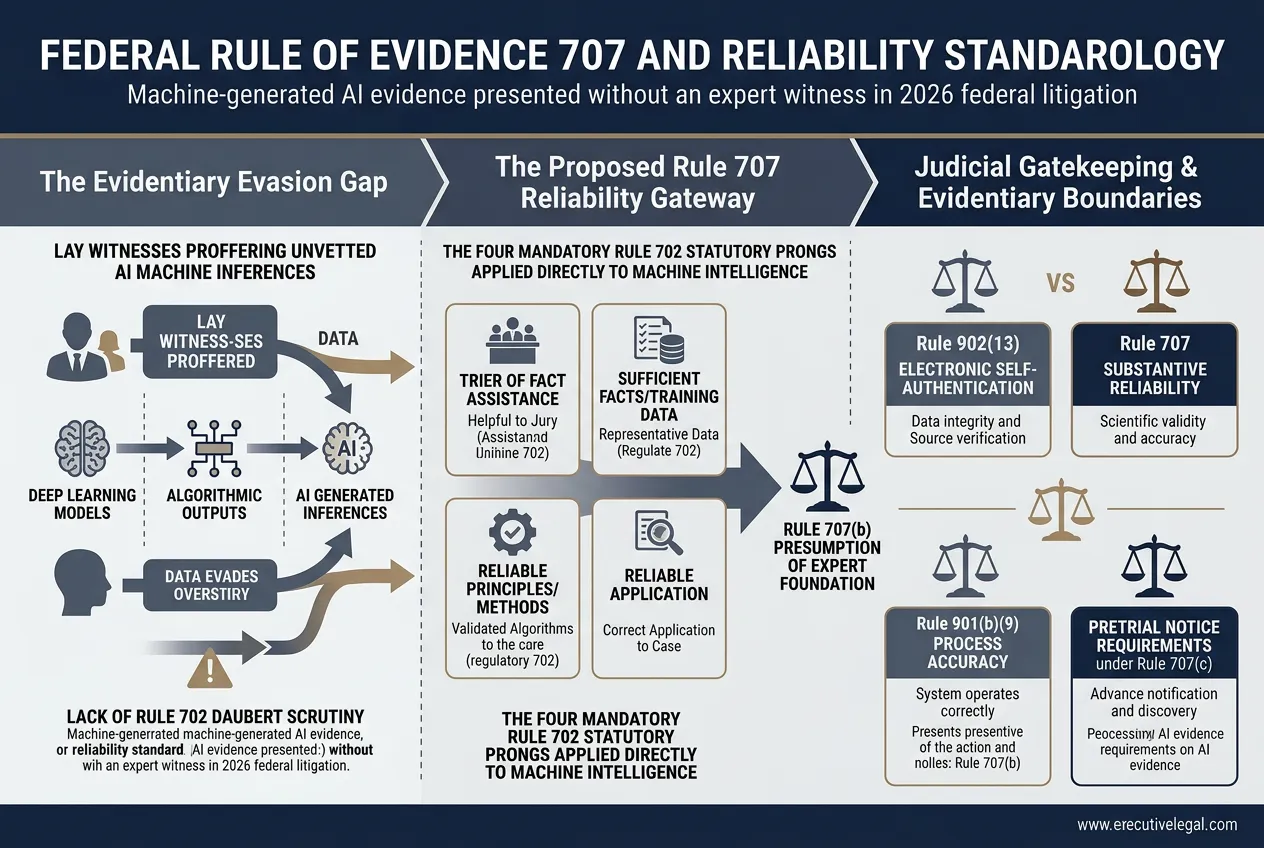
Why Does Federal Litigation Face an Evidentiary Evasion Gap for AI Evidence?
Federal practice has historically relied upon a bifurcated proof structure: factual perception admitted through lay witnesses under Rule 701, and specialized technical inferences screened for scientific validity through qualified human experts under Rule 702. The rapid diffusion of autonomous AI agents, multi-modal foundation models, and algorithmic analytics into business operations has shattered this framework by creating an evidentiary evasion gap.
When a human expert witness utilizes artificial intelligence in formulating an opinion, their testimony is subject to rigorous judicial gatekeeping under Federal Rule of Evidence 702 and the Supreme Court’s Daubert-Kumho Tire doctrine. Trial judges must evaluate whether the expert’s reliance on the model is grounded in sufficient facts or data, whether the algorithm reflects reliable scientific principles, and whether the expert reliably applied the methodology to the facts of the case. Furthermore, Rule 703 ensures that the underlying software tools are those that experts in the particular field would reasonably rely upon.
However, when an autonomous system or complex machine learning tool produces an analytical finding, diagnostic classification, or predictive model that is introduced without an expert, existing evidentiary rules offer no clear mechanism to screen for reliability:
- Rule 701 Lay Opinion Limits: Rule 701(c) explicitly restricts lay witnesses from offering opinions based on scientific, technical, or specialized knowledge. Yet lay technicians who merely query a deep learning system or print an automated algorithmic output are not testifying as experts.
- Rule 801 Declarant Doctrine: As courts held in United States v. Washington (4th Cir. 2007) and United States v. Lizarraga-Tirado (9th Cir. 2015), autonomous machine calculations and raw computer-generated logs do not constitute hearsay under Rule 801(b) because a machine is not a natural person declarant.
- Rule 901 and 902 Authenticity Traps: Self-authentication under Rule 902(13) and Rule 902(14) merely certifies that an electronic record matches its hash or was generated by a certified computer process; it does not test whether the substantive conclusions of the model are reliable. Similarly, Rule 901(b)(9) requires only prima facie evidence of a process producing an accurate result, setting an evidentiary threshold far lower than Rule 702 gatekeeping.
Without a targeted rule, litigants could bypass Rule 702 entirely by laundering complex algorithmic conclusions through lay witnesses or introducing autonomous machine outputs directly as unvetted business records.
What Are the Core Provisions and Mandates of Proposed Federal Rule of Evidence 707?
To close this procedural loophole, the Judicial Conference Advisory Committee on Evidence Rules formulated proposed Federal Rule of Evidence 707, titled Evidence Produced By Artificial Intelligence and Presented at Trial Without an Expert. As detailed in the Committee's October 2026 proceedings, Rule 707 directly imports the substantive reliability prongs of Rule 702 and imposes them upon machine-generated evidence.
+----------------------------------------------------------------------------------------------------+
|                               PROPOSED FEDERAL RULE OF EVIDENCE 707                                |
+----------------------------------------------------------------------------------------------------+
|  Rule 707(a)  | Substantive Gatekeeping Prongs:                                                   |
|               | (1) Will help the trier of fact understand the evidence or determine a fact        |
|               | (2) Is based on sufficient facts or data (including training data quality)         |
|               | (3) Is the product of reliable principles and methods                             |
|               | (4) Reflects a reliable application of the principles and methods to the case      |
+---------------+------------------------------------------------------------------------------------+
|  Rule 707(b)  | Establishing Admissibility: Presumption of Expert Foundation                      |
|               | Ordinarily requires a human expert to explain how the AI system reliably produced  |
|               | the output; exceptional circumstances allow objective validation tests or studies. |
+---------------+------------------------------------------------------------------------------------+
|  Rule 707(c)  | Pretrial Notice Requirement:                                                       |
|               | Proponent must provide reasonable written notice to all parties to ensure a fair   |
|               | opportunity to challenge algorithmic reliability prior to trial.                  |
+---------------+------------------------------------------------------------------------------------+
|  Rule 707(e)  | Statutory Definition:                                                              |
|               | Machine-based system that can, for a given set of human-defined objectives,        |
|               | provide analysis or make predictions, recommendations, or decisions.               |
+----------------------------------------------------------------------------------------------------+
Under proposed Rule 707(a), if evidence is a product of artificial intelligence and is offered without an expert witness—but would be subject to Rule 702 if testified to by a human witness—the proponent must satisfy all four reliability criteria.
Crucially, Rule 707(b) establishes a procedural presumption: "Ordinarily, the proponent must provide an expert to explain how the system of artificial intelligence reliably produced the evidence." Only in exceptional circumstances may the court consider alternative proof—such as peer-reviewed independent validation studies, error rate benchmarks, or established industry testing—to satisfy the reliability threshold without live expert testimony.
How Does Rule 707 Distinguish Machine Reliability from Electronic Authentication?
A frequent point of confusion among federal trial counsel is the distinction between authenticating digital records under Rule 901/902 and establishing substantive reliability under Rule 702/707. The Advisory Committee Note to proposed Rule 707 explicitly resolves this interplay:
- Authentication Is Distinct from Substantive Truth: Certifying an electronic record under Rule 902(13) or Rule 902(14) establishes only that the record was retrieved from a certified system without data corruption. As the Advisory Committee noted, Rule 902 certifications do not preclude an objection that the information produced is unreliable.
- Rule 901(b)(9) Is Subsumed by Rule 707: Rule 901(b)(9) requires evidence describing a process or system and showing that it produces an accurate result. Because authenticity requires only a prima facie showing under Rule 104(b), satisfying Rule 901(b)(9) does not satisfy the higher preponderance of the evidence gatekeeping standard required under Rule 104(a). Conversely, qualifying machine output under Rule 707 automatically satisfies Rule 901(b)(9).
- Pretrial Notice Under Rule 707(c): Because evaluating algorithmic architectures, training data distributions, and error rates requires extensive technical discovery, Rule 707(c) mandates reasonable advance notice. This requirement prevents trial-by-ambush and permits opposing counsel to file timely motions in limine under Rule 104(a).
What Factors Must Trial Courts Evaluate Under a Rule 707 Daubert Hearing for AI?
In evaluating whether machine-generated evidence satisfies Rule 707(a)(2)–(4), the Advisory Committee outlines five foundational inquiries that mirror traditional Daubert gatekeeping:
- Training Data Sufficiency and Representation: Courts must examine whether the training data utilized by the underlying machine learning model is sufficiently representative and free from sampling bias to render an accurate prediction for the specific population and factual circumstances at issue.
- Domain-Specific Validation in Similar Circumstances: Proponents cannot rely on general benchmark performance; the system must be validated in circumstances substantially similar to the litigated matter. In Linkugel v. City of Los Angeles (Cal. App. 2026), generative AI photo modifications were excluded because the proponent failed to demonstrate that the generative algorithm reliably enhanced images rather than fabricating pixels.
- Auditability and Record Retention: Courts will review what operational telemetry the system maintains, whether inference parameters (such as temperature, top-p, and random seeds) are preserved, and whether the output can be deterministically audited or reproduced.
- Independent Evaluation and Research Licensing: Courts should consider whether the algorithmic process has undergone evaluation by independent entities outside the software developer, and whether opposing counsel has meaningful access to inspect system mechanics.
- Interpretability and Black-Box Limitations: When an autonomous agent or deep neural network programs itself or reaches decisions through inexplicable latent weights, the proponent must demonstrate reliability through empirical testing, low error rates, and rigorous validation studies.
What Are the Strategic Implications for Corporate Counsel and Litigators in 2026?
The emergence of proposed Federal Rule of Evidence 707 transforms how corporate enterprises and trial attorneys must manage AI-generated work product:
Corporate legal departments must integrate evidentiary preservation into production AI engineering. Retaining immutable inference prompts, execution graphs, OpenTelemetry spans, and golden dataset validation reports is no longer merely an IT best practice—it is the prerequisite for courtroom admissibility under the emerging Federal Rules of Evidence.
For detailed analysis of related federal evidentiary rules governing artificial intelligence, see our analyses on Federal Rule of Evidence 803(6) AI Business Records, Federal Rule of Evidence 902(14) AI Hash Verification, and Federal Rule of Evidence 604 AI Machine Translation Evidence.
What is proposed Federal Rule of Evidence 707?
Proposed Federal Rule of Evidence 707 is an evidentiary rule drafted by the Judicial Conference Advisory Committee on Evidence Rules to govern artificial intelligence evidence offered at trial without an accompanying expert witness, applying the four reliability standards of Rule 702 directly to machine outputs.
Does Rule 707 require a human expert witness for all AI evidence?
Rule 707(b) establishes a legal presumption that the proponent must ordinarily present an expert witness to explain how the AI system reliably produced the evidence, though courts may accept alternative proof such as objective validation studies in exceptional circumstances.
How does Rule 707 interact with self-authentication under Rule 902(13)?
Self-authentication under Rule 902(13) establishes only that an electronic record was accurately retrieved from a computer system; it does not establish that the substantive analytical conclusions drawn by an AI algorithm are scientifically reliable under Rule 707.
Why can't lay witnesses introduce AI-generated evidence under Rule 701?
Rule 701(c) prohibits lay witnesses from testifying to opinions based on scientific, technical, or specialized knowledge. A lay technician who merely inputs data into an AI tool cannot provide the necessary foundation regarding algorithmic reliability.
What notice is required before offering AI evidence under Rule 707?
Rule 707(c) requires the proponent to provide reasonable advance written notice to all parties to ensure opposing counsel has a fair opportunity to inspect system documentation and challenge reliability before trial.
How does proposed Rule 707 define artificial intelligence?
Rule 707(e) defines artificial intelligence as a machine-based system that can, for a given set of human-defined objectives, provide analysis or make predictions, recommendations, or decisions influencing real or virtual environments.
What standard of proof applies to Rule 707 admissibility determinations?
Admissibility under Rule 707 is governed by Federal Rule of Evidence 104(a), requiring the trial judge to find by a preponderance of the evidence that all statutory reliability prongs are satisfied.
How does Rule 707 affect generative AI images and video enhancements?
Modifications or enhancements made by generative AI algorithms cannot be admitted as simple demonstrative exhibits unless the proponent demonstrates through expert foundation or validation that the process reliably reflects reality rather than inserting fabricated data.