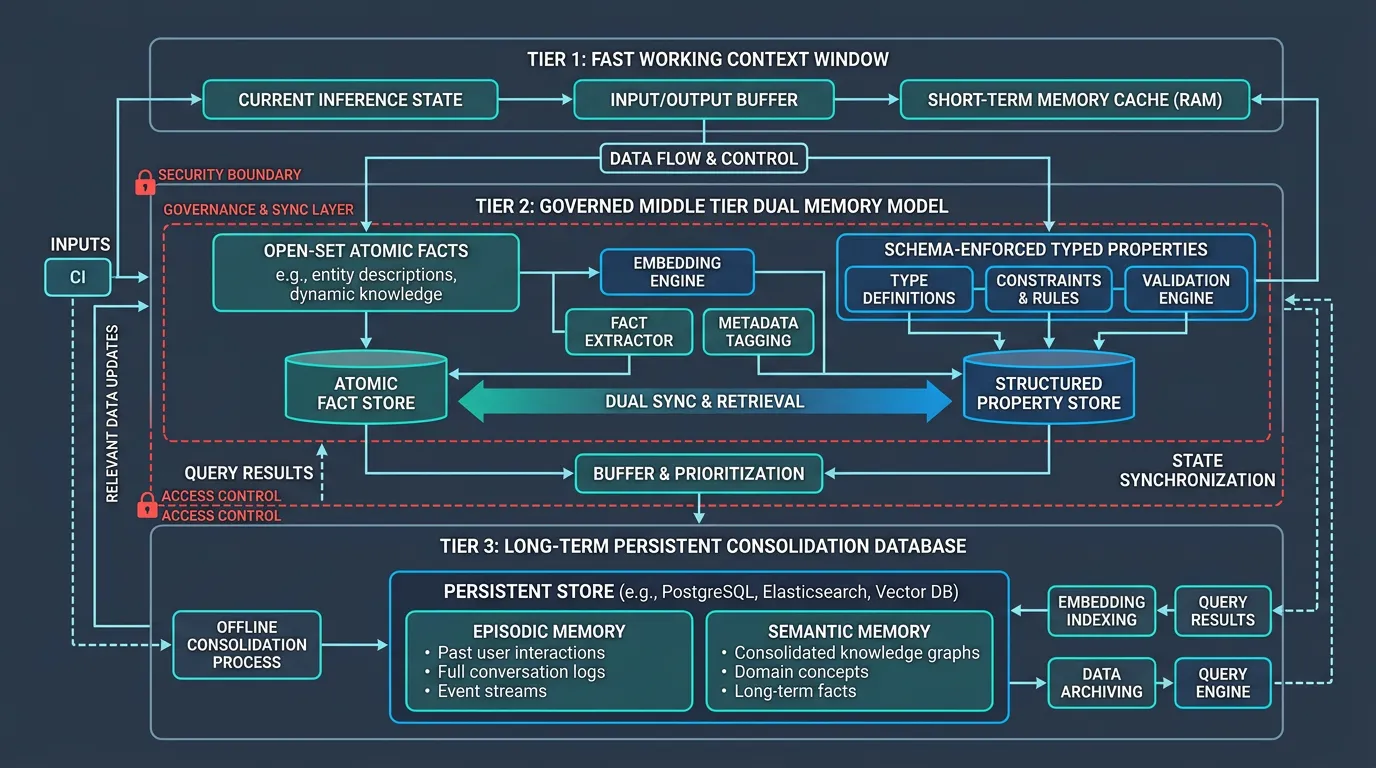
Hierarchical agent memory production architectures solve context degradation and cross-tenant leakage in multi-agent systems by decoupling dynamic working execution from structured long-term state. Instead of appending raw conversational histories into massive context windows, production systems deploy tiered memory topologies combining open-set atomic facts, schema-enforced typed properties, and progressive context delivery. Recent empirical benchmarks demonstrate that governed memory layers achieve 99.6% fact recall while reducing prompt token consumption by 50% and preventing cross-entity data leakage under adversarial evaluation.
Why Do Flat Context Windows Fail in Long-Horizon Agent Execution?
As autonomous AI agents execute tasks spanning hours or days, naive architectures rely on accumulating prompt history or performing unstructured vector similarity search over conversation transcripts. Both approaches fail under production conditions.
Directly packing conversational transcripts into LLM context windows causes severe context degradation—commonly observed as "lost-in-the-middle" attention dispersion, instruction drift, and runaway inference latency. Furthermore, standard Retrieval-Augmented Generation (RAG) vector embeddings fail to preserve entity boundaries, temporal validity, or relational hierarchies. A semantic vector similarity search can easily retrieve an outdated, superseded fact or conflate state variables across disparate organizational entities.
Production engineering requires treating memory not as an unstructured text log, but as a governed database subsystem with deterministic access controls, typed validation, and explicit lifecycle management.
What Is the Architecture of a Dual Governed Memory Model?
Recent production research from Taheri (arXiv:2603.17787) establishes that high-reliability multi-agent platforms require a dual memory representation operating across complementary planes:
- Open-Set Atomic Facts: Free-form declarative statements capturing qualitative observations, nuanced user preferences, and evolving situational context that cannot be predicted in advance.
- Schema-Enforced Typed Properties: Strongly validated, programmatic key-value schemas governing critical operational state—such as matter numbers, user authentication boundaries, policy flags, and workflow status.
+-----------------------------------------------------------------------+
|                       Agent Execution Engine                          |
+-----------------------------------------------------------------------+
                                   |
             +---------------------+---------------------+
             |                                           |
             v                                           v
+-------------------------+                 +-------------------------+
|  Open-Set Atomic Facts  |                 | Schema-Enforced Typed   |
|  - Qualitative nuances  |                 | - Entity IDs & statuses |
|  - Situational context  |                 | - Validated properties  |
+-------------------------+                 +-------------------------+
             |                                           |
             +---------------------+---------------------+
                                   |
                                   v
+-----------------------------------------------------------------------+
|     Tiered Governance Layer & Progressive Context Delivery Controller  |
+-----------------------------------------------------------------------+
By decoupling extensible atomic facts from typed properties, the agent preserves flexible reasoning capabilities without sacrificing schema rigor. Empirical testing across 250 evaluation benchmarks confirmed that combining both planes yields 99.6% fact recall, whereas relying on either representation in isolation introduces significant omission rates.
How Does Progressive Context Delivery Cut Token Consumption by 50%?
In multi-agent systems, passing full memory states across every subagent hop introduces severe computational overhead. Progressive context delivery acts as an intelligent memory caching and paging mechanism.
Rather than injecting the entire historical profile into the prompt prompt upfront, the governance router evaluates the incoming step's functional signature and injects only the minimal subset of relevant entity properties required for that immediate subtask.
When evaluated across multi-stage reasoning tasks, progressive delivery achieved an approximate 50% token reduction while maintaining a 92% governance routing precision. This dynamic hydration prevents context bloating, cuts API costs in half, and eliminates context-distraction errors during downstream execution.
How Do Isolation Boundaries Eliminate Cross-Entity Leakage?
In enterprise deployments handling multi-tenant workloads or privileged legal matters, memory leakage across customer accounts or adverse parties constitutes a critical security vulnerability.
Traditional RAG setups frequently succumb to indirect prompt injections or cross-tenant contamination when embedding spaces overlap. Governed hierarchical memory resolves this through reflection-bounded retrieval and deterministic entity scoping:
- Strict Entity Sandboxing: Memory partitions are enforced at the storage engine level using verified cryptographic tenant identifiers rather than semantic prompt instructions.
- Reflection-Bounded Retrieval: Every retrieval candidate is pre-filtered through an internal policy gate before token synthesis occurs.
- Adversarial Resilience: Across 500 adversarial extraction queries designed to trigger cross-entity leakage, the governed architecture maintained zero cross-entity leakage and achieved 100% adversarial governance compliance.
For legal and enterprise platforms handling confidential client records, this guarantees that memory retrieval adheres to ethical walls and privilege isolation by design.
What Benchmark Results Validate Governed Agent Memory?
The following table summarizes empirical performance across standard multi-agent benchmarks reported by Taheri (arXiv:2603.17787):
| Architectural Metric | Measured Performance | Operational Significance |
|---|---|---|
| Fact Recall Rate | 99.6% | Eliminates missed instructions across extended reasoning chains |
| Prompt Token Reduction | ~50% | Halves prompt input costs and accelerates time-to-first-token |
| Governance Routing Precision | 92.0% | Correctly maps required access policies without manual intervention |
| Cross-Entity Leakage | 0.0% (0 / 500 queries) | Guarantees strict multi-tenant and privilege isolation boundaries |
| LoCoMo Benchmark Accuracy | 74.8% | Matches ungoverned retrieval baselines with zero governance penalty |
| Memory Quality Saturation | ~7 items / entity | Identifies optimal memory density before diminishing returns occur |
Frequently Asked Questions
How does hierarchical agent memory differ from traditional RAG?
Traditional RAG performs vector similarity search over static document chunks without tracking temporal state or write permissions. Hierarchical agent memory operates as a stateful, read-write memory database that tracks evolving atomic facts, enforces typed schemas, manages memory obsolescence, and maintains strict tenant isolation.
Does enforcing memory governance slow down agent execution?
No. By filtering and delivering only the minimal necessary context (progressive context delivery), governed architectures cut prompt token payloads by roughly 50%, resulting in faster inference latency and lower end-to-end token consumption.
When does memory density reach saturation?
Empirical evaluations demonstrate that output quality plateaus at approximately seven highly relevant governed memory items per entity. Injecting additional peripheral context provides negligible quality improvement while consuming context window capacity.
Related Engineering Analysis
- Explore our analysis on multi-agent execution in Dynamic Subagent Orchestration: Architecture and Topologies for Production AI in 2026.
- Review security controls in Agentic Memory Security and Privilege Isolation: Stopping Context Poisoning in Production AI.
- Learn about state resilience in Durable AI Agent Execution: Sagas and Checkpoint Recovery in 2026.
- Learn more about the Prest0 Platform Architecture.