Law firm AI alternative fee arrangements in 2026 have transformed legal business models from billing hourly increments to pricing deliverables, risk allocation, and verified business outcomes. As enterprise clients refuse to subsidize manual research and drafting that autonomous legal agents resolve in seconds, law firms that decouple revenue from time spent are capturing higher profit margins while expanding market share.
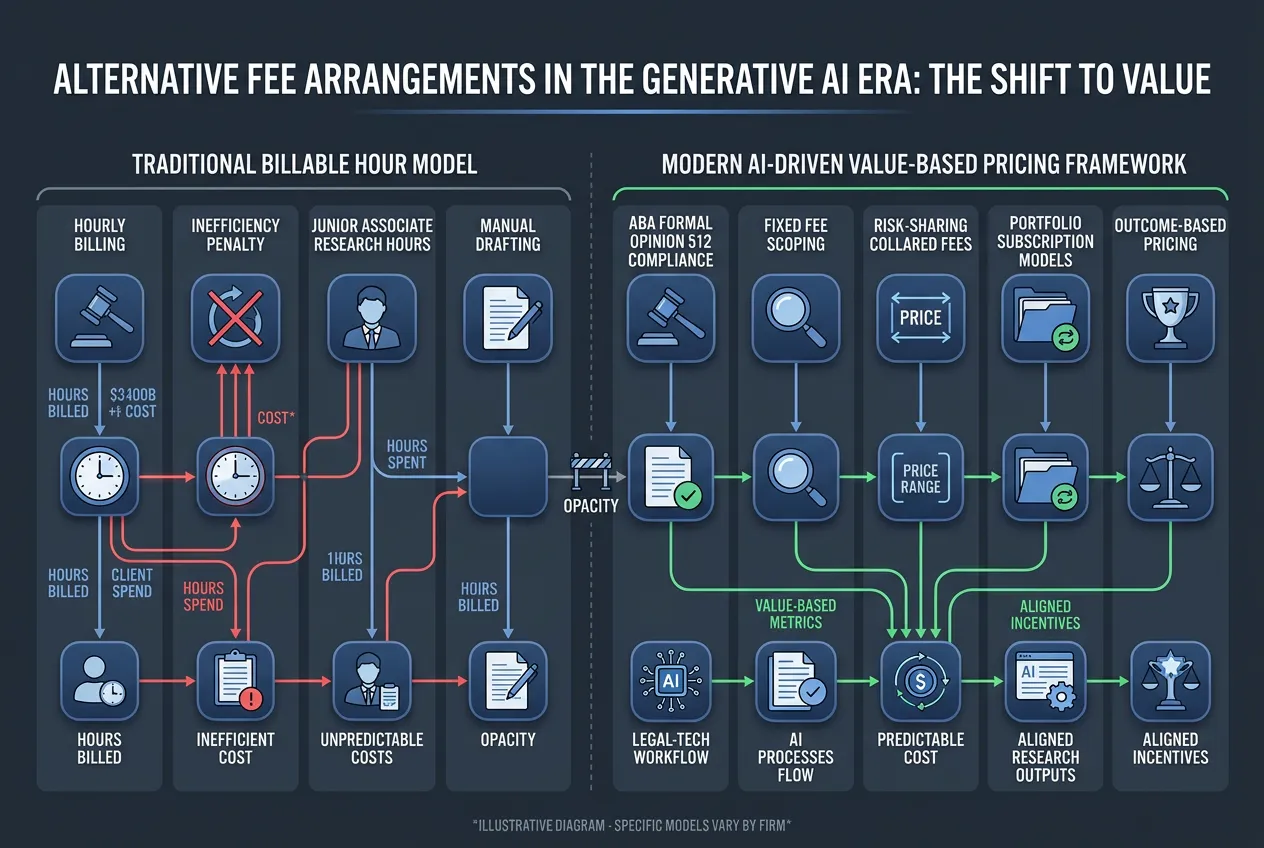
Why Does Generative AI Break the Traditional Billable Hour?
For over a century, the billable hour served as the dominant economic engine of private practice law firms. By tying law firm gross revenue directly to the volume of recorded attorney time, the billable hour created an institutional business model that rewarded operational friction: the longer a brief took to research, draft, cite-check, and review, the more revenue a law firm billed.
Generative artificial intelligence and autonomous agentic workflows invert this economic dynamic. When an AI legal agent drafts a 30-page memorandum, indexes 50,000 discovery documents, or extracts indemnity clauses across commercial agreements in minutes rather than 40 associate hours, an hourly-billed firm faces an immediate financial penalty. Billing 0.2 hours for work that previously generated $15,000 in associate billable time destroys top-line realization if the law firm relies strictly on hourly rates.
Furthermore, corporate legal departments refuse to tolerate legacy billing habits for automated tasks. In 2026, general counsel equipped with enterprise billing audits actively reject invoices that bill associate rates for standard document review, contract redlining, or preliminary case law research. Law firms that maintain hourly billing for AI-automated work find their realization rates cut, their fees challenged, and their enterprise client relationships strained.
What Are the Ethical Billing Boundaries Under ABA Formal Opinion 512?
Transitioning to AI-driven legal pricing requires strict adherence to professional responsibility standards. The American Bar Association's Standing Committee on Ethics and Professional Responsibility established comprehensive guidance in ABA Formal Opinion 512, interpreting Model Rule 1.5 in the context of generative artificial intelligence:
- Prohibition on Billing "Saved Time": Under Model Rule 1.5, a lawyer billing on an hourly basis may bill only for actual time spent supervising, operating, and reviewing AI tools. A lawyer who completes a task in 30 minutes with AI cannot bill the client for the five hours the task would have taken manually. Billing fictional "phantom hours" constitutes an ethical violation.
- AI Tools as Firm Overhead: ABA Formal Opinion 512 clarifies that general-purpose AI subscriptions (such as firm-wide legal research copilots, word-processing AI assistants, and enterprise model licenses) constitute standard law firm overhead. Like electricity or legal library books, these software costs cannot be billed as client disbursements unless the client explicitly consents in advance to direct software pass-through costs.
- Out-of-Pocket Expense Restrictions: If a law firm utilizes specialized, matter-specific AI infrastructure (such as dedicated eDiscovery ingestion clusters or high-compute model fine-tuning for complex multidistrict litigation), it may charge the client only the direct, actual out-of-pocket cost incurred, without markup or surcharge, passing through any volume discounts received.
- Mandatory Scrutiny of Flat and Contingent Fees: If generative AI reduces the labor required to complete a matter from 100 hours to three hours, maintaining an identical historical fixed fee or contingency percentage may render the fee unreasonable under Model Rule 1.5(a) if the risk, complexity, and attorney skill involved do not justify the price.
Because ABA Formal Opinion 512 strictly limits hourly billing to real minutes worked while barring markups on software expenses, law firms cannot restore profitability through software fee pass-throughs or inflated hourly rates. The only sustainable path is restructuring fee agreements around value, risk, and output.
How Are Leading Law Firms Structuring Alternative Fee Arrangements (AFAs)?
Enterprise law firms in 2026 deploy five core alternative fee structures that align law firm profitability with client business objectives:
| Pricing Model | Operational Mechanics | Client Risk Allocation | Law Firm Margin Driver |
|---|---|---|---|
| Fixed Deliverable Pricing | Flat fees for standardized legal deliverables (e.g., M&A due diligence, credit agreements, summary judgment briefs). | High certainty; client pays fixed sum regardless of internal firm hours. | High efficiency; automated AI drafting and review yields 70%+ gross margins. |
| Capped & Collared Fees | Target fee agreed with upper and lower bands (e.g., ±15%). Efficiencies and cost overruns are shared between firm and client. | Symmetrical risk-sharing; prevents runaway budgets while rewarding speed. | Shared savings bonuses when AI streamlines procedural workflows. |
| Portfolio Subscription Models | Enterprise clients pay fixed monthly retainers covering all routine compliance, commercial contracts, and intake. | Predictable operational expenditure; comprehensive operational coverage. | High recurring ARR; autonomous agents handle 80% of routine workflows at zero marginal labor cost. |
| Success-Fee Hybrids | Lower base fee combined with contingency upside or milestone bonuses upon achieving defined commercial outcomes. | Aligns legal spend with business success; lower upfront cash commitment. | Substantial fee multipliers when strategic advice delivers high-value outcomes. |
| Value-Based Transactional Pricing | Pricing calculated as a percentage of deal size or economic risk mitigated, independent of hours worked. | Value-centric; fee corresponds directly to organizational importance. | Completely uncoupled from labor hours, capturing true economic value. |
1. Fixed Deliverable Pricing
Fixed deliverable pricing establishes an agreed, all-inclusive price for a defined legal product—such as an employment handbook, an intellectual property patent clearance review, a standard commercial loan facility, or an antitrust Hart-Scott-Rodino filing.
Because autonomous AI workflows standardize document extraction, precedent retrieval, and draft generation, law firms can forecast completion costs with actuarial precision. Work that previously required 25 associate hours ($12,500 at $500/hour) can be delivered via AI in two hours of senior attorney review. Pricing the deliverable at a flat $7,500 saves the corporate client 40% while generating $3,750 per partner hour worked—doubling the firm's effective realization.
2. Collared and Target Fee Arrangements
For complex litigation and contested regulatory proceedings where scope cannot be rigidly defined, leading firms utilize collared fee structures. The firm and corporate legal department agree on a target budget (e.g., $250,000 for dispositive motion practice). If the matter completes within a 10% collar ($225,000 to $275,000), the firm is paid the exact amount.
If AI-driven litigation analytics and automated document review allow the firm to resolve the phase for $180,000, the $45,000 savings below the collar is split evenly between the client and the firm as a 50/50 efficiency bonus. Conversely, if procedural complications arise, cost overruns above the ceiling are discounted or absorbed by the firm, aligning firm incentives directly with efficient matter resolution.
3. Portfolio Subscriptions for Commercial Contracting
Corporate legal departments increasingly retain law firms on annual or quarterly portfolio subscriptions. For a predictable monthly fee (e.g., $40,000/month), the law firm assumes full responsibility for all corporate contract negotiation, vendor agreement reviews, and regulatory licensing.
Behind the scenes, the law firm deploys supervised agentic pipelines that ingest counterparty redlines, run automated compliance checks against client fallback playbooks, and draft standard revisions. Routine contracts that previously took five business days are returned within four hours, allowing in-house counsel to achieve unprecedented velocity while the law firm generates recurring, predictable software-scale profit margins.
What Operational Infrastructure Is Required to Scale Alternative Fees?
Transitioning from timekeeping to value pricing requires robust operational capabilities. A law firm cannot price fixed deliverables profitably without deep visibility into task effort, variance, and delivery risk.
+-----------------------------------------------------------------------------------+
|               ENTERPRISE AI ALTERNATIVE FEE OPERATIONAL ARCHITECTURE              |
+-----------------------------------------------------------------------------------+
|                                                                                   |
|  [Matter Ingestion & Scoping]                                                     |
|         │                                                                         |
|         ▼                                                                         |
|  [Historical Matter Telemetry] ──► Analyzes historical phase duration, complexity |
|         │                          metrics, and variance benchmarks.              |
|         ▼                                                                         |
|  [Algorithmic Fee Scoping Engine]                                                 |
|         │                          Calculates fixed baseline, risk collars, and   |
|         │                          predictive contingency margins.                |
|         ▼                                                                         |
|  [Supervised Autonomous Agent Execution]                                          |
|         │                          Tier 1: Ingestion, OCR, and Document Indexing  |
|         │                          Tier 2: Vector Synthesis & Precedent Analysis  |
|         │                          Tier 3: Context-Free Grammar Drafting Engine   |
|         ▼                                                                         |
|  [Partner Verification & Redline Gateway] ──► Mandated Human-in-the-Loop Review   |
|         │                                                                         |
|         ▼                                                                         |
|  [Outcome Delivery & Realization Audit]                                           |
|                                                                                   |
+-----------------------------------------------------------------------------------+
Successful firms deploy three foundational operational disciplines:
- Historical Matter Data Mining: Firms mine historical billing databases and enterprise resource management (ERM) systems to determine the true empirical cost of matter phases. By categorizing matters by industry, jurisdiction, counterparty, and volume of evidence, firms calculate precise standard deviations and price fixed deliverables with defensible safety margins.
- Strict Scope Governance and Change Orders: Fixed-fee engagements require clear scoping documentation. Leading firms define exactly what is included (e.g., two rounds of counterparty redlines and one motion to dismiss) and establish clear trigger thresholds for contractual change orders if discovery volumes exceed agreed limits.
- Tiered Multi-Agent Automation Architecture: To sustain high margins under fixed fees, firms build tiered agentic architectures. First-tier ingestion and semantic indexing run autonomously; second-tier retrieval and draft generation execute with deterministic Context-Free Grammar (CFG) constraints; and final review is concentrated on specialized senior partner judgment rather than junior associate pyramid layers.
What Is the Future of the Law Firm Business Model?
The rise of generative artificial intelligence dismantles the traditional Cravath law firm pyramid, which depended on high ratios of junior associates billing hourly rates for manual research to fund senior partner profits.
In 2026, the law firm pyramid is rapidly evolving into a diamond model. Routine research, initial drafting, and discovery parsing are executed by supervised AI agents, drastically reducing the demand for entry-level billable hours. The bulk of law firm value creation centers on senior legal strategists, negotiation experts, and specialized practitioners who supervise AI pipelines and deliver high-stakes counsel.
Firms that embrace alternative fee arrangements leverage AI as a profit multiplier. By selling solutions rather than time, forward-looking law firms deliver faster turnaround times, greater budgetary certainty, and superior legal outcomes—securing enduring competitive dominance in an AI-native legal market.
Can law firms bill clients for the cost of generative AI software licenses?
Under ABA Formal Opinion 512, general-purpose generative AI tools and firm-wide software subscriptions are considered standard law firm overhead, similar to office software or legal research databases, and cannot be billed directly to clients as disbursements. Specialized, matter-specific AI expenses (such as high-volume third-party document processing) may be charged only if disclosed and agreed in advance, and then only at the actual out-of-pocket cost without firm markup.
Why does AI make alternative fee arrangements more profitable for law firms?
The billable hour penalizes efficiency: when an AI tool completes a 10-hour research project in 30 minutes, an hourly firm loses 9.5 hours of billable revenue. Under an alternative fee arrangement (such as a fixed fee of $5,000 for the completed brief), the firm captures the full economic value of its technology, earning significantly higher effective hourly rates and profit margins while delivering faster results for the client.
How do clients benefit from AI-driven alternative fee arrangements?
Clients obtain absolute budget predictability, transparent pricing, and substantially faster turnaround times. Instead of bearing the financial risk of associate learning curves and open-ended billable hours, clients pay for verified deliverables and business outcomes, eliminating invoice disputes and unexpected legal bills.
Related reading on prest0.ai/insights: