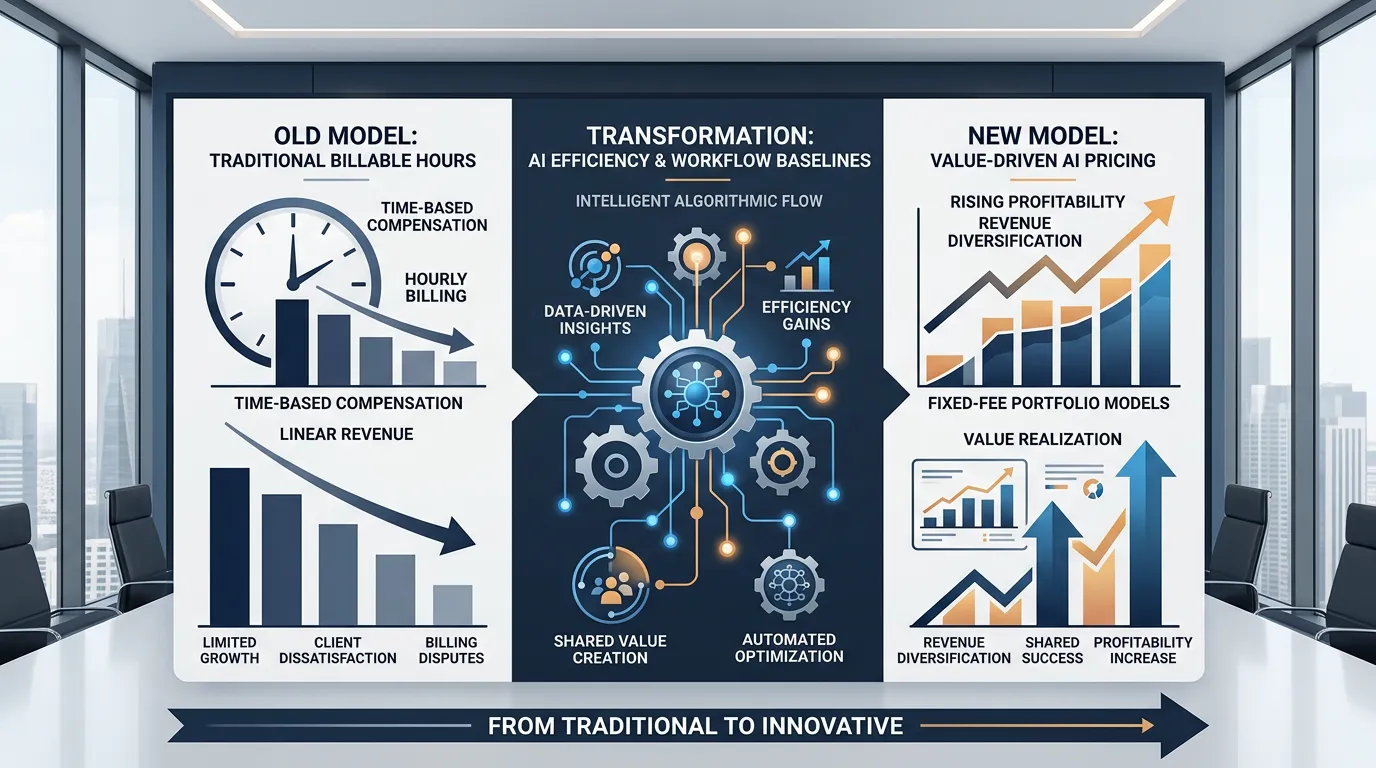
Enterprise AI implementation in 2026 has shifted from experimental experimentation to rigorous economic accountability, forcing enterprises and law firms to replace generic adoption metrics with verifiable value realization and data-backed alternative fee arrangements. Across Fortune 500 legal departments and Am Law firms, deploying agentic workflows without restructuring billing models produces an immediate efficiency paradox: organizations compress labor hours while remaining trapped in legacy cost-plus or hourly pricing structures that penalize operational velocity.
Why Is Measurable AI ROI So Difficult for Enterprises to Achieve?
According to an October 19, 2026 Gartner survey of Chief Information Officers, only 13% of CIOs report that their enterprise has realized significant or transformational value from AI initiatives, while just 11% qualify as AI vanguards capable of demonstrating high business impact. Parallel research from IDC indicates that a large share of organizations find measuring return on investment difficult or impossible, with only 15% achieving measurable outcomes across more than three-quarters of their deployed AI projects.
The root cause of this value gap is structural rather than technological. Most organizations adopted generative tools as personal productivity assistants rather than system-level workflow automation:
- Unmeasured Knowledge Work: Teams deploy autonomous drafting and analysis tools without establishing pre-implementation baselines for cycle time, revision volume, or error rates.
- The "Efficiency Penalty" in Professional Services: When billing clients by the hour, completing a complex 12-hour diligence or contract abstraction task in 45 minutes reduces top-line revenue under traditional billing arrangements unless pricing shifts to value.
- Fragmented Tool Sprawl: Individual departments procure point solutions lacking unified auditability, shared enterprise memory, or enterprise privilege boundaries, creating operational drag and compliance exposure.
How Are Law Firms Restructuring Pricing Around Alternative Fee Arrangements?
Leading legal practices are leveraging AI efficiency to accelerate the transition from the billable hour to Alternative Fee Arrangements (AFAs), including fixed-fee portfolios, capped risk-sharing arrangements, and value-based subscription retainers.
When firms possess deterministic baseline metrics on matter completion, agentic orchestration transforms fixed-fee pricing from a margin risk into a margin expansion engine. Instead of billing fewer hours for the same work, firms price matters based on deliverable value, turnaround speed, and risk allocation:
- Pre-Execution Baseline Modeling: Using historical matter data to accurately predict matter costs, required agent iterations, and attorney review time before quoting clients.
- Shared-Value Risk Corridors: Structuring agreements where client legal spend is capped at a discounted rate, while the firm retains a performance bonus for hitting accelerated milestone deadlines.
- Continuous Matter Monitoring: Deploying autonomous workflow agents that track task velocity, document synthesis, and revision cycles against agreed project milestones in real time.
For an in-depth breakdown of how autonomous agents enforce professional responsibility and judicial candor while handling complex filings, read our analysis on Rule 11 and Ethical Verification Requirements.
What Does a Production Enterprise AI Value Architecture Look Like?
Operationalizing AI at enterprise scale requires moving beyond individual conversational prompts into secure, auditable agentic execution layers. High-performing enterprises implement a three-tier adoption architecture:
| Architectural Layer | Core Function | Enterprise Verification Gate |
|---|---|---|
| Control Plane | Policy orchestration, tool gating, and tenant isolation | Strict authorization rules preventing unauthorized external tool execution |
| Execution Plane | Autonomous task execution, document synthesis, and multi-step workflows | Pre-commit validation against enterprise memory and factual source grounding |
| Audit & Metrics Plane | Real-time tracking of task duration, compute cost, and realization yield | Direct linkage between agent completion logs and enterprise ERP/billing systems |
To understand how enterprise architectures protect confidential multi-tenant knowledge bases from prompt injection and context poisoning, see our architectural guide on Agentic Memory Security and Privilege Isolation.
How does enterprise AI implementation affect firm profitability under fixed fees?
Under traditional hourly billing, efficiency reduces billable revenue. Under fixed-fee and alternative fee arrangements, AI automation lowers the labor cost per matter, expanding profit margins while delivering faster client turnaround.
What baseline metrics should an enterprise establish before scaling AI agents?
Organizations must measure pre-AI baseline labor hours, average review cycles, error rates, vendor costs, and project cycle times. Without these quantitative baselines, measuring downstream ROI is virtually impossible.
Why do Gartner and IDC report low satisfaction with AI ROI despite high adoption?
High adoption often reflects widespread experimentation and desktop assistant seat licenses. Significant ROI only emerges when organizations redesign core business processes, integrate systems via secure APIs, and align commercial incentives with speed.
This analysis is provided for general informational purposes only and does not constitute formal legal or financial advice.