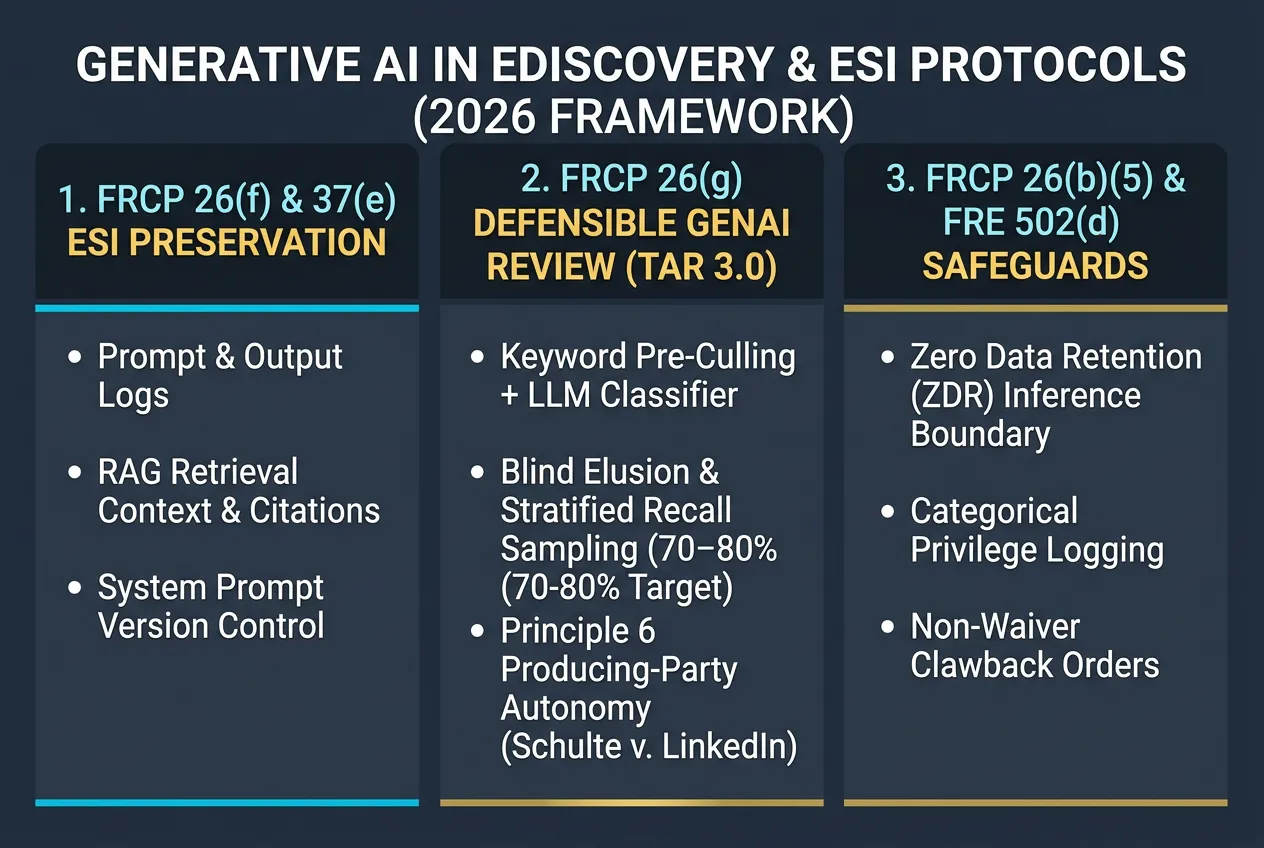
Generative AI in eDiscovery and ESI protocols is governed in 2026 under established Federal Rules of Civil Procedure proportionality, reasonable inquiry, and producing-party autonomy doctrines rather than heightened technological scrutiny. In Schulte v. LinkedIn Corp. (N.D. Cal. July 1, 2026), federal courts confirmed that generative AI responsiveness review operates as an evolution of technology-assisted review (TAR), while In re OpenAI, Inc. Copyright Infringement Litigation (S.D.N.Y. 2025) demonstrated how Rule 37(e) preservation duties extend to dynamic prompt, output, and retrieval logs.
How Are Federal Courts Regulating Generative AI Document Review Under FRCP 26 and 34 in 2026?
As litigation teams transition from continuous active learning (TAR 2.0) to large language model (LLM) classifiers for first-pass responsiveness and privilege review, requesting parties have increasingly demanded "discovery on discovery"—seeking opposing counsel's internal prompts, model weights, and validation metrics prior to any showing of production error.
On July 1, 2026, U.S. Magistrate Judge Laurel Beeler of the Northern District of California addressed this conflict directly in Schulte v. LinkedIn Corp., No. 22-cv-00237-HSG (LB) (signed June 30, 2026). In Schulte, LinkedIn utilized 25 search strings to pre-cull custodial documents down to a target review population of approximately 204,444 documents before applying Relativity aiR, a generative AI review tool, alongside human quality-check sampling. The plaintiffs moved to compel LinkedIn to run generative AI review across the entire unculled custodial universe or, alternatively, to turn over granular AI performance metrics and prompt engineering records.
The court denied both requests, establishing three operational benchmarks for 2026 ESI practice:
- Ordinary Proportionality and Principle 6 Autonomy Govern GenAI Review: Citing The Sedona Conference Principles, Third Edition (Principle 6), the court reaffirmed that the producing party is best situated to evaluate and select the procedures, methodologies, and technologies appropriate for preserving and producing its own electronically stored information (ESI). Employing generative AI does not trigger a heightened evidentiary threshold beyond ordinary relevance and proportionality under FRCP 26(b)(1).
- Search-Term Pre-Culling Before LLM Classification Is Permissible: A producing party is not required to run generative AI across every unculled custodial file when doing so imposes substantial computational burden and expense, provided the party meets and confers in good faith over the initial search strings (with the court ordering the parties to confer on the 25 search strings within 21 days).
- No "Discovery on Discovery" Without Specific Production Deficiencies: Absent concrete evidence of a production deficiency, requesting parties cannot compel disclosure of internal generative AI review prompts or statistical validation logs where the producing party complied with the governing ESI order, retained human final responsiveness determinations, and performed quality-control sampling.
When Do AI Prompts, Outputs, and RAG Logs Become Discoverable ESI Under FRCP 34 and 37(e)?
While Schulte governs how legal teams use generative AI as a review tool, a separate body of 2025–2026 jurisprudence governs generative AI as a source of discoverable evidence. Under Federal Rule of Civil Procedure 34(a)(1)(A), ESI encompasses information stored in any medium from which information can be obtained directly or translated into a reasonably usable form.
In enterprise and legal deployments, generative AI interactions rarely consist of isolated text strings. Modern agentic workflows generate four distinct layers of ephemeral telemetry:
- User Prompt Inputs and Session History: The raw queries and uploaded context submitted by custodians.
- System Prompts and Model Configuration Versions: The underlying behavioral instructions, temperature settings, and guardrail parameters active at the time of execution.
- Retrieval-Augmented Generation (RAG) Context Chunks: The specific vector database slices or document passages injected into the context window prior to inference.
- Model Outputs and Tool-Execution Traces: The resulting synthesis, intermediate reasoning steps, and downstream API actions.
The preservation tension surrounding ephemeral AI telemetry reached a flashpoint in In re OpenAI, Inc. Copyright Infringement Litigation, No. 1:25-md-03143 (S.D.N.Y.). On May 13, 2025, the court issued an initial sweep preservation order requiring the segregation and preservation of output-log data that would otherwise be deleted under standard retention cycles or user deletion requests. On October 9, 2025, the court terminated that broad forward-looking preservation mandate effective September 26, 2025, while maintaining preservation over previously segregated logs and specified accounts; subsequently, on December 2, 2025, the court ordered production of a sample of approximately 20 million de-identified logs deemed relevant and proportional to the copyright claims.
For enterprise general counsel and litigation teams, the lesson under FRCP 37(e) is precise: companies are not required to indefinitely retain every ephemeral AI interaction across their workforce prior to anticipating litigation. However, once a duty to preserve attaches, allowing automated Zero Data Retention (ZDR) sweeps or rolling log-deletion policies to purge relevant AI prompt-and-output logs from key custodians can trigger Rule 37(e) spoliation analysis if reasonable steps were not taken to suspend deletion for those custodians.
How Does TAR 2.0 Compare to Generative AI Document Review in 2026 ESI Protocols?
To draft defensible Rule 26(f) ESI protocols, litigation teams must account for the architectural differences between traditional predictive coding (TAR 1.0/2.0) and zero-shot or few-shot LLM document review (often termed TAR 3.0).
| Governance Dimension | Traditional TAR 2.0 (Continuous Active Learning) | Generative AI / LLM Document Review (2026 Standard) | FRCP & ESI Protocol Implications |
|---|---|---|---|
| Classification Input | Bag-of-words / n-gram feature vectors trained iteratively on human-coded documents | Prompt-driven rubric applied via semantic attention across full document context | Prompts act as coding guidelines; generally protected as work product unless waived or stipulated in the ESI Order |
| Cold-Start Requirement | Requires initial human coding decisions to train the supervised classifier | Zero-shot or few-shot execution directly from written responsiveness definitions | Accelerates early case assessment (ECA) under FRCP 16 and 26(f) before large-scale human review |
| Multimodal & Nuanced Context | Struggles with code, complex tables, and implicit conversational context | Evaluates structured JSON, source code, and multi-turn chat threads with explicit rationale output | Reduces false positives on complex technical and financial custodial collections |
| Statistical Validation | Precision, Recall, and Elusion sampling against the unreviewed tail | Blind human QC sampling, Elusion testing on AI-rejected set, and end-to-end recall verification | Governed by FRCP 26(g) reasonable inquiry; benchmarks historically reference 70%–80% recall adequacy |
| Privilege & Confidentiality | Runs on isolated local index or dedicated review database | Requires strict Zero Data Retention (ZDR) API boundaries to prevent third-party training | Mandatory to preserve protection under AI Legal Privilege and Work Product rulings |
What Validation Metrics Satisfy FRCP 26(g) Reasonable Inquiry for AI-Assisted Review?
Under Federal Rule of Civil Procedure 26(g)(1), an attorney's signature on a discovery response or objection certifies that, to the best of the signer's knowledge, information, and belief formed after a reasonable inquiry, the disclosure is complete and correct as of the time it is made. Just as courts require human verification of AI-generated legal citations under Federal Court AI Standing Orders and Statewide AI Court Rules, Rule 26(g) prohibits blind reliance on an LLM's responsiveness or privilege labels.
In technology-assisted review literature—most notably Maura R. Grossman and Gordon V. Cormack's foundational research and the 2018 Richmond Journal of Law & Technology synthesis of the In re Broiler Chicken Antitrust Litigation protocol—courts and practitioners have frequently referenced recall on the order of 70% to 80% as a general indicator of an adequate review (compared against the 2011 Richmond study findings where TAR averaged 78.7% recall versus 59.3% for manual human review).
However, when combining keyword pre-culling with generative AI review—as approved in Schulte v. LinkedIn Corp.—litigators must account for multiplicative recall loss across sequential filters:
$\text{End-to-End Recall} = \text{Recall}{\text{Keyword Cull}} \times \text{Recall}{\text{LLM Review}}$
Step-by-Step Math for Sequential Discovery Recall
- Inputs: Suppose an initial keyword search-string filter captures $85%$ ($0.85$) of truly responsive documents in the custodial universe, and a downstream generative AI classifier achieves $85%$ ($0.85$) recall on the documents that survive the keyword cull.
- Formula: $\text{End-to-End Recall} = 0.85 \times 0.85$
- Computation: $0.85 \times 0.85 = 0.7225$ (or $72.25%$ net end-to-end recall).
- Check by second method: Out of $1,000$ responsive documents, the $85%$ keyword cull retains $850$ documents ($150$ missed). The $85%$ LLM classifier then identifies $850 \times 0.85 = 722.5$ documents ($127.5$ missed), leaving $722.5 / 1,000 = 72.25%$ total responsive documents produced.
If either stage drops to $75%$ ($0.75 \times 0.75 = 56.25%$), end-to-end recall falls well below defensible adequacy benchmarks. Consequently, defensible 2026 validation workflows pair stratified random sampling of the AI-responsive population with blind elusion testing of the AI-non-responsive (null) set before certifying production completeness under Rule 26(g).
How Should Litigation Teams Draft FRCP 26(f) ESI Protocols and FRE 502(d) Orders for Generative AI?
To prevent mid-discovery satellite litigation and protect attorney-client privilege, litigation teams should address four provisions during the FRCP 26(f) meet-and-confer:
- Preserve Principle 6 Methodological Autonomy: Expressly state in the ESI protocol that each party retains the right under Sedona Principle 6 to use generative AI, machine learning, or TAR for internal sorting, responsiveness coding, and privilege screening without disclosing proprietary prompts or model instructions, provided the party discloses the general workflow and conducts statistically valid elusion and recall sampling.
- Define Carve-Outs for Ephemeral AI Telemetry: Mirroring standard ESI carve-outs for backup tapes, dynamic server caches, and ephemeral messaging, specify that transient LLM inference caches, unlogged prompt autocompletions, and vector embedding indices are not subject to routine preservation absent a targeted showing of good cause and proportionality under FRCP 26(b)(2)(B).
- Mandate Zero Data Retention (ZDR) and FRE 502(d) Non-Waiver: Processing unredacted discovery productions—yours or an adversary's—through consumer AI endpoints risks both protective-order violations and privilege waiver, as examined in our analysis of Enterprise Shadow AI Governance. Every ESI protocol should pair mandatory Enterprise AI Inference Boundaries (contractual zero data retention and zero model training) with a rigorous Federal Rule of Evidence 502(d) order confirming that neither automated AI privilege screening nor inadvertent production constitutes a waiver in that proceeding or any other federal or state proceeding.
- Integrate Categorical and Metadata Privilege Logs Under FRCP 26(b)(5): Where generative AI assists in identifying privileged communications and generating draft privilege descriptions, stipulate to metadata-driven or categorical privilege logs alongside a two-tier human attorney verification check so that every withheld document satisfies Rule 26(b)(5)(A) without exposing underlying attorney mental impressions.
Do parties have to disclose their generative AI review prompts to opposing counsel in federal discovery?
Under recent federal rulings such as Schulte v. LinkedIn Corp. (N.D. Cal. July 1, 2026), producing parties are generally not required to disclose internal generative AI review prompts or seed instructions absent a specific negotiated requirement in the Rule 26(f) ESI protocol or concrete evidence of a production deficiency. Prompts crafted by counsel to identify responsive or privileged documents often reflect protected attorney work product.
Are employee ChatGPT or enterprise AI prompts and outputs discoverable as ESI under FRCP 34?
Yes, if they are relevant to a claim or defense, proportional to the needs of the case under FRCP 26(b)(1), and stored in a reasonably accessible medium. As demonstrated in In re OpenAI, Inc. Copyright Infringement Litigation (S.D.N.Y. 2025), once a duty to preserve attaches, relevant prompt and output logs maintained by a custodian or enterprise platform are subject to standard ESI preservation and production rules under FRCP 34 and 37(e).
Does using generative AI to screen for privileged documents waive attorney-client privilege or satisfy FRE 502(b)?
Using an enterprise generative AI tool governed by contractual Zero Data Retention (ZDR) and strict tenant isolation does not waive privilege. Moreover, pairing human quality-control sampling of AI privilege classifications with a court-entered FRE 502(d) order protects the producing party against subject-matter and inadvertent-production waiver even if an LLM misclassifies a privileged file.
This information is for general informational purposes only and does not constitute legal advice. Qualified legal counsel should review any case-specific discovery stipulation, preservation notice, or ESI protocol prior to filing.