Enterprise AI inference boundaries require separating data storage residency from runtime GPU execution and side-channel retention. While corporate legal and security teams routinely require data residency commitments and customer-managed encryption keys (CMEK) to satisfy compliance mandates, storing encrypted embeddings within a specific geographic zone does not prevent runtime prompts from being dynamically routed to cross-border compute clusters or logged in unencrypted safety queues. Achieving true AI sovereignty in 2026 requires engineering teams to enforce three independent perimeters: strictly pinned in-region GPU inference paths, contractually verified Zero Data Retention (ZDR) without caching, and explicit side-channel isolation for retrieval-augmented generation and search grounding.
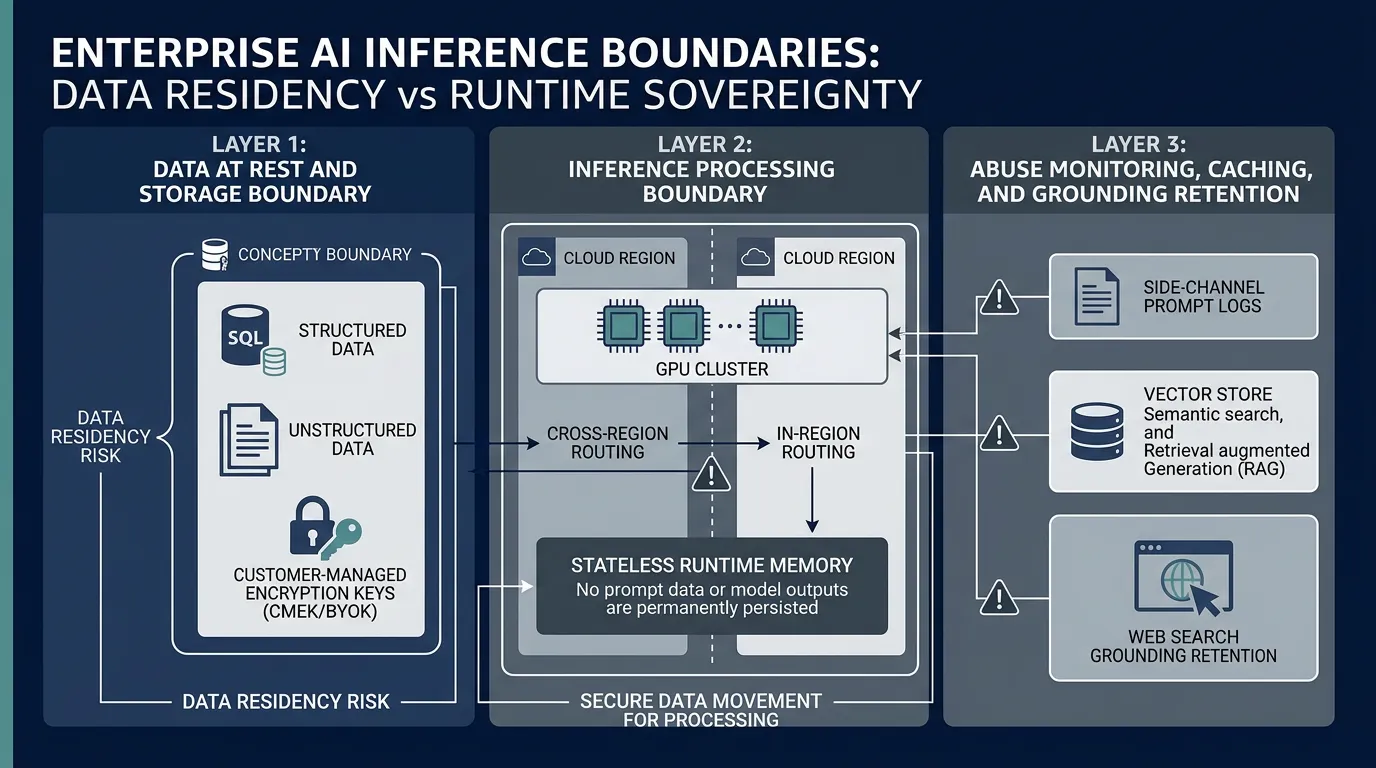
Why Does Storage Residency Fail to Protect AI Runtime Data?
Enterprise compliance questionnaires frequently treat "data residency" as a single boolean checklist item. If cloud storage buckets and vector databases are provisioned in a Frankfurt, Dublin, or Virginia availability zone, compliance teams often assume their AI pipeline satisfies regulatory sovereignty.
This assumption conflates data at rest with data in transit and execution:
- Storage Isolation vs. Dynamic Compute Routing: Cloud providers operating large language model infrastructure routinely deploy dynamic load balancing across international data centers to optimize GPU capacity. Under standard multi-tenant configurations, a prompt submitted from a European cloud region can be routed to a North American GPU cluster for inference if local accelerator capacity is constrained, unless explicit regional-pinning parameters are enforced.
- Customer-Managed Keys Do Not Protect GPU Memory: Customer-managed encryption keys (CMEK or BYOK) protect persistent database blocks, blob storage, and disk-level snapshots. However, when tokenized prompts enter GPU high-bandwidth memory (HBM) for matrix multiplication and attention calculations, the payload is necessarily unencrypted in volatile runtime memory.
- The Transit Boundary: Prompt payloads and model completions travel over external API gateways and service-mesh fabrics before reaching the model weights. Without strict network zoning and VPC endpoint pinning, intermediate hops can cross administrative and jurisdictional borders.
What Are the Three Perimeters of Enterprise AI Inference Boundaries?
Enterprise architectures deploying foundation models or autonomous agentic workflows must establish three distinct isolation perimeters to ensure verifiable data sovereignty and regulatory compliance.
| Architectural Perimeter | Primary Security Mechanism | Common Failure Mode | Enterprise Verification Standard |
|---|---|---|---|
| 1. Storage & Persistence Boundary | KMS-managed CMEK, encrypted vector partitions, local blob storage | Storing raw prompts in unencrypted application audit logs | Automated key revocation testing and cryptographically segregated tenant storage |
| 2. Runtime GPU Inference Boundary | In-region GPU pinning, private endpoints (PrivateLink/VPC peering) | Fallback to geographic cross-region inference during GPU peak demand | Explicit disabling of global routing; telemetry monitoring of inference IP origin |
| 3. Side-Channel & Grounding Boundary | Zero Data Retention (ZDR), cache-busting headers, private safety processing | Search grounding and automated prompt evaluation retaining 30-day logs | Elimination of public search grounding; audited ephemeral safety filtering |
How Do Cloud Model Gateways Implement Inference Boundaries?
Major enterprise model providers in 2026 expose distinct configuration tiers for inference routing, but default settings rarely enforce sovereign isolation:
- OpenAI API & Enterprise: API customers can configure regional processing endpoints for EU or US data boundaries. Under qualifying enterprise commitments, Zero Data Retention (ZDR) can be paired with Private Safety Processing to prevent automated abuse-monitoring queues from persisting prompt text on disk.
- Microsoft Azure AI Foundry: Model deployments are categorized as Regional, Data Zone, or Global. Regional deployments pin compute to the designated geography, whereas Global deployments reserve the right to route traffic across international datacenters based on available accelerator throughput. Furthermore, persistent features such as assistant threads, file uploads, and hosted vector indexes require separate retention policies.
- Amazon Bedrock: Bedrock differentiates between In-Region, Geographic Cross-Region (e.g., EU-only or US-only multi-region pooling), and Global Cross-Region routing. Selecting Geographic Cross-Region allows latency-optimized failover within a defined legal trade block while preventing data from leaving the continent. Zero data retention applies only to stateless model invocations, whereas persistent knowledge bases and guardrail evaluation logs must be explicitly isolated.
- Google Cloud Vertex AI: Regional resource deployments isolate training artifacts and custom models, but zero data retention requires disabling prompt caching and configuring customer-managed encryption. Crucially, enterprise features such as Google Search grounding can retain input prompts for up to 30 days under standard terms unless sovereign private grounding configurations are enabled.
What Are the Legal and Regulatory Implications for Corporate Deployers?
Enterprise governance of AI inference boundaries is driven by both statutory mandates and established professional conduct rules:
In professional services and legal operations, the standards are equally demanding:
- ABA Formal Opinion 512: The American Bar Association's landmark ethics opinion on generative artificial intelligence mandates that attorneys understand the specific technology tools they deploy (Model Rule 1.1 Competence) and make reasonable efforts to prevent unauthorized access or disclosure of confidential client information (Model Rule 1.6 Confidentiality). Lawyers uploading sensitive client files to public or shared-inference LLMs without verifying zero-retention and training-exclusion terms risk waiving attorney-client privilege.
- Privilege Waiver Risks: Recent federal decisions (such as United States v. Heppner and Morgan v. V2X, Inc.) emphasize that transmitting proprietary discovery materials or work product into AI systems that persist training data or human-reviewer logs constitutes an unforced waiver of work-product protection.
Frequently Asked Questions
Does using a Customer-Managed Key (CMEK) prevent the AI vendor from seeing prompts during execution?
No. CMEK encrypts data while stored at rest in databases, object storage, and disk volumes. When an inference request is executed, the model must read the plaintext tokens in GPU memory. To prevent prompt exposure at runtime, enterprises must combine CMEK with Zero Data Retention (ZDR) contracts and isolated compute environments.
What is the difference between In-Region Inference and Geographic Cross-Region Inference?
In-Region Inference confines processing to a single specific cloud datacenter (e.g., us-east-1 or eu-central-1). Geographic Cross-Region Inference pools compute across multiple datacenters within a single geopolitical or regulatory boundary (such as within the EU or within the continental US), ensuring compliance with regional data residency laws while providing higher availability.
Why does prompt caching create an inference boundary risk?
Prompt caching improves latency and reduces cost by persisting pre-computed attention keys and values for common prompt prefixes across calls. If cached representations are stored across multi-tenant servers or outside the customer's dedicated private network, sensitive corporate system prompts can persist in unmonitored cache storage.
Strategic Next Steps for Enterprise Architecture Teams
To establish defensible AI inference boundaries, enterprise IT and security leaders should implement four mandatory controls:
- Audit Gateway Routing Configurations: Inspect every cloud model endpoint to verify that dynamic global load balancing is disabled and compute is locked to designated sovereign zones.
- Execute Formal Zero Data Retention Addenda: Ensure that B2B enterprise master service agreements explicitly mandate Zero Data Retention (ZDR) across both generation and abuse-monitoring pipelines.
- Decouple Search Grounding from Public Web APIs: Replace public web search grounding with private, in-VPC vector search (RAG) protected by customer-managed keys.
- Enforce Continuous Egress Telemetry: Deploy automated network probes and traffic inspection to verify that outbound API payloads resolve exclusively to authorized regional gateway IP blocks.
For further analysis on enterprise governance architectures, explore our companion reports on Enterprise AI Governance Charter: CAIO Mandates and Decision Rights and Enterprise AI Vendor Change Control.