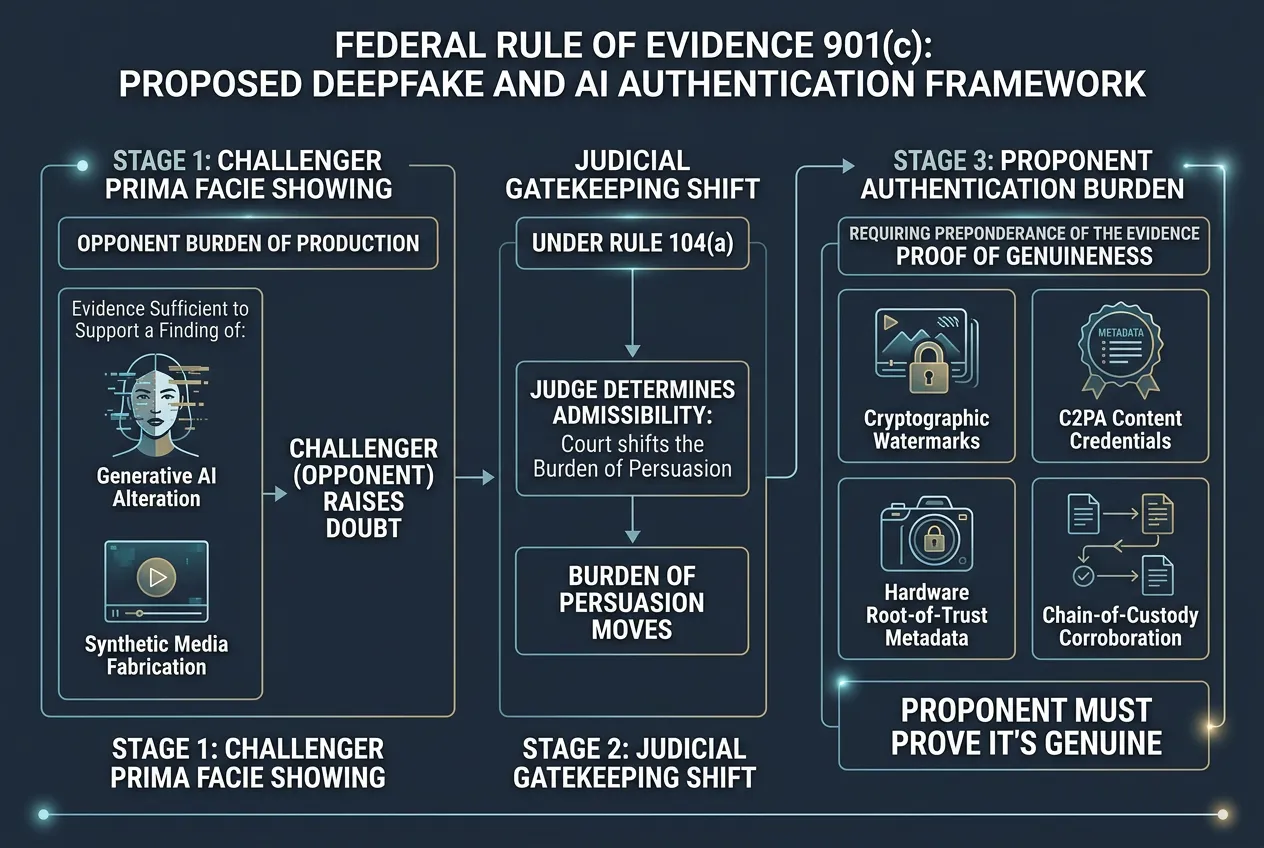
Federal Rule of Evidence 901(c) deepfakes authentication establishes a revolutionary two-tiered burden-shifting framework drafted by the Advisory Committee on Evidence Rules to govern evidence challenged as synthetic or altered by generative artificial intelligence. Under the proposed rule, the traditional low authentication threshold of Rule 901(a)—requiring merely a prima facie showing that an item is what its proponent claims—is fundamentally reshaped whenever an opponent produces evidence sufficient to support a finding that digital media was fabricated or manipulated by generative AI. Once that threshold showing is met, the burden shifts back to the proponent, who must prove to the court under Rule 104(a) by a preponderance of the evidence that the disputed audio, video, photograph, or document is authentic.
Why Does Traditional Rule 901 Fail for Generative AI and Deepfakes?
Federal Rule of Evidence 901(a) has historically operated under an extraordinarily forgiving standard: evidence is authenticated if the proponent produces "evidence sufficient to support a finding that the item is what the proponent claims it is." Traditionally, this standard is resolved under Rule 104(b) as a matter of conditional relevance—meaning that so long as a reasonable juror could find the exhibit authentic based on basic witness testimony or circumstantial marks, the exhibit is admitted, and any doubts regarding authenticity go strictly to the weight of the evidence, not its admissibility.
In the era of hyper-realistic multimodal diffusion models, neural voice clones, and synthetic document generators, this low threshold creates catastrophic evidentiary vulnerabilities:
- The Plausibility Deficit: Synthetic media tools can generate high-fidelity audio recordings, lifelike video footage, and photorealistic imagery that easily mimic authentic artifacts, rendering surface-level visual inspection obsolete.
- The "Liar's Dividend" Paradox: As deepfakes proliferate, bad-faith litigants exploit public awareness of AI to fabricate doubt around authentic, damning evidence (such as genuine bodycam recordings or voicemail admissions) by crying "AI fabrication" without presenting technical proof.
- Inadequacy of Rule 901(b)(9): While Federal Rule of Evidence 901(b)(9) permits authentication by showing that a "process or system produces an accurate result," it was engineered for automated data logging, toll plaza sensors, and computer spreadsheets—not for defending against adversary attacks where third parties forge digital content using generative models.
Recognizing that the traditional conditional relevance framework leaves trial juries ill-equipped to evaluate black-box synthetic media, the Advisory Committee on Evidence Rules formulated proposed Rule 901(c) to install a formal judicial gatekeeping mechanism.
How Does Proposed Federal Rule of Evidence 901(c) Shift the Burden of Proof?
Proposed Federal Rule of Evidence 901(c) establishes a structured two-stage procedural test designed to filter out synthetic fabrications while deterring frivolous deepfake objections. The rule operates through a calibrated burden-shifting mechanism:
| Evidentiary Stage | Governing Actor | Standard of Proof | Procedural Mechanism |
|---|---|---|---|
| Stage 1: Opponent Threshold | Challenging Party (Opponent) | Evidence sufficient to support a finding | Must introduce affirmative technical or circumstantial evidence indicating the item was fabricated or altered by generative AI. Mere uncorroborated argument does not trigger burden-shifting. |
| Stage 2: Judicial Gatekeeping | Trial Judge (Rule 104(a)) | Preponderance of the evidence | Court resolves authenticity as a preliminary question of admissibility rather than punting credibility entirely to the jury. |
| Stage 3: Proponent Authentication | Offering Party (Proponent) | Preponderance of the evidence | Proponent must affirmatively prove genuineness through forensic provenance, cryptographic signatures, or verifiable chain of custody. |
Step 1: The Opponent's Prima Facie Threshold
The challenger cannot derail trial proceedings by simply reciting that generative AI exists. Under the Advisory Committee's draft text, the opponent bears the initial burden of production: they must introduce evidence sufficient to support a finding that the challenged item was fabricated, in whole or in part, by generative artificial intelligence.
This showing can be satisfied through:
- Forensic artifact detection (e.g., spectral audio inconsistencies, facial warp artifacts, or lighting vectors inconsistent with physical physics);
- Expert affidavits analyzing generative model artifacts or latent-space signatures; or
- Direct circumstantial proof establishing that the putative creator or depicted subject was demonstrably elsewhere at the timestamped occurrence.
Step 2: The Proponent's Preponderance Requirement
If the trial court determines that the opponent has satisfied their threshold burden of production, the legal presumption flips. The proponent can no longer rest on a bare witness assertion that "this video accurately depicts what happened."
Instead, proposed Rule 901(c) shifts the burden of persuasion to the proponent, who must prove to the presiding judge under Rule 104(a) that the item is more likely than not authentic under the preponderance standard. If the proponent fails to meet this preponderance burden, the exhibit is excluded from evidence entirely.
[Opponent Objection: Deepfake Claimed]
                │
                ▼
[Does opponent provide evidence sufficient to support finding of generative AI fabrication?]
         ├── NO  ──► [Standard Rule 901(a) Conditional Relevance: Exhibit Admitted]
         └── YES ──► [Burden Shifts to Proponent under Rule 104(a)]
                         │
                         ▼
        [Does proponent prove authenticity by Preponderance of Evidence?]
                 ├── NO  ──► [EXCLUSION of Evidence]
                 └── YES ──► [ADMISSION with Opponent Weight Arguments Preserved]
How Does Proposed Rule 901(c) Intersect with Federal Rule of Evidence 707?
Proposed Rule 901(c) and proposed Rule 707 form the twin pillars of the Advisory Committee's modern evidence architecture, addressing opposite sides of the AI evidentiary ledger:
- Proposed Rule 707 (AI Machine-Generated Outputs): Governs machine-generated analysis, autonomous algorithmic models, and predictive analytics offered as substantive evidence without a sponsoring expert witness under Rule 702. Rule 707 mandates that the proponent establish that the software process or system is reliable and grounded in valid data inputs.
- Proposed Rule 901(c) (Defensive Authentication & Deepfakes): Governs human or multimedia evidence (recordings, photographs, documents, emails) that an opposing party alleges has been synthetic, manipulated, or hallucinated via generative artificial intelligence.
While Rule 707 regulates AI acting as an analytical machine witness, Rule 901(c) protects the record from AI operating as an undetectable digital forger. Both rules reflect a decisive transition toward judicial gatekeeping under Rule 104(a), taking complex technical evaluations out of unguided jury deliberations.
What Technical Evidence Satisfies Authentication Under Rule 901(c)?
Trial lawyers facing a Rule 901(c) deepfake challenge must construct an unassailable digital provenance dossier. Litigators cannot rely on post-hoc consumer AI detection software alone, as commercial classifiers suffer from high error rates and false positives on compressed media.
To satisfy the preponderance of the evidence standard under Rule 104(a), litigators must deploy four technical pillars:
- Cryptographic Provenance and C2PA Content Credentials: Utilizing Coalition for Content Provenance and Authenticity (C2PA) metadata bound cryptographically at the hardware capture layer (camera sensor or audio recorder root-of-trust).
- Immutable Chain of Custody: Documenting cryptographically hashed master copies (such as SHA-256 digests) from the moment of forensic acquisition through forensic storage, ensuring no intermediary transformation occurred.
- Forensic Expert Attribution: Retaining digital forensics experts capable of analyzing file headers, container atom structures, and PRNU (Photo-Response Non-Uniformity) sensor noise patterns to confirm hardware camera sensor lineage.
- Extrinsic Circumstantial Corroboration: Pairing disputed recordings with non-generative extrinsic records, such as telecommunication carrier call-detail records (CDRs), cell site location information (CSLI), physical access-badge logs, or third-party witness cross-examination.
Related Insights Analysis
- Federal Rule of Evidence 707: Admitting AI Output Without an Expert Witness in 2026
- Federal Court AI Standing Orders: The 2026 Judicial Patchwork
- Generative AI in eDiscovery and ESI Protocols: Federal Rules and Validation Standards in 2026
What is proposed Federal Rule of Evidence 901(c)?
Proposed Federal Rule of Evidence 901(c) is an evidentiary amendment developed by the Advisory Committee on Evidence Rules that establishes a two-tiered burden-shifting framework for authenticating digital evidence challenged as deepfakes or generative AI fabrications.
Who carries the initial burden under proposed Rule 901(c)?
The opponent challenging the evidence carries the initial burden of production. They must present evidence sufficient to support a finding that the item was fabricated or altered by generative AI. Mere unsubstantiated argument is legally insufficient.
What burden does the proponent face once the opponent meets the threshold?
Once the opponent satisfies their threshold showing, the burden of persuasion shifts to the offering proponent, who must prove by a preponderance of the evidence under Rule 104(a) that the evidence is authentic.
Is proposed Rule 901(c) officially in effect in federal courts?
No. As of November 2026, proposed Rule 901(c) remains under ongoing debate and committee consideration within the Advisory Committee on Evidence Rules, with active discussions regarding formal publication for public comment and interaction with existing Rule 901(b)(9).