Multi-agent deadlock prevention in 2026 requires moving beyond naive timeouts to structured distributed concurrency control, enforcing strict resource ordering, dynamic wait-for graph cycle detection, and preemption protocols across shared tools, memory, and database locks. When autonomous LLM agents execute non-deterministic trajectories, uncoordinated locks and circular inter-agent RPC waits stall execution indefinitely. Production architectures eliminate circular wait by modeling agent interactions as directed acyclic graphs, applying strict partial ordering to resource acquisition, and deploying wound-wait preemption policies that isolate failing subagents before cascading latency exhausts compute budgets.
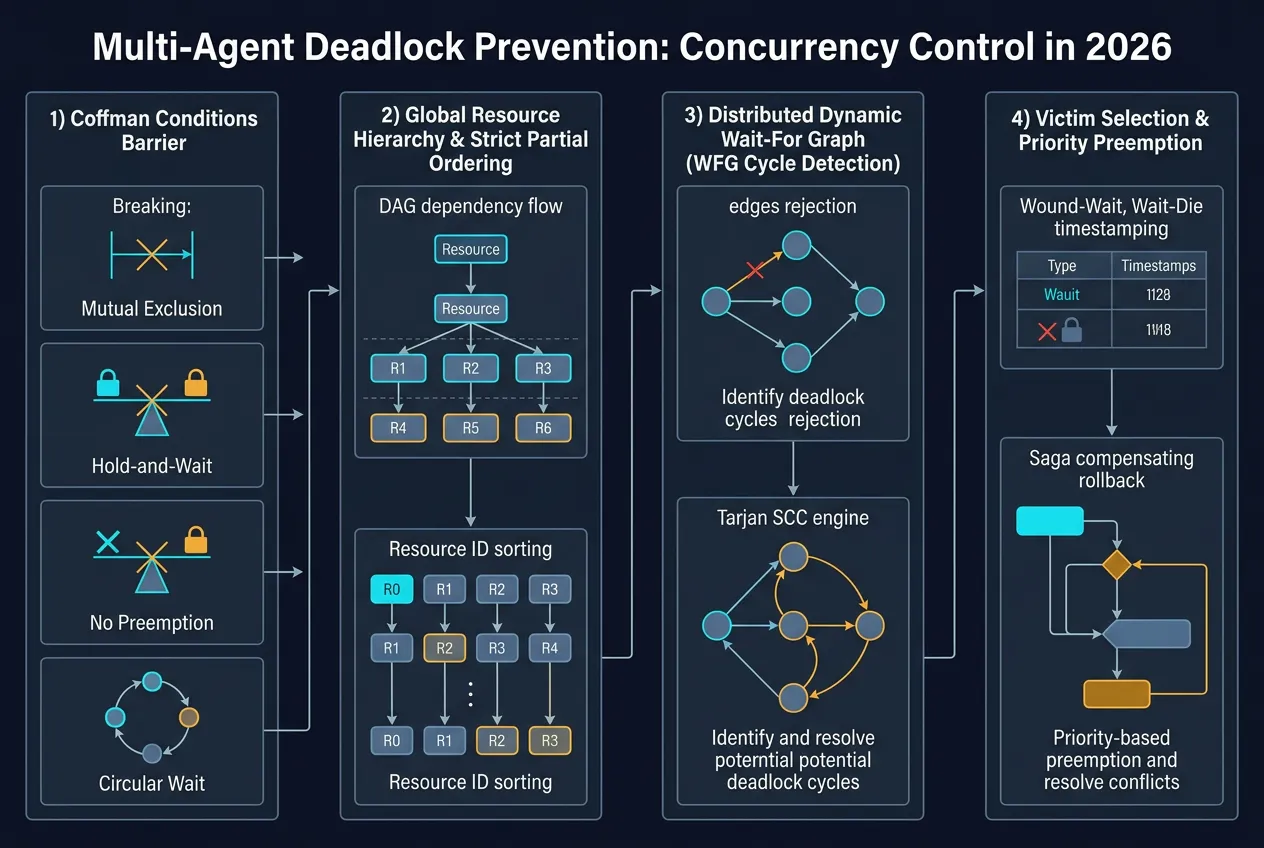
Why Do Production Multi-Agent Systems Deadlock?
As enterprise AI systems evolve from single-turn LLM prompts to distributed, multi-agent systems, agents frequently share access to mutable state: shared vector memory namespaces, transactional relational database records, API rate-limit buckets, and execution sandboxes. In these topologies, deadlocks occur when two or more agents concurrently acquire locks or await task outputs in an unresolved circular dependency chain.
A classic multi-agent deadlock satisfies all four Coffman conditions simultaneously:
- Mutual Exclusion: Agents acquire unshareable, exclusive locks on resources (e.g., an exclusive write lock on a client’s CRM record or shared scratchpad memory).
- Hold-and-Wait: An agent retains an acquired lock while issuing asynchronous tool calls or awaiting intermediate outputs from downstream peer agents.
- No Preemption: Once an agent acquires a lock or enters an execution phase, external orchestrators cannot forcibly release its resources without corrupting transient LLM reasoning contexts.
- Circular Wait: Agent A holds Lock 1 and awaits Output 2 from Agent B; simultaneously, Agent B holds Lock 2 and awaits intermediate validation from Agent A.
In non-deterministic agent workflows, relying on HTTP request timeouts to resolve these stalls is disastrous. A coarse timeout aborts work indiscriminately after minutes of inactivity, wasting costly inference tokens, leaving distributed side effects partially executed, and triggering synchronized retry storms that immediately re-enter the deadlock condition.
How Does Strict Resource Ordering Eliminate Circular Waits?
The most robust architectural strategy for deadlock prevention is breaking Coffman’s fourth condition—circular wait—at the orchestrator level by enforcing strict partial ordering across all resource identifiers.
Recent systems research, including the 2026 CoAgent concurrency framework (arXiv:2606.15376) and DPBench evaluation benchmarks (arXiv:2602.13255), establishes that multi-agent resource contention reduces to a generalized Dining Philosophers problem. When agents are permitted to acquire locks in arbitrary, dynamic sequences dictated by LLM reasoning, circular wait probabilities scale exponentially with agent density.
Under a strict partial ordering regime:
- Canonical Resource Hierarchies: Every shared mutable resource across the cluster is assigned a unique, monotonically comparable identifier (e.g.,
res_namespace:tenant:entity_id). - Lexicographical Lock Acquisition: Regardless of prompt reasoning or agent subtask order, any agent requiring multiple locks must acquire them in ascending lexicographical order ($R_1 < R_2 < R_3$).
- Atomic Multi-Lock Claims: If an agent discovers during trajectory execution that it requires an additional resource $R_{prior}$ where $R_{prior} < R_{current}$, it must release all held locks and re-acquire the entire lock bundle atomically in canonical sequence.
By constraining all dependency edges to point in a single direction, the global resource allocation graph is mathematically guaranteed to remain a Directed Acyclic Graph (DAG), rendering circular wait structural impossibilities.
What Is Dynamic Wait-For Graph (WFG) Cycle Detection?
When agent workflows require dynamic, ad-hoc task delegation where lock requirements cannot be predetermined prior to execution, systems must deploy runtime Wait-For Graph (WFG) cycle detection.
Modern coordination engines, such as the SyncPlan multi-agent dependency protocol (arXiv:2608.01652), maintain a centralized or distributed directed graph $G = (V, E)$ where vertices $V$ represent active agent workers and directed edges $e = (A_i, A_j) \in E$ signify that Agent $A_i$ is blocked waiting for a lock held or an output generated by Agent $A_j$.
Agent A (Worker 1) ----[waits for Lock B]----> Agent B (Worker 2)
      ^                                             |
      |                                             |
      +-------------[waits for Lock A]--------------+
                   [Cycle Detected by Engine]
The Edge-Rejection Protocol
- Pre-Wait Path Checking: Before allowing Agent $A_i$ to enter a blocked wait state for Agent $A_j$, the orchestrator executes a cycle detection algorithm (such as Tarjan’s strongly connected components or incremental depth-first search).
- Immediate Cycle Rejection: If adding the edge $(A_i, A_j)$ would complete a directed cycle, the lock or wait request is immediately rejected rather than queued.
- Execution Replanning: Upon receiving an edge rejection, the calling agent’s runtime catches a concurrency exception and branches into an alternative execution path, replans tool sequencing, or yields execution back to the coordinator.
By intercepting dependency cycles before blocking occurs, orchestrators prevent execution threads from entering indefinite sleep states.
How Do Wound-Wait and Wait-Die Timestamp Protocols Enforce Preemption?
Breaking Coffman's "no preemption" condition requires formal distributed transaction algorithms adapted for multi-agent reasoning. In database concurrency control, timestamp-based deadlock prevention algorithms govern resource contention without requiring continuous global graph traversals. Two primary schemes govern production agent systems:
| Protocol | Older Agent (Lower Timestamp $T_o$) Wants Resource Held by Younger Agent (Higher Timestamp $T_y$) | Younger Agent (Higher Timestamp $T_y$) Wants Resource Held by Older Agent (Lower Timestamp $T_o$) | Production Characteristic |
|---|---|---|---|
| Wound-Wait (Preemptive) | Wounds: Younger agent is preempted, rolls back, and releases locks; older agent proceeds immediately. | Waits: Younger agent is allowed to wait for the older agent to complete. | Minimizes latency for high-priority/long-running root trajectories; younger speculative agents abort early. |
| Wait-Die (Non-Preemptive) | Waits: Older agent is allowed to wait for the younger agent to finish. | Dies: Younger agent is immediately terminated, rolls back, and retries with backoff. | Prevents starvation of older agents but may incur higher retry frequency on speculative child agents. |
In high-throughput enterprise agent swarms, Wound-Wait is the preferred topology. When a long-running, parent business trajectory (assigned an earlier initialization timestamp) contends for memory or database rows with an ephemeral subagent, the orchestrator "wounds" the younger subagent. The subagent executes its compensating saga actions, releases its leases, and restarts asynchronously, preserving the parent trajectory's deadline budget.
How Does Deadlock Prevention Integrate with Distributed Tracing and Sagas?
Deadlock prevention cannot operate in isolation from overall system resiliency. As explored in our analysis of Agentic Checkpointing and State Persistence and Durable Agentic Execution with Saga Recovery, aborting or preemption of a deadlocked agent requires clean state reclamation.
- Distributed Lease Timeouts (TTL): Every agent lock acquisition must carry a cryptographically validated, heartbeat-refreshed lease (TTL). If an agent experiences process failure or cognitive looping, its lease expires, triggering automated lock reclamation.
- Compensating Transactions: When an agent is selected as a deadlock victim under Wound-Wait or WFG cycle breaking, the orchestrator invokes compensating rollback actions to cleanly undo intermediate writes made to external systems.
- OpenTelemetry GenAI Tracing: Each dependency edge, lock claim, and preemption event must be propagated across W3C Trace Context headers, as outlined in our architectural guide on Distributed Agent Tracing with OpenTelemetry. Span attributes such as
concurrency.lock.id,concurrency.lock.mode, andconcurrency.preemption.statusallow SRE teams to visualize resource contention hotspots in production.
How does multi-agent deadlock differ from traditional multithreading deadlock?
Traditional OS deadlocks involve CPU threads contending for static memory addresses or mutexes within milliseconds. In multi-agent AI systems, deadlocks involve non-deterministic, long-running LLM trajectories contending for heterogeneous distributed resources—such as API rate limits, tool execution queues, and database records—with execution durations spanning seconds or minutes and financial token costs attached to every stalled step.
Why are simple timeouts insufficient to handle agent deadlocks?
Simple timeouts act only after significant latency has already accrued, burning compute time and holding locks until the expiration threshold. Furthermore, when multiple deadlocked agents time out simultaneously, standard retry loops frequently cause them to re-request the exact same resources in identical order, creating recurring live-lock storms.
What is the performance overhead of maintaining a runtime Wait-For Graph?
In clusters with fewer than 1,000 concurrent agent threads, incremental cycle detection algorithms (such as cycle-checking on each edge insertion) add sub-millisecond CPU overhead, which is negligible compared to model inference latencies (200ms–2,000ms). For ultra-large swarms, static resource hierarchy ordering or Wound-Wait timestamping provides $O(1)$ local checking without centralized graph synchronization.
Architectural Checklist for Deadlock-Free Agent Orchestration
To safeguard production multi-agent workflows against unrecoverable concurrency deadlocks, engineering teams should validate four core mechanisms:
- [x] Enforce Global Resource Ordering: Assign canonical, comparable identifiers to all shared memory namespaces, tool execution leases, and entity records; require ascending acquisition sequences.
- [x] Deploy WFG Pre-Wait Cycle Rejection: Maintain a dependency graph of agent-to-agent and agent-to-resource wait states; intercept and reject any dependency edge that would close a directed cycle.
- [x] Implement Wound-Wait Timestamp Preemption: Protect high-priority, root agent trajectories by preempting and rolling back speculative or younger child subagents upon resource contention.
- [x] Bind Locks to Ephemeral Leases with Sagas: Never grant indefinite mutexes; enforce bounded leases with heartbeat renewals and wire compensating rollback actions for all preemption victims.