Enterprise AI contracts face a critical negotiation breakdown: vendors sell transformative autonomous systems while disclaiming all liability behind blanket "as is" warranty clauses, leaving corporate buyers with unmitigated operational risk. In traditional software-as-a-service (SaaS) procurement, enterprise buyers rely on established implied warranties of merchantability and fitness for a particular purpose, coupled with express commitments that software will materially conform to technical documentation. In production AI deployments, however, standard vendor terms disclaim every implied warranty and treat output accuracy as an uninsurable probabilistic artifact.
Closing this contractual gap requires shifting the negotiation from impossible promises of absolute output perfection to enforceable commitments around architectural conformance, benchmark validation, and operational change control. By anchoring enterprise AI warranties to empirical test suites and structured remedies, corporate counsel and procurement teams can eliminate the "as is" trap without stalling enterprise AI adoption.
Why Do Commercial AI Vendors Insist on "As Is" Warranty Disclaimers?
Under the Uniform Commercial Code (UCC) and common law technology licensing principles, software licensors face substantial liability if an enterprise platform fails to perform its essential business functions. To mitigate this exposure, foundation model providers and vertical AI vendors draft standard enterprise agreements with comprehensive warranty disclaimers:
- Probabilistic Non-Determinism: Large language models and autonomous agent swarms generate outputs through probabilistic token sampling. Even with zero temperature parameters, underlying hardware architectures and dynamic context windows introduce minor variations. Vendors argue that guaranteeing deterministic output across arbitrary enterprise prompts is mathematically impossible.
- Open-Ended Prompt Vulnerability: Model providers cannot predict how enterprise employees will prompt an agent or what unstructured data will enter retrieval-augmented generation (RAG) pipelines. Disclaiming the warranty of fitness for a particular purpose protects vendors when buyers deploy general-purpose models into specialized domains without proper fine-tuning or guardrails.
- Third-Party Upstream Dependencies: Many enterprise AI vendors build applications on foundation models accessed via APIs. If an upstream foundation provider updates model weights, alters safety filters, or degrades reasoning performance, downstream vendors resist taking legal responsibility for the resulting behavioral shift.
Accepting an uncalibrated "as is" disclaimer shifts the entirety of these risks to the enterprise buyer. If an autonomous agent generates defective code, hallucinates critical financial figures, or executes unauthorized system mutations, an agreement without operational warranties leaves the buyer with no contractual recourse, zero service credits, and no right to terminate without penalty.
What Are the Four Enforceable Enterprise AI Warranty Pillars?
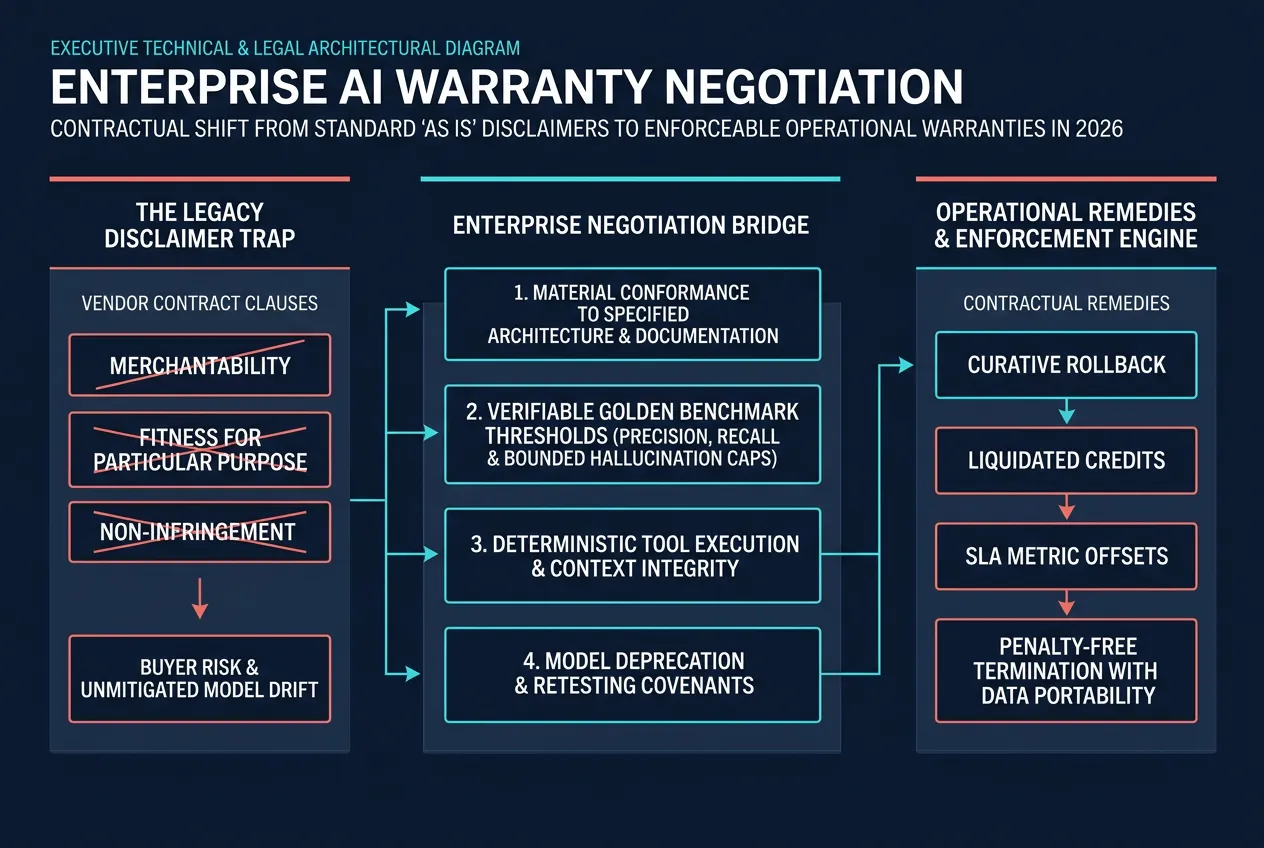
Sophisticated corporate buyers no longer accept blanket "as is" language. Instead, procurement teams negotiate four structured warranty pillars that bind vendors to measurable technical baselines:
┌────────────────────────────────────────────────────────────────────────┐
│               FOUR PILLARS OF ENTERPRISE AI WARRANTIES                │
├───────────────────────────────┬────────────────────────────────────────┤
│ 1. Documentation Conformance  │ Material conformance to published APIs,│
│                               │ context windows, latency & integrations│
├───────────────────────────────┼────────────────────────────────────────┤
│ 2. Golden Benchmark Baselines │ Minimum precision, recall & bounded    │
│                               │ hallucination caps on customer datasets│
├───────────────────────────────┼────────────────────────────────────────┤
│ 3. Deterministic Tool Calls   │ Strict schema validation, CFG decoding,│
│                               │ and zero payload mutation warranties   │
├───────────────────────────────┼────────────────────────────────────────┤
│ 4. Change Control & Retesting │ Advance deprecation notice, parallel   │
│                               │ canary staging, and mandatory re-test  │
└────────────────────────────────┴────────────────────────────────────────┘
1. Material Conformance to Specified Architecture and Documentation
While vendors resist warranting output correctness for arbitrary prompts, they must warrant that their platform materially conforms to published technical specifications and service documentation. This express warranty covers:
- Core service availability, API interfaces, and documented tool integrations;
- Specified context window capacity without silent truncation or middle-token degradation;
- Stated data isolation boundaries, zero data retention (ZDR) guarantees, and privacy controls;
- Documented authentication protocols, including role-based access control and OAuth token exchange.
2. Empirical Benchmark and Golden Dataset Validation
Rather than demanding an abstract promise of "substantially accurate" output, enterprise agreements incorporate objective, use-case-specific evaluation benchmarks as formal contractual exhibits. As recommended in the NIST AI Risk Management Framework (NIST AI 600-1), performance must be measured under realistic operational conditions using held-out customer datasets.
- Contractual Precision and Recall Floors: In document review and automated intake workflows, agreements establish statistical thresholds (for example, target precision and recall minimums on designated regulatory entity extraction).
- Bounded Hallucination and Citation Accuracy Caps: For automated research and customer-facing summaries, contracts warrant that citations resolve directly to underlying retrieved corpus documents with zero fabricated sources.
- Standardized Scoring Methodology: The contract defines the exact evaluation metrics, sample sizes, and scoring harnesses used to measure compliance, eliminating subjective disputes over what constitutes a system defect.
3. Tool Execution and Context Integrity
In agentic workflows where models invoke external software tools via protocol layers like the Model Context Protocol (MCP), enterprises face operational risks beyond text generation. Buyers require express warranties ensuring execution integrity:
- Schema-Valid Invocations: The vendor warrants that agentic tool calls adhere strictly to registered JSON schemas via pushdown automaton Context-Free Grammar (CFG) decoding.
- Payload Fidelity: System prompts and user inputs cannot be silently injected, manipulated, or dropped during orchestration routing.
- Idempotency and Rollback Support: The platform must support transactional deduplication keys and compensating actions for failure recovery.
4. Advance Change Control and Mandatory Retesting
Model providers frequently update inference endpoints, modify instruction-following prompts, or deploy quantizations without announcing technical changelogs. Under an enterprise change control warranty:
- Vendors must provide at least 90 to 180 days advance written notice before deprecating or altering underlying foundation model snapshots;
- Buyers maintain the right to pin specific model versions for the duration of the enterprise contract term;
- Any vendor-initiated update requires re-running the agreed golden benchmark suite, with failure to meet baseline thresholds constituting a material breach.
How Should Buyers Structure Contractual Remedies for Warranty Breaches?
A warranty is only as effective as the contractual remedies tied to its breach. If an AI vendor breaches an operational warranty, traditional SaaS remedies—such as commercially reasonable efforts to fix bugs within 30 days—frequently fail because fixing a deep non-deterministic reasoning failure cannot be resolved with a simple software patch.
Enterprises structure tiered, progressive remedies designed specifically for AI failure modes:
| Breach Level | Operational Trigger | Required Contractual Remedy |
|---|---|---|
| Tier 1: Curative Rollback | Performance drift or benchmark drop following vendor update | Mandatory instant rollback to previous pinned model snapshot within 4 hours; freeze updates until remediation. |
| Tier 2: Liquidated Service Credits | Unresolved failure to meet benchmark thresholds (>5 business days) | Pro-rated service fee credits or invoice offsets tied directly to degraded throughput and human remediation costs. |
| Tier 3: Penalty-Free Termination | Continued failure across two consecutive benchmark cycles (30 days) | Unilateral buyer right to terminate contract without penalty, full refund of unearned prepaid fees, and complete data export. |
| Tier 4: Super-Capped Liability | Material breach of data retention or training isolation covenants | Specific carve-out from standard consequential damages caps, providing enhanced annual contract value liability protection. |
By pre-negotiating these remedy tiers, corporate buyers prevent vendors from hiding behind protracted investigation cycles while operational workflows remain impaired.
What Due Diligence Questions Must Precede Contract Execution?
Before signing an enterprise AI licensing agreement or master services agreement (MSA), procurement and legal teams must evaluate five practical operational questions:
- Does the agreement distinguish foundation model outputs from software infrastructure? Ensure that while output accuracy may be governed by benchmark baselines, infrastructure uptime, security, and API integrations remain under strict absolute performance warranties.
- Is the golden evaluation dataset legally protected? The held-out benchmark data must remain strictly confidential and contractually barred from being used to train or fine-tune the vendor's models.
- What happens during an upstream provider outage? If the vendor relies on third-party foundation models, determine whether the vendor warrants multi-provider redundancy or if upstream outages trigger SLA credits.
- Are liability limitations bilateral? If the vendor disclaims all implied warranties and caps liability at fees paid in the prior twelve months, ensure customer indemnities and use restrictions do not carry uncapped exposure.
- How are beta and experimental features segregated? Ensure that standard operational warranties apply to all production features, preventing vendors from classifying core enterprise agent capabilities as "beta" to invoke unilateral "as is" disclaimers.
Can an enterprise AI vendor ever warrant complete output accuracy?
No. Because generative AI models are probabilistic neural networks that sample tokens based on statistical likelihoods, guaranteeing absolute factual perfection across arbitrary inputs is technically unachievable. Sophisticated enterprise negotiations replace unfeasible accuracy guarantees with empirical benchmark thresholds, golden dataset validation gates, and express architectural conformance warranties.
What is the difference between an SLA and an AI performance warranty?
A Service Level Agreement (SLA) typically measures operational availability and infrastructure uptime (such as API endpoint availability and token latency limits). An AI performance warranty, by contrast, establishes substantive quality standards, warranting that the system conforms to documented capabilities, adheres to objective precision/recall floors on validation datasets, and maintains context integrity.
How does model version pinning protect buyers against silent performance drift?
Model version pinning contractually binds the vendor to serve a specific, dated snapshot of a model weights file rather than a dynamic floating alias. This ensures that vendor-side fine-tuning, system prompt adjustments, or safety filter changes do not silently degrade enterprise agent reasoning or invalidate downstream software integrations during the contract term.
For deeper analysis on aligning commercial contracts with technical AI governance, explore our companion reviews on Enterprise AI Acceptance Testing and Contractual Procurement Benchmarks, Enterprise AI Model Deprecation Covenants, and Enterprise AI Vendor Indemnification Standards.