An enterprise AI model registry is the authoritative, immutable control plane that catalogs, governs, validates, and tracks every foundation model, fine-tuned adapter, and agentic prompt configuration deployed across an organization. By replacing fragmented engineering tracking spreadsheets with cryptographically signed metadata, automated evaluation gates, and continuous provenance graphs, modern registries enforce organizational compliance under NIST AI 600-1 and ISO/IEC 42001 while guaranteeing instant rollback capabilities against runtime drift and adversarial failure.
Why Do Distributed Enterprise AI Deployments Fail Without an Immutable Model Registry?
When enterprise engineering teams scale from ad-hoc generative AI prototypes to dozens of distributed production microservices and autonomous agents, model tracking breaks down rapidly across three operational failure modes:
- Silent Upstream Model Mutation and API Drift: Commercial cloud providers continuously update, quantize, and swap underlying model checkpoints behind stable API endpoint names. Without an enterprise registry that pins immutable model digests and validates daily inference outputs against static golden test suites, enterprise workflows experience silent behavioral drift, increased hallucination rates, and corrupted downstream tool calls without triggering traditional HTTP infrastructure alerts.
- Untracked Training and Fine-Tuning Provenance: Enterprise teams fine-tune open-weights models and Low-Rank Adaptation (LoRA) adapters on internal proprietary data across dispersed developer workstations and disparate compute clusters. When an intellectual property dispute, privacy inquiry, or internal audit arises, organizations without unified model lineage cannot verify whether proprietary codebases, customer PII, or copyrighted third-party material contaminated a specific model checkpoint.
- Absence of Centralized Kill-Switches and Rollback Targets: When an agent system suffers context poisoning, prompt extraction, or catastrophic performance degradation, operations teams must instantly sever runtime access to compromised models. Without a centralized model registry governing API gateway routing, teams must manually locate, reconfigure, and redeploy dozens of disparate application containers under active incident conditions.
Under NIST AI RMF GOVERN 1.6 and the NIST AI 600-1 Generative AI Profile, enterprises must maintain a comprehensive, risk-prioritized inventory of all deployed AI systems, explicitly detailing system ownership, documentation, data provenance, and incident response procedures.
What Are the Core Architectural Pillars of an Enterprise AI Model Registry?
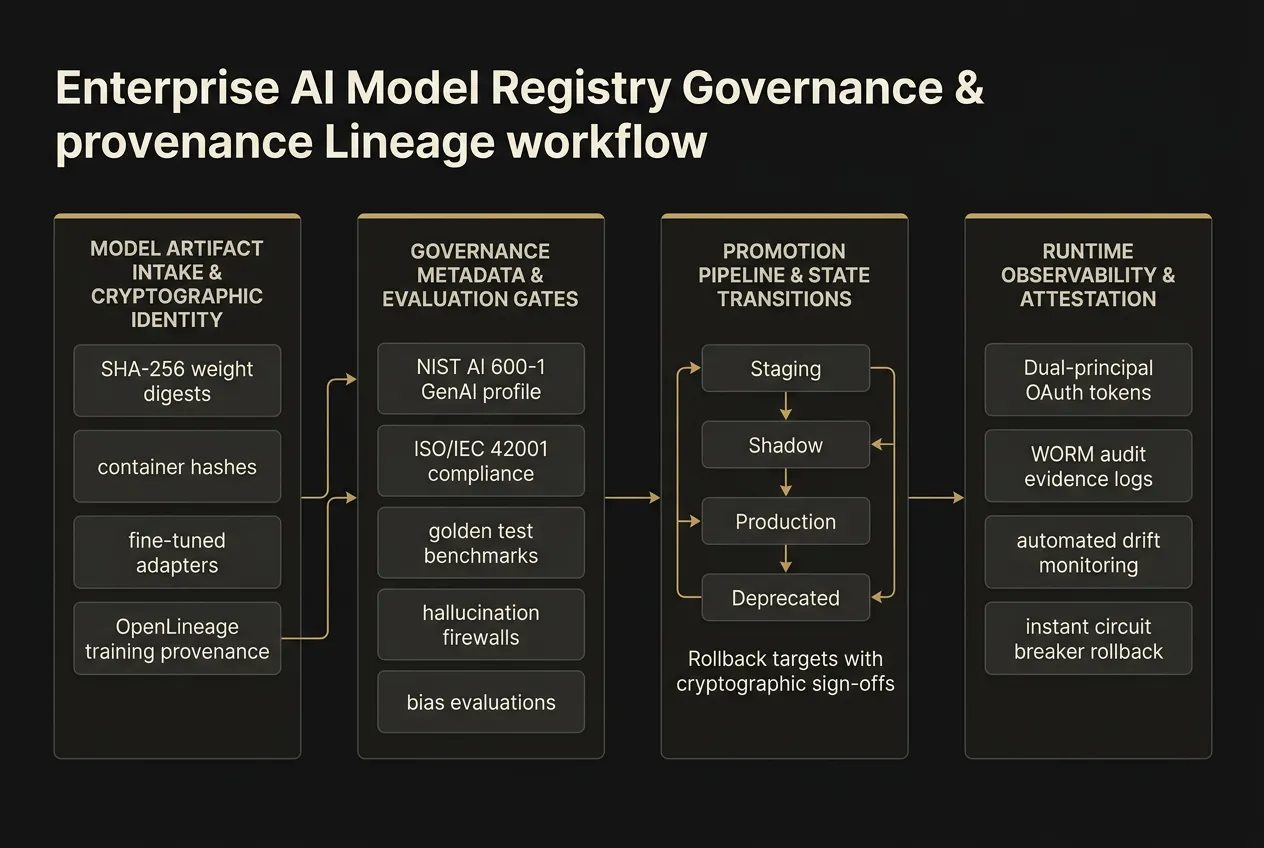
A production-grade enterprise AI model registry operates across four architectural pillars that connect developer training workflows directly to runtime governance and observability:
| Architectural Pillar | Core Technical Mechanism | Enterprise Compliance Standard |
|---|---|---|
| Cryptographic Identity & Artifact Hashing | SHA-256 weight digests, OCI container image digests, adapter configurations | FIPS 140-3, WORM Evidence Storage |
| Data & Code Provenance Lineage | OpenLineage job-run-dataset facets, Git commit hashes, dataset version pinning | ISO/IEC 42001:2023 Clause 8, EU AI Act Art. 53 |
| Automated Evaluation & Promotion Gates | Static golden holdout benchmarks, toxicity and bias scoring, prompt-injection red teaming | NIST AI 600-1 GenAI Profile, OWASP Agentic ASI01-10 |
| Dynamic Routing & State Transitions | Staging, shadow testing, canary deployment, production pinning, instant rollback targets | SOC 2 Type II, Enterprise BCP / Disaster Recovery |
[Training & Fine-Tuning]
       │
       ▼
┌────────────────────────────────────────────────────────┐
│ 1. Artifact Intake & Cryptographic Identity            │
│    • SHA-256 Model Digest                              │
│    • OpenLineage Training Dataset Fingerprint          │
│    • OCI Container Hash & Quantization Parameters      │
└───────────────────────┬────────────────────────────────┘
                        │
                        ▼
┌────────────────────────────────────────────────────────┐
│ 2. Automated Quality & Security Evaluation Gates       │
│    • Golden Test Suite Pass Thresholds (Accuracy Gates)│
│    • OWASP Top 10 Red-Teaming Firewalls                │
│    • Licensing & Data Cleanliness Audits               │
└───────────────────────┬────────────────────────────────┘
                        │
                        ▼
┌────────────────────────────────────────────────────────┐
│ 3. Enterprise Model Registry State Machine             │
│    • Lifecycle: Draft → Staging → Shadow → Production │
│    • Dual-Principal Sign-Off (Security + Product Lead) │
│    • Deprecation Schedules & Rollback Aliases          │
└───────────────────────┬────────────────────────────────┘
                        │
                        ▼
┌────────────────────────────────────────────────────────┐
│ 4. Runtime Gateway Enforcement & Telemetry             │
│    • Dynamic Endpoint Routing                          │
│    • OpenTelemetry Span Context Attribution            │
│    • Instant Circuit-Breaker Rollback to N-1 Artifact  │
└────────────────────────────────────────────────────────┘
How Does Provenance Lineage Protect Enterprise IP and Regulatory Compliance?
In production AI architectures, an artifact record in the model registry must not merely store an arbitrary serialized weight file; it must link upstream to the complete data and compute lineage graph that produced it.
By leveraging interoperable lineage frameworks such as OpenLineage, the model registry captures:
- Input Datasets & Transformations: Immutable SHA-256 digests of training and evaluation datasets, data cleansing scripts, tokenization filters, and synthetic data augmentation pipelines.
- Compute Environment & Hyperparameters: Docker container base images, PyTorch / CUDA runtime versions, learning rate schedules, quantization precision (FP16, INT8, INT4), and hardware cluster identifiers.
- Licensing and Consent Attestation: Machine-readable metadata verifying that all underlying training corpora possess valid commercial use licenses, comply with customer zero-data-retention (ZDR) covenants, and exclude protected user categories.
When paired with a formal AI Management System aligned with ISO/IEC 42001:2023, this continuous lineage provides verifiable evidentiary proof for regulatory audits, internal risk committee reviews, and intellectual property defense.
How Do Automated Evaluation Gates Prevent Dangerous Production Promotions?
Manual reviews are incapable of keeping pace with continuous fine-tuning schedules and weekly open-weights model releases. A compliant registry embeds automated, programmatic gates into the promotion pipeline:
- Private Golden Benchmark Holdouts: The model is evaluated against private, continuously updated ground-truth datasets that are never exposed in training splits or vendor pre-training runs, ensuring true out-of-sample performance validation.
- Deterministic Safety and Red-Teaming Suites: Automated probe pipelines evaluate susceptibility to indirect prompt injection, jailbreaking, and data exfiltration across hundreds of adversarial vectors before artifacts transition from
StagingtoProduction. - Latency and Throughput Regressions: Automated load tests measure Time to First Token (TTFT) and sustained token generation velocity under peak enterprise concurrency limits, rejecting models that introduce unacceptable latency into user-facing agentic loops.
- Dual-Key Approval Sign-Offs: Promotion to active production status requires programmatic cryptographic approvals from both the technical model owner and the designated compliance or security risk steward.
Frequently Asked Questions
What is the difference between an MLOps model registry and an enterprise AI governance registry?
Traditional MLOps registries (such as basic artifact stores) focus primarily on versioning code, metrics, and serialized weight binaries for engineering teams. An enterprise AI governance registry expands this foundation into a cross-functional system of record that incorporates legal risk classifications, regulatory control mappings (ISO 42001, NIST AI 600-1), cryptographic provenance lineage, deployment approvals, and automated compliance reporting.
How does an enterprise model registry handle third-party commercial APIs versus internal open-weights models?
For proprietary internal models, the registry manages the exact binary weights, container layers, and training data hashes. For external SaaS models (such as commercial cloud APIs), the registry tracks vendor endpoint versions, configuration parameters (temperature, system prompts, tool schemas), service level agreements (SLAs), and daily golden-dataset evaluation drift to detect unannounced vendor backend changes.
Can an enterprise AI model registry enforce automated rollbacks during production failures?
Yes. By decoupling application services from static model endpoints through a centralized registry gateway, organizations assign logical aliases (such as @production and @rollback-target). When automated telemetry or circuit breakers detect abnormal error spikes or performance regressions, the gateway atomically updates the @production pointer to the verified prior artifact without requiring container rebuilds or application redeployments.
Explore related enterprise AI frameworks in our deep dives on Enterprise AI Audit Readiness and Enterprise AI Service Level Agreements.