Enterprise AI exit readiness is the operational and contractual discipline of decoupling core enterprise workflows, system state, and proprietary knowledge from specific model providers and hosted platforms. Without a proactive exit strategy, organizations adopting generative AI face sudden platform obsolescence, unilateral price hikes, model degradation, or sudden vendor insolvency. Achieving true runtime sovereignty requires building portable abstraction layers, standardizing memory and context extraction, and enforcing contractual off-ramps before deploying AI agents into business-critical operations.
Why Is Vendor Lock-In More Dangerous in AI Than Traditional Cloud?
In traditional enterprise cloud migrations, switching vendors involves moving compute instances, relational databases, and object storage. While challenging, the underlying protocols—TCP/IP, POSIX filesystems, SQL dialects, and container runtimes—remain largely standardized.
Artificial intelligence fundamentally alters switching costs through three proprietary entrapment vectors:
- Proprietary Prompt and Tool Schemas: Enterprise agent architectures that directly bind tool definitions, parameter schemas, and reasoning loops to single-vendor function-calling formats cannot pivot without re-engineering prompt libraries and re-evaluating prompt efficacy across millions of historical runs.
- Opaque Embedding Spaces and Semantic Silos: Vector databases indexed using proprietary provider embedding models become useless if that provider ceases operations or alters its embedding algorithms. Migrating millions of vectorized documents requires re-embedding the entire corpus, generating immense latency, compute expenditure, and context downtime.
- Implicit Fine-Tuning and Preference Enclosure: Knowledge embedded in vendor-hosted fine-tuned checkpoints or proprietary alignment pipelines cannot be exported. If a provider changes API access rules or sunsets a base checkpoint, years of enterprise domain calibration are extinguished overnight.
As organizations scale production deployments across hundreds of internal teams, an unexpected vendor termination or forced architectural migration creates catastrophic business interruptions.
What Are the Four Pillars of Enterprise AI Exit Readiness?
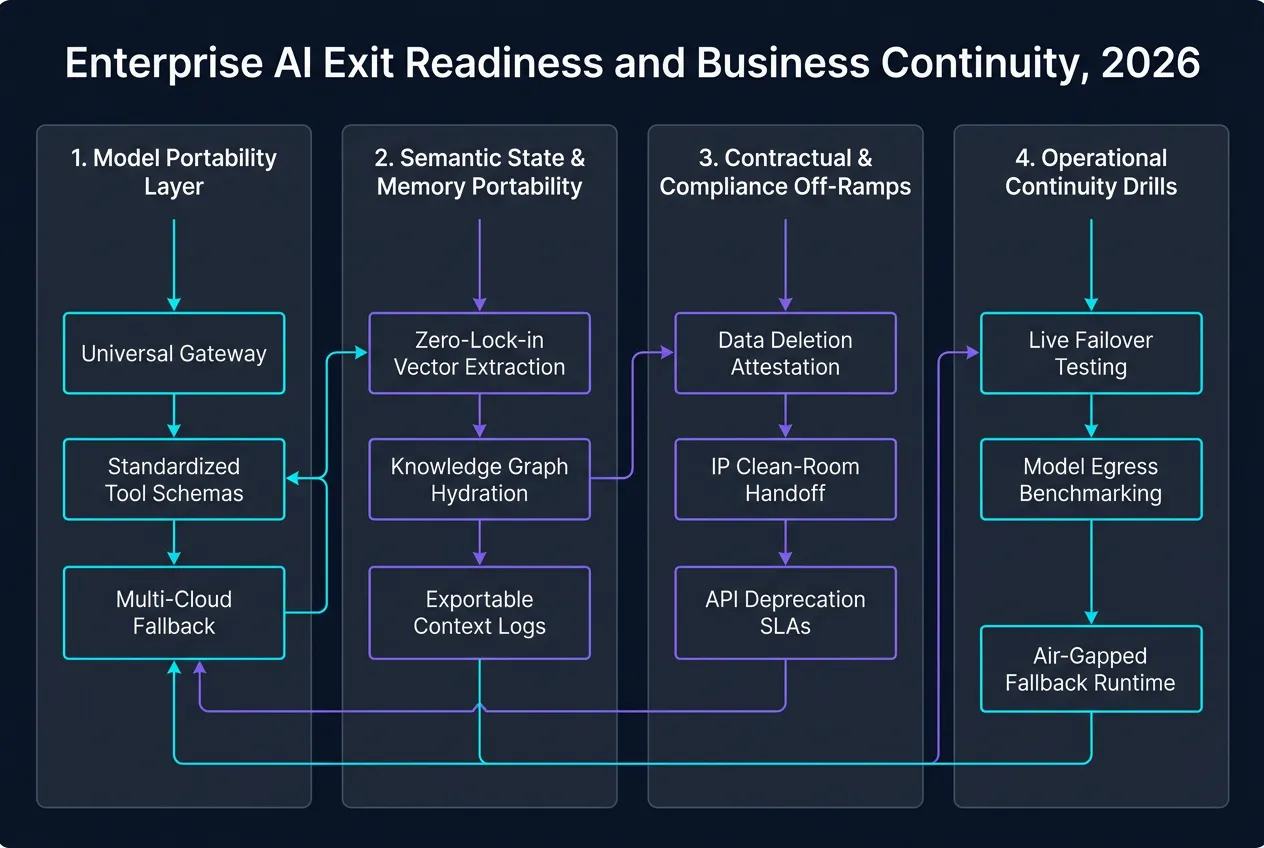
Engineering an enterprise AI environment capable of executing a zero-downtime off-ramp demands structural decoupling across four operational planes.
1. The Universal Model Portability Gateway
Enterprise software should never interact directly with underlying foundation model APIs. Instead, enterprise architectures mandate an internal AI Gateway layer that standardizes request and response schemas across all model endpoints.
- Standardized JSON Schema Contracts: Enforce uniform schema specifications for tool invocation, structured extraction, and streaming tokens. Adapters inside the gateway translate universal calls into vendor-specific API formats dynamically.
- Dynamic Multi-Provider Fallbacks: If a primary model provider experiences elevated latency, outage conditions, or breaking API deprecations, the gateway executes active circuit-breaking, rerouting execution to pre-evaluated secondary foundation models without code redeployment.
- Automated Regression Canaries: Continuous shadow evaluation runs sample traffic across secondary model endpoints, ensuring that backup model providers maintain parity in reasoning accuracy, compliance guardrails, and latency targets.
For teams deploying high-throughput multi-tenant environments, coupling gateway abstraction with detailed cost and token tracking provides immediate visibility into failover implications, as examined in Enterprise AI Gateway FinOps: Multi-Tenant Cost Attribution in 2026.
2. Semantic Memory and State Portability
Runtime state, conversational history, and vectorized knowledge must exist independently of vendor platforms.
- Dual-Model Vector Indexing: When embedding enterprise knowledge bases, organizations evaluate open, self-hosted, or cross-platform embedding models alongside commercial APIs. Critical retrieval-augmented generation (RAG) pipelines should maintain raw text corpora in vendor-neutral object stores so that re-indexing runs can be executed programmatically across alternative vector stores.
- Exportable Structured Memory: Context stores and long-term agent memory must be formatted as portable property graphs, relational state tables, or standard JSON context frames. Proprietary agent "assistants" whose memory resides exclusively on third-party servers introduce immediate single-point-of-failure vulnerabilities.
- Stateless Execution Runtime: Decouple agent planning engines from state storage. Ensuring that agents can restore their execution state from an external database allows rapid migration of agent workloads between different orchestration engines.
3. Contractual and Legal Off-Ramps
Technical portability is ineffective if enterprise vendor agreements fail to secure the legal rights and data guarantees necessary for an orderly transition.
- Enforceable Data Return and Deletion Attestation: Vendor contracts must mandate that upon termination, all enterprise fine-tuning weights, customer logs, context caches, and uploaded documents are delivered in standard industry formats and irreversibly deleted from vendor infrastructure, accompanied by an officer-signed certificate of destruction.
- Minimum Deprecation Notice SLAs: Enterprise master services agreements (MSAs) must guarantee a minimum of 180 days of continued access and support following any formal model retirement or breaking API deprecation announcement.
- Zero-Penalty Early Termination for Policy Changes: Enterprise buyers must secure unilateral exit rights if a model vendor alters its data training policies, updates its intellectual property indemnification terms, or modifies its Zero Data Retention (ZDR) commitments.
- Jurisdictional and Data Residency Safeguards: Cross-border data flows and foreign hosting mandates can trigger abrupt regulatory sanctions. Maintaining clear boundary controls ensures enterprise compliance remains resilient, as detailed in Enterprise AI Inference Boundaries: Data Residency vs Runtime Sovereignty.
4. Operational Continuity Drills (The "Chaos Monkey" for AI)
An exit plan that exists only as policy documentation is guaranteed to fail during an actual crisis. Leading enterprises treat AI exit readiness as an operational capability tested through scheduled disaster-recovery simulations.
- Quarterly Model Deprecation Drills: Without advance notice to application teams, platform engineers disable primary model API keys in staging environments to verify that multi-model routing gateways seamlessly divert traffic to secondary providers.
- Cold-Start Memory Hydration Tests: Systems restore agent memory graphs and historical context sessions into entirely distinct model families to measure accuracy degradation and identify prompt-incompatibility bottlenecks.
- Egress Speed and Cost Benchmarks: Teams simulate the extraction of all stored context logs, fine-tuning artifacts, and vector collections to verify that data egress bandwidth, export tool APIs, and cloud egress fees remain within acceptable recovery time objectives (RTO) and recovery point objectives (RPO).
How Does Regulatory Governance Accelerate Exit Readiness Mandates?
Regulatory frameworks worldwide are making AI business continuity a statutory obligation rather than an optional IT preference:
- EU Digital Operational Resilience Act (DORA): Mandates that financial institutions manage ICT third-party risk, explicitly requiring comprehensive exit strategies for critical third-party technology providers—including cloud AI services—to ensure operational continuity during vendor failures.
- NIST AI Risk Management Framework (AI RMF 1.0): Identifies third-party vendor dependence and supply-chain vulnerabilities as primary enterprise risks, establishing governance controls (GOVERN 6.1 and MANAGE 4.1) for monitoring vendor viability and establishing contingency failovers.
- Executive Oversight and CAIO Mandates: Enterprise risk committees and Chief AI Officers are increasingly held accountable for single-vendor concentration risk, requiring formal board-level reporting on AI supply-chain redundancy, as explored in Enterprise AI Governance Charter: CAIO Mandates and Decision Rights in 2026.
Summary Comparison: Vulnerable vs. Exit-Ready AI Architectures
| Architectural Layer | Vendor-Locked Enterprise | Exit-Ready Enterprise |
|---|---|---|
| API Integration | Direct calls to single commercial provider SDKs | Universal internal AI Gateway with schema abstraction |
| Failover Routing | Hardcoded endpoints requiring code changes | Dynamic circuit-breaking with multi-model fallback |
| Vector Storage | Proprietary vendor embeddings locked in SaaS | Dual-embedded or neutral embedding models with raw text store |
| Agent State | Stored on vendor platform threads | Externalized portable knowledge graph and relational context |
| Contractual Terms | Standard SaaS terms with 30-day change rights | 180-day deprecation SLAs, verified deletion, zero-penalty exit |
| Validation Method | Theoretical documentation | Quarterly unannounced failover drills and recovery benchmarking |
How long does an enterprise AI exit transition typically take?
In an unprepared enterprise with deep proprietary vendor coupling, rebuilding agent prompts, fine-tuning alternative models, and re-indexing vector embeddings typically takes 4 to 9 months of engineering effort. In an exit-ready architecture with standardized gateway schemas and portable state stores, shifting production traffic to a secondary foundation model requires less than 48 hours.
Does multi-model exit readiness increase ongoing operational costs?
While developing and maintaining abstraction gateways adds an initial 5% to 10% infrastructure overhead, multi-model architectures actually lower long-term operating costs. Enterprises leverage portable architectures to route commodity tasks to lower-cost open-weight models, reserve frontier models for complex reasoning, and negotiate superior volume discounts by eliminating vendor monopolistic pricing power.
Can open-weight models serve as an effective fallback for commercial frontier APIs?
Yes. High-performing open-weight models deployed in private cloud environments provide exceptional resilience as emergency failover runtimes. Even if an open-weight fallback exhibits a modest 5% delta in complex reasoning capabilities, maintaining uninterrupted operational throughput far exceeds the catastrophic cost of a total business shutdown.