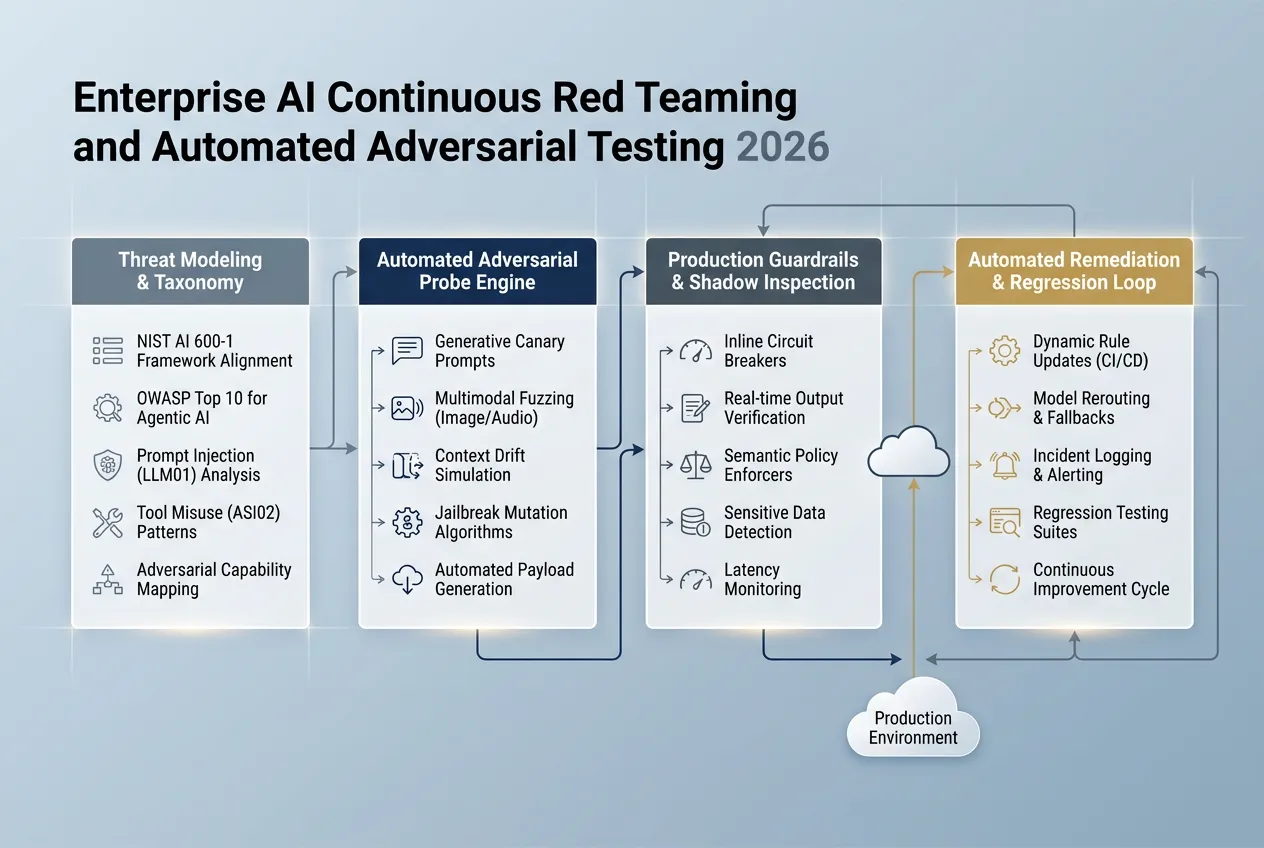
Enterprise AI continuous red teaming is the operational discipline of embedding automated, recurring adversarial testing into production agent pipelines to detect prompt injection, tool hijacking, and data exfiltration before malicious inputs or drifting agent states compromise core enterprise workflows. Unlike legacy penetration testing conducted as an annual checkpoint, continuous red teaming evaluates autonomous multi-agent trajectories against dynamic threat models—systematically verifying safety gates, model routing integrity, and permission boundaries at enterprise scale.
Why Does Enterprise AI Require Continuous Red Teaming Over Point-in-Time Audits?
In traditional software architectures, application code remains static between releases. Penetration testing once or twice a year can validate input validation and authentication boundaries effectively. In contrast, enterprise agentic systems operate probabilistically, ingest unstructured external data, call external APIs, and maintain persistent state across multi-turn sessions.
When an organization deploys autonomous agents into customer service, legal review, financial forecasting, or code generation, static security audits fail for three structural reasons:
- Non-Deterministic Exploit Surface: Large language models exhibit behavioral variance based on prompt context, system instructions, and tool outputs. An adversarial payload that fails on Monday may succeed on Wednesday if a downstream retrieval-augmented generation (RAG) corpus ingests new external documents.
- Autonomous Tool Execution (ASI02): Under the OWASP Top 10 for Agentic Applications, agent systems possess tool-execution privileges. A prompt injection attack does not merely extract text; it can instruct an agent to trigger bank wire transfers, issue e-signatures, modify database records, or exfiltrate customer records.
- Continuous Data Drift: RAG pipelines, external connectors, and real-time data synchronization continuously modify the context window of production models. As documented in our analysis of Multi-Agent State Synchronization, context drift degrades system predictability unless continuously validated under adversarial conditions.
What Are the Four Pillars of a Production Red Teaming Architecture?
Leading enterprise engineering organizations structure automated red teaming into a four-stage closed-loop pipeline:
1. Threat Modeling and Dynamic Taxonomy
Testing begins with a formalized threat catalog mapped directly to global standards, including the NIST AI 600-1 Generative AI Profile and the OWASP Top 10 for LLM Applications. Key vulnerability classes include:
- Direct and Indirect Prompt Injection (LLM01 / ASI01): Untrusted text hidden in web pages, PDFs, emails, or user queries instructing the model to bypass safety constraints.
- Privilege Escalation and Tool Misuse (ASI02 / ASI03): Inducing an agent to execute functions beyond the caller's authorized scope.
- Training and Context Poisoning (ASI06): Injecting malicious demonstrations or documents into persistent vector memory.
- Sensitive Information Disclosure (LLM06): Forcing models to reveal system instructions, API keys, or tenant PII.
2. Synthetic Adversarial Probe Generation
Rather than relying solely on human testers, enterprises deploy dedicated adversarial generation models ("attacker agents"). These models systematically mutate jailbreak prompts, generate linguistic encodings (e.g., Base64, multilingual translation, cipher obfuscation), and craft multi-turn conversational traps designed to erode system guardrails over extended interactions.
3. Shadow Execution and Canary Environments
Adversarial probes must not compromise production data or disturb end-user sessions. Modern architectures route synthetic adversarial traffic through isolated canary environments, mirroring production tool endpoints with sandboxed mock APIs and synthetic customer records. This aligns with the canary deployment architectures established in our guide to Production AI Agent Evaluation.
4. Automated Circuit Breakers and Dynamic Remediation
When an adversarial probe succeeds in bypassing semantic filters or executing an unauthorized action, the platform must trigger immediate operational controls:
- Inline Circuit Breakers: Automatically isolating the compromised tool endpoint or model route.
- Dynamic Policy Updates: Synthesizing the successful attack vector into negative constraints and updating semantic guardrails in real time.
- Incident Escalation: Stamping audit records with trace identifiers and dispatching engineering alerts for root-cause resolution.
How Does Continuous Red Teaming Align with ISO/IEC 42001 and NIST AI 600-1?
Enterprise compliance and legal leaders increasingly demand proof of ongoing risk management. While neither ISO/IEC 42001 nor NIST AI 600-1 prescribes a fixed daily testing frequency by name, both frameworks establish clear expectations for continuous technical evidence and performance evaluation.
| Assurance Framework | Clause / Function | Continuous Red Teaming Implementation |
|---|---|---|
| ISO/IEC 42001:2023 | Clause 9.1 (Monitoring, Measurement, Analysis & Evaluation) | Automated adversarial test runs provide continuous quantitative metrics on safety boundary resilience across all production deployments. |
| ISO/IEC 42001:2023 | Clause 10.2 (Continual Improvement) | Vulnerabilities identified by automated probes feed directly into prompt updates, model fine-tuning, and guardrail patches. |
| NIST AI 600-1 (2024) | MEASURE 2.5 & 2.6 (Adversarial Testing & Red Teaming) | Systematic testing across pre-deployment and post-deployment stages against prompt injection, data leakage, and harmful outputs. |
| NIST AI 600-1 (2024) | MANAGE 1.3 & 2.4 (Risk Treatment & Incident Response) | Automated quarantine of vulnerable agent endpoints when novel jailbreak patterns succeed. |
By maintaining an automated audit trail of red team probes and mitigation verification, enterprise legal teams can demonstrate proactive governance, directly mitigating liability under corporate due diligence standards and evolving regulatory mandates.
How Do Enterprises Balance Safety Testing with Inference Budgets?
Running thousands of complex multi-turn adversarial simulations against proprietary frontier models can dramatically increase monthly infrastructure expenditure. As explored in our framework on Enterprise AI Gateway FinOps, cost governance requires intelligent workload tiering:
- Tiered Model Routing: Attacker models and early-stage fuzzing engines utilize lightweight, highly efficient open-weights models to generate variations and screen obvious syntax weaknesses.
- Selective Frontier Escalation: Only attacks that successfully penetrate first-line semantic classifiers are escalated to expensive frontier models to evaluate multi-turn reasoning traps.
- Synthetic Deterministic Replay: Once an attack pattern is discovered, it is converted into a regression unit test executed in deterministic test harnesses, avoiding redundant frontier model generation during continuous CI/CD pipelines.
What is the difference between AI red teaming and traditional penetration testing?
Traditional penetration testing focuses on deterministic software vulnerabilities such as SQL injection, broken authentication, and buffer overflows in static code. AI red teaming evaluates non-deterministic cognitive boundaries, testing whether unstructured text, multimodal media, or adversarial system prompts can coerce a machine learning model into violating organizational policies, exfiltrating data, or executing unauthorized agentic actions.
How often should enterprise AI agents undergo adversarial testing?
In production environments with frequent model updates, tool integrations, or dynamic RAG knowledge ingestion, baseline automated adversarial suites should run continuously in CI/CD pipelines and shadow environments on a daily cadence. Deep multi-turn manual red teaming by specialized security teams should occur quarterly or whenever significant architectural changes are deployed.
Does continuous red teaming risk corrupting production data?
No. Enterprise continuous red teaming must strictly execute against isolated shadow canary environments utilizing synthetic data and sandboxed API endpoints. Production agents are tested using read-only canary probes and inline semantic guardrail validation, ensuring business-critical databases remain untouched.