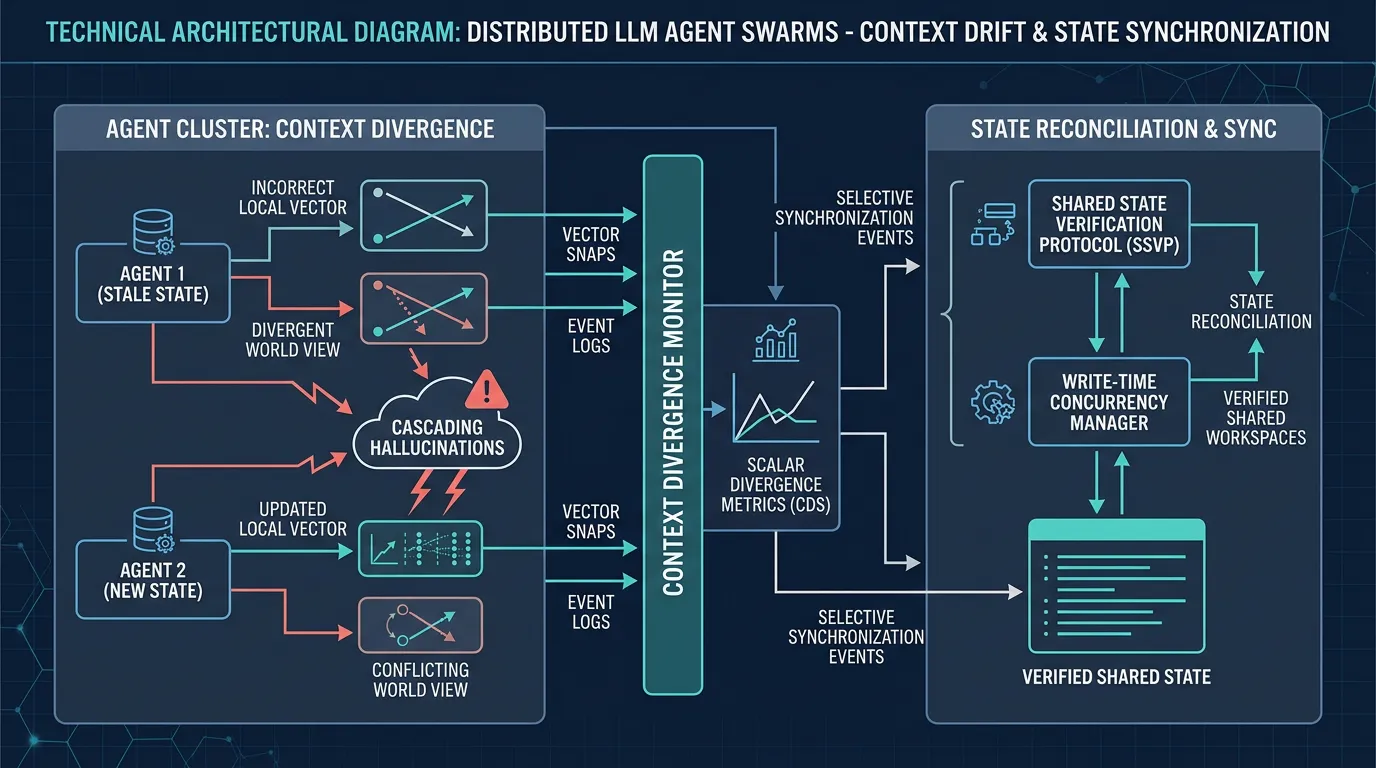
Multi-agent state synchronization protocols eliminate cascading hallucinations in distributed LLM systems by replacing naive context broadcasting with divergence-triggered verification and write-time concurrency controls. In production agent clusters, hallucinations frequently stem from context drift—asynchronous, unaligned local working memories across collaborating subagents—rather than single-model incapacity. By monitoring scalar divergence metrics and verifying shared workspace states before execution, engineering teams prevent silent contradictions and systemic task failure.
Why Do Multi-Agent LLM Systems Suffer From Context Drift?
In production multi-agent architectures, each autonomous agent maintains its own localized context window, reasoning trajectory, and tool execution history. As subagents work concurrently across distributed tasks, their internal representations of the shared environment inevitably diverge. One agent reads a file state at timestamp $T_0$, while a parallel agent modifies dependent services at $T_1$. Without deterministic state synchronization, the first agent acts on stale assumptions.
Recent empirical research by Suh et al. (Hallucination as Context Drift: Synchronization Protocols for Multi-Agent LLM Systems, arXiv:2606.21666, June 2026) demonstrates that multi-agent contradictions and task failures are primarily distributed synchronization failures rather than stochastic token hallucinations. When misaligned agents exchange reasoning without reconciling their underlying state assumptions, contradictory priors compound exponentially across execution graphs.
Crucially, naive solutions—such as broadcasting full conversational histories across all participating agents after every turn—fail catastrophically. The same research revealed that naive full-broadcast synchronization actually produced a severe surge in multi-agent hallucination rates (reaching a hallucination rate of 0.658 versus the uncoordinated baseline, $p=0.0022$). Full broadcasts pollute working context windows with irrelevant tokens, dilute attention over critical task constraints, and drive token expenses upward without establishing true consistency.
What Is the Context Divergence Score (CDS)?
To govern distributed agent execution without suffocating context windows, modern engineering stacks employ metric-driven drift detection. The Context Divergence Score (CDS) quantifies semantic discrepancy between two collaborating agents across spatial, temporal, and task-state dimensions:
$\text{CDS}(A_i, A_j) = \sum_{k \in {\text{spatial}, \text{temporal}, \text{task}}} w_k \cdot \mathcal{D}(\mathbf{v}{i,k}, \mathbf{v}{j,k})$
Instead of exchanging raw prompt transcripts, agents exchange compressed context vectors $\mathbf{v}$ summarizing:
- Active World State: Verified file hashes, API record pointers, and environment variables.
- Execution Trajectory: Completed subgoals and registered side effects.
- Pending Constraints: Immutable boundaries and resource allocations.
When $\text{CDS}(A_i, A_j)$ remains below an established operational threshold, subagents proceed autonomously without network overhead or token dilution. Only when the divergence score breaches the threshold does the orchestration fabric trigger a formal synchronization event.
How Does the Shared State Verification Protocol (SSVP) Work?
When context divergence breaches tolerance limits, the Shared State Verification Protocol (SSVP) activates a structured reconciliation phase rather than a blind context overwrite:
+-------------------------------------------------------------+
|                 Agent A (State S_A)                         |
+-------------------------------------------------------------+
                              |
                     CDS > Divergence Threshold
                              |
                              v
+-------------------------------------------------------------+
|               SSVP Verification Arbiter                     |
|  - Compares State Delta Assertions                          |
|  - Identifies Mutually Contradictory Invariants             |
|  - Resolves Stale vs. Fresh Dependency Graph                |
+-------------------------------------------------------------+
                              |
                    Reconciled Invariants
                              |
                              v
+-------------------------------------------------------------+
|                 Agent B (State S_B)                         |
+-------------------------------------------------------------+
Under SSVP:
- Targeted Delta Exchange: Agents exchange structured delta packets (JSON schemas detailing explicit variable updates) rather than unstructured narrative histories.
- Explicit Conflict Adjudication: If Agent A and Agent B hold conflicting assertions regarding external resources, the system invokes an arbiter prompt specifically focused on reconciling the discrepancy before downstream tools are invoked.
- Idempotency Checkpoints: Shared workspace states are registered in an append-only transaction ledger, preventing circular overwrites.
As established by Liu et al. (Multi-Agent Collaboration with State Management, arXiv:2605.20563, May 2026), managing shared workspace interactions through write-time concurrency detection (the STORM framework) outperforms traditional isolated Git-worktree architectures on multi-agent software engineering benchmarks (Commit0-Lite). Resolving state collisions at write time prevents divergent agents from committing corrupted artifacts to production environments.
What Are the Core Architectural Patterns for Multi-Agent Consensus?
Designing resilient distributed agent systems requires adopting established distributed computing primitives adapted for non-deterministic model components:
| Architectural Pattern | Synchronization Mechanism | Token Overhead | Primary Failure Mode |
|---|---|---|---|
| Naive Full Broadcast | Global history concatenation | Extreme ($O(N^2)$ token growth) | Attention dilution; compounding hallucination rates |
| Periodic Snapshotting | Fixed-interval state dumping | Moderate ($O(N)$ periodic cost) | Stale window vulnerability between snapshots |
| Divergence-Gated (SSVP) | Vector distance triggering | Minimal (selective updates) | Requires calibrated divergence thresholds |
| Write-Time Concurrency (STORM) | Shared memory workspace locks | Low (deterministic schema checks) | Serialization bottlenecks on dense write graphs |
Engineering teams deploying production swarms must avoid treating agent communication as an open-ended group chat. Durable multi-agent systems treat context as a distributed database cache: localized reads are permitted, but state mutations require verification, structured schema alignment, and explicit conflict resolution.
Related Engineering Architecture Analyses
For deeper investigations into production agent reliability and memory systems, explore our engineering analyses:
- Agentic Memory Security and Privilege Isolation
- Hierarchical Agent Memory Production Architectures in 2026
- Production AI Agent Evaluation: Canaries, Shadow Gates, and Continuous Regression Harnesses in 2026
- Agent Tool Contracts: Valid JSON Is Not Verified Work
Frequently Asked Questions
What causes context drift in multi-agent LLM systems?
Context drift occurs when distributed agents execute concurrent tasks without synchronizing their local environment state. As individual agents interact with tools, external APIs, and document stores, their internal working memories diverge, resulting in conflicting assumptions that manifest as system-level hallucinations.
Why does broadcasting full context histories increase hallucinations?
Indiscriminately broadcasting complete prompt histories across all agents floods context windows with irrelevant tokens, dilutes the model's attention over crucial instructions, and increases contradiction risk. Research shows full-broadcast synchronization substantially increases hallucinations compared to uncoordinated execution.
How does write-time state management prevent agent conflicts?
Write-time concurrency management, such as the STORM architecture, intercepts proposed mutations to the shared workspace before they commit. By checking state invariants and schema consistency at write time, the system detects conflicting assumptions immediately rather than attempting costly retrospective reconciliations.