An enterprise AI gateway FinOps architecture establishes centralized control over multi-tenant LLM consumption by decoupling application code from foundation model providers, routing traffic through virtual API keys, and enforcing immutable token attribution at the gateway perimeter. As organizations transition from departmental pilots to scaled enterprise deployments, unallocated model spend and opaque provider billing threaten operating margins. By pairing real-time token telemetry with dual-axis rate limiting, prompt prefix cache optimization, and automated chargeback ledgers, enterprise technology leaders achieve deterministic cost attribution without degrading developer velocity.
Why Do Traditional Cloud Cost Models Fail for Enterprise AI?
Traditional cloud infrastructure FinOps relies on predictable server provisioning, container autoscaling metrics, and static resource tagging (such as AWS Cost Allocation Tags or Azure Resource Groups). However, foundation model inference introduces dynamic, non-linear cost mechanics that break conventional FinOps patterns:
- Non-Deterministic Token Consumption: A single user query can trigger an autonomous agentic loop executing dozens of multi-step tool calls, compounding input and output token counts unpredictably.
- Asymmetric Input vs. Output Pricing: Across major foundation model providers, generated output tokens are priced 3x to 5x higher than processed input tokens, creating significant cost divergence depending on task structure (e.g., code generation versus document extraction).
- Dispersed Direct-to-Provider Keys: When business units independently acquire model API keys directly from cloud providers or model labs, telemetry scatters across disjointed vendor consoles, making cross-departmental spend reconciliation nearly impossible.
- Prompt Cache Volatility: Emerging provider discounts for cached prompt prefixes (which often reduce the cost of repetitive input tokens by half or more) depend heavily on prompt structure and eviction windows. Without centralized gateway caching policies, teams miss substantial structural discounts.
According to the FinOps Foundation's FinOps for AI Framework (2026), failure to establish unified gateway attribution is among the leading drivers of unexpected enterprise AI budget overruns, with unallocated model spend frequently representing a substantial fraction of total inference expenditures.
How Does an Enterprise AI Gateway Enforce Virtual Key Attribution?
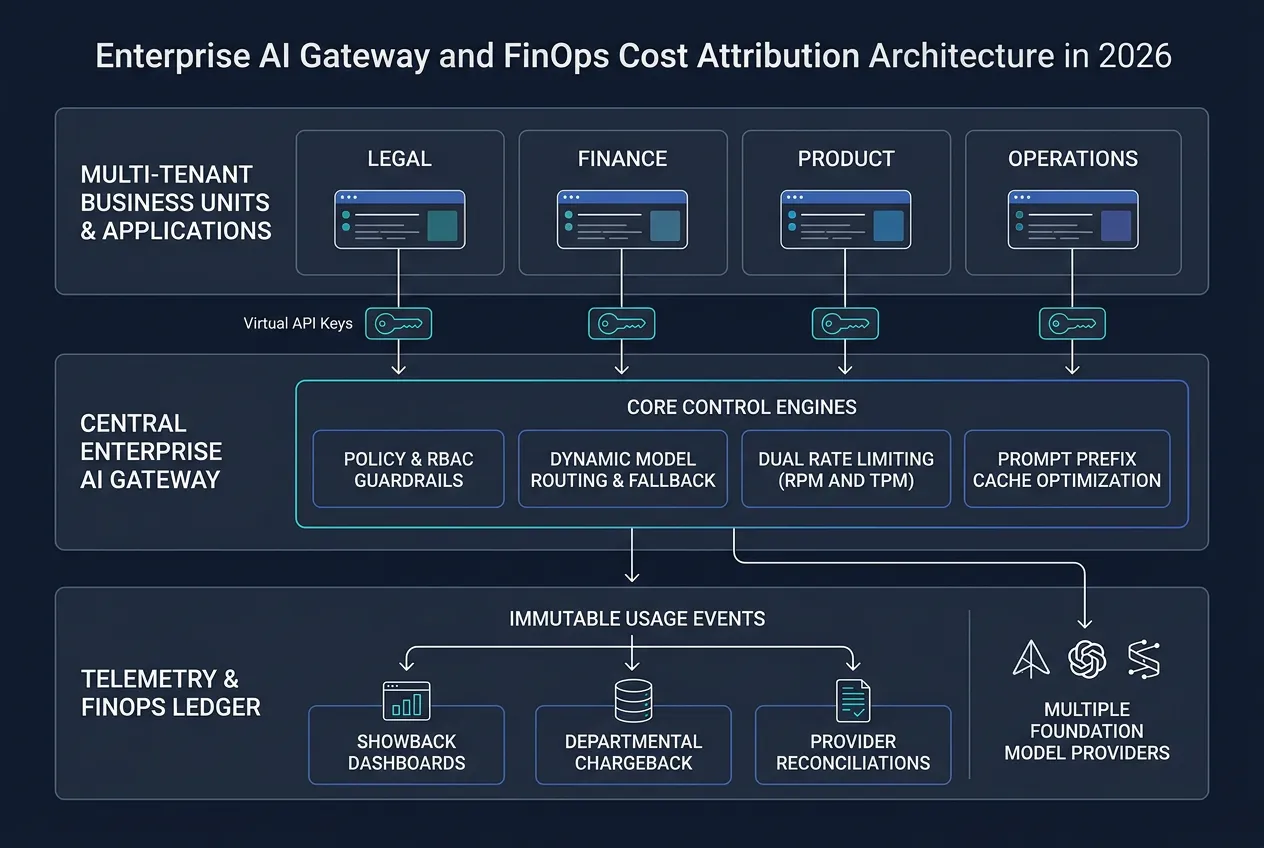
An enterprise AI gateway acts as an authenticated reverse proxy sitting between internal applications and external model providers. Rather than distributing raw foundation model API credentials to software engineering teams, the gateway issues virtual API keys mapped to a strict hierarchical metadata schema:
$\text{Request Attribution} = {\text{Organization ID}, \text{Cost Center}, \text{Department}, \text{Application ID}, \text{Environment}, \text{User ID}}$
+-------------------------------------------------------------+
|    Client Applications (Legal, Finance, Product, CX)       |
+-------------------------------------------------------------+
                              |
                   Virtual Key + Metadata
                              |
                              v
+-------------------------------------------------------------+
|               Central Enterprise AI Gateway                 |
|  - Virtual Key Validation & RBAC Guardrails                 |
|  - Dual-Axis Rate Limiting (RPM + TPM)                      |
|  - Semantic & Prefix Prompt Cache Optimization              |
|  - Dynamic Fallback & Cost-Aware Model Routing              |
+-------------------------------------------------------------+
                              |
                   Server-Side Provider Keys
                              |
                              v
+-------------------------------------------------------------+
|          Foundation Model Providers (OpenAI, Anthropic,      |
|           Google Cloud Vertex AI, Self-Hosted vLLM)          |
+-------------------------------------------------------------+
                              |
                     Usage Telemetry Stream
                              |
                              v
+-------------------------------------------------------------+
|               Enterprise FinOps Ledger                      |
|  - Immutable Event Ingestion (Kafka/ClickHouse)             |
|  - Real-Time Showback Dashboards                            |
|  - Automated Monthly Departmental Chargeback                |
+-------------------------------------------------------------+
When an application invokes an endpoint, the gateway:
- Authenticates the Virtual Key: Validates that the requesting application and department are authorized to access the requested model tier and data boundary.
- Injects Provider Credentials Server-Side: Appends the master enterprise API key or IAM role for the destination provider, ensuring credentials never touch client-side applications or distributed repositories.
- Emits Immutable Usage Events: Generates an audit record capturing exact input tokens, cached prompt tokens, output tokens, latency (TTFT and end-to-end), model version, and business attribution tags.
What Are the Core Mechanisms of Gateway FinOps Governance?
Governing enterprise AI expenditures requires active runtime intervention rather than passive end-of-month invoice analysis. A modern enterprise AI gateway operationalizes four core control capabilities:
1. Dual-Axis Hierarchical Rate Limiting
Traditional API gateways throttle traffic solely on Requests Per Minute (RPM). In generative AI workloads, RPM rate limiting is insufficient: a single request containing a 100,000-token legal brief imposes drastically different computational and financial costs than a 50-token query. Advanced AI gateways implement simultaneous dual-axis quotas:
- RPM Thresholds: Mitigating denial-of-service and connection exhaustion.
- TPM (Tokens Per Minute) Allocations: Enforcing hard token quotas per application, team, and cost center.
2. Prompt Cache Optimization and Prefix Alignment
Foundation model APIs reward exact prefix matching by offering dramatic price reductions for cached input tokens (discounting cached prompt tokens substantially). However, minor variations in prompt headers, system prompts, or tool schemas invalidate provider cache trees. The gateway standardizes system prompt templates and tool definitions across enterprise applications, ensuring shared prompt prefixes hit provider cache thresholds reliably.
3. Dynamic Cost-Aware Routing and Graceful Degradation
Enterprise workloads rarely require frontier-grade flagship models for every task. By implementing semantic model routing, the gateway evaluates prompt complexity and SLA requirements:
- Routine classification, entity extraction, and embedding tasks are directed to cost-efficient, high-throughput models.
- Complex multi-step reasoning, contract negotiation, and code synthesis are routed to frontier reasoning tiers.
- If a preferred provider experiences transient rate limits or latency spikes, the gateway automatically fails over to an equivalent authorized model while logging the fallback cost delta.
4. Real-Time Token Budget Envelopes
Departments receive explicit monthly financial budgets configured within the gateway. When a business unit approaches predetermined operational thresholds, automated alerts notify engineering leads and FinOps managers. If spend breaches configured ceilings, the gateway can enforce soft throttles (routing traffic to lower-cost models) or hard blocks, preventing runaway autonomous agent loops from exhausting enterprise commitments.
How Do Organizations Transition from Showback to Departmental Chargeback?
Maturity in enterprise AI FinOps progresses through three distinct operational phases:
| FinOps Maturity Stage | Operational Focus | Primary Tools & Metrics | Organizational Impact |
|---|---|---|---|
| Stage 1: Visibility & Discovery | Cataloging dispersed shadow AI keys and consolidating provider billing into a single procurement master agreement. | Centralized invoice tracking; gross spend by provider; basic application tagging. | Eliminates rogue subscriptions; establishes baseline enterprise spend. |
| Stage 2: Granular Showback | Routing all internal AI traffic through the enterprise gateway and publishing departmental spend dashboards. | Virtual key telemetry; input vs. output token ratios; prompt cache hit rates; unit economics per query. | Fosters departmental accountability; reveals prompt inefficiencies and high-cost workloads. |
| Stage 3: Automated Chargeback | Feeding immutable gateway usage logs directly into enterprise ERP and financial accounting systems. | Automated monthly journal entries; internal cost recovery; departmental margin accounting. | Aligns AI infrastructure costs directly with business unit P&L; incentivizes prompt optimization. |
By treating model usage as an accountable utility rather than an untracked corporate overhead expense, organizations create a sustainable foundation for scaling autonomous workflows.
Related Enterprise AI Architecture Analyses
For additional strategic insights into enterprise AI governance and infrastructure, review our related publications:
- Enterprise AI Inference Boundaries: Data Residency vs Runtime Sovereignty
- Enterprise AI Governance Charter: CAIO Mandates and Decision Rights in 2026
- Enterprise Shadow AI Governance: Modernizing Corporate Procurement in 2026
- Enterprise AI Permission Readiness: Discovery Is Not Access
Frequently Asked Questions
What is the difference between an API gateway and an enterprise AI gateway?
While traditional API gateways manage authentication, routing, and rate limits for REST and GraphQL endpoints, an enterprise AI gateway specializes in the unique dynamics of foundation models. It manages token-based metering (TPM and RPM), multi-provider credential injection, prompt prefix cache optimization, semantic model routing, and granular FinOps chargeback ledgers.
Why is Request-Per-Minute (RPM) throttling insufficient for LLM cost control?
In generative AI workloads, cost is determined by token volume and model complexity rather than raw HTTP request count. A single request processing an extensive document repository can consume millions of tokens, generating hundreds of dollars in compute costs, whereas thousands of short status queries cost pennies. Controlling spend requires monitoring and capping Tokens Per Minute (TPM) alongside RPM.
How does prompt caching improve enterprise AI unit economics?
Modern foundation model providers offer significant discounts for input tokens that match previously processed prompt prefixes. An enterprise AI gateway standardizes common system prompts, organizational context, and tool schemas across teams, maximizing prompt cache hit rates and dramatically lowering operational inference costs across high-volume applications.