Dynamic tool discovery enables autonomous AI agents to query external tool registries at runtime, retrieve relevant tool definitions through semantic search or metadata filtering, and selectively bind JSON schemas into model context only when needed. Instead of bloating system prompts with static tool manifests that exhaust token budgets and degrade invocation accuracy, production architectures in 2026 decouple catalog registration from execution context. By combining cursor-paginated Model Context Protocol (MCP) servers, two-stage hybrid retrieval pipelines, and just-in-time schema injection, engineering teams scale agentic tool inventories to thousands of capabilities while keeping selection precision optimal.
Why Do Static Tool Manifests Break Down at Enterprise Scale?
Early autonomous agent frameworks relied on static tool declarations embedded directly into initial system prompts or API function-calling parameters. When an agent required access to five internal database queries and a calculator, this approach proved functional. However, enterprise production deployments routinely interface with hundreds of internal microservices, third-party software-as-a-service (SaaS) integrations, document processing engines, and customer support utilities.
Dumping hundreds of raw JSON schemas into an LLM context window creates three critical failure modes:
- Context Window Exhaustion and Token Economics: A single enterprise tool definition containing input validation constraints, property descriptions, nested objects, and error enumerations averages between 300 and 800 tokens. Registering two hundred enterprise tools consumes tens of thousands of prompt tokens on every turn of conversation. Across multi-turn agentic loops requiring fifteen to twenty-five reasoning steps, token costs compound exponentially while starving the model of reasoning context.
- Degradation of Tool Selection Accuracy: Benchmark evaluations on large-scale API datasets—such as ToolBench (covering over 16,000 APIs) and Berkeley Function-Calling Leaderboard (BFCL)—demonstrate that expanding context windows alone does not resolve selection errors. When models face sprawling tool lists, distraction and semantic overlap cause hallucinated parameters, wrong tool invocations, or outright execution paralysis. Empirical research reveals that simply expanding context windows to one million tokens still yields severe accuracy decay in dense tool-calling environments.
- Rigid Re-Deployment Cycles: Any modification to an underlying API endpoint, security parameter, or field requirement forces a full restart and cache invalidation of the host agent process. Decoupled microservices cannot evolve independently when agent clients rely on hardcoded tool manifests.
How Does the Model Context Protocol (MCP) Standardize Tool Discovery?
The Model Context Protocol (MCP) 2026 specifications provide a formalized client-server architecture that standardizes how language models connect to external tools, data resources, and system prompts. Rather than inventing proprietary integration harnesses for every database and API, enterprise engineering teams deploy modular MCP servers that expose standard discovery endpoints.
Under the MCP protocol specification, client runtimes interact with tool servers through standardized JSON-RPC 2.0 primitives:
{
  "jsonrpc": "2.0",
  "id": "req-discover-001",
  "method": "tools/list",
  "params": {
    "cursor": "eyJvZmZzZXQiOjEwMCwibGltaXQiOjIwfQ=="
  }
}
Key discovery mechanics within the MCP standard include:
- Opaque Cursor-Based Pagination: Enterprise servers managing extensive catalogs partition tool listings into discrete pages. The server returns a
nextCursortoken when additional tools exist. Clients must iterate through pages untilnextCursoris absent, treating cursor strings as completely opaque tokens to preserve server-side state isolation. - Dynamic Change Notifications (
notifications/tools/list_changed): When microservices deploy updates, add functions, or revoke permissions, MCP servers emit asynchronouslistChangedevent signals over stdio process pipes or Streamable HTTP connections. This informs agent orchestrators to invalidate local catalog caches without restarting agent reasoning loops. - Capability Negotiation via
server/discover: Clients and servers negotiate supported features—including response caching time-to-live (ttlMs), cache scoping (cacheScope), and dynamic routing headers (Mcp-MethodandMcp-Name)—allowing enterprise API gateways to inspect and authorize requests without parsing entire JSON payloads.
What Is the Architectural Flow of Schema Routing and Just-In-Time Ingestion?
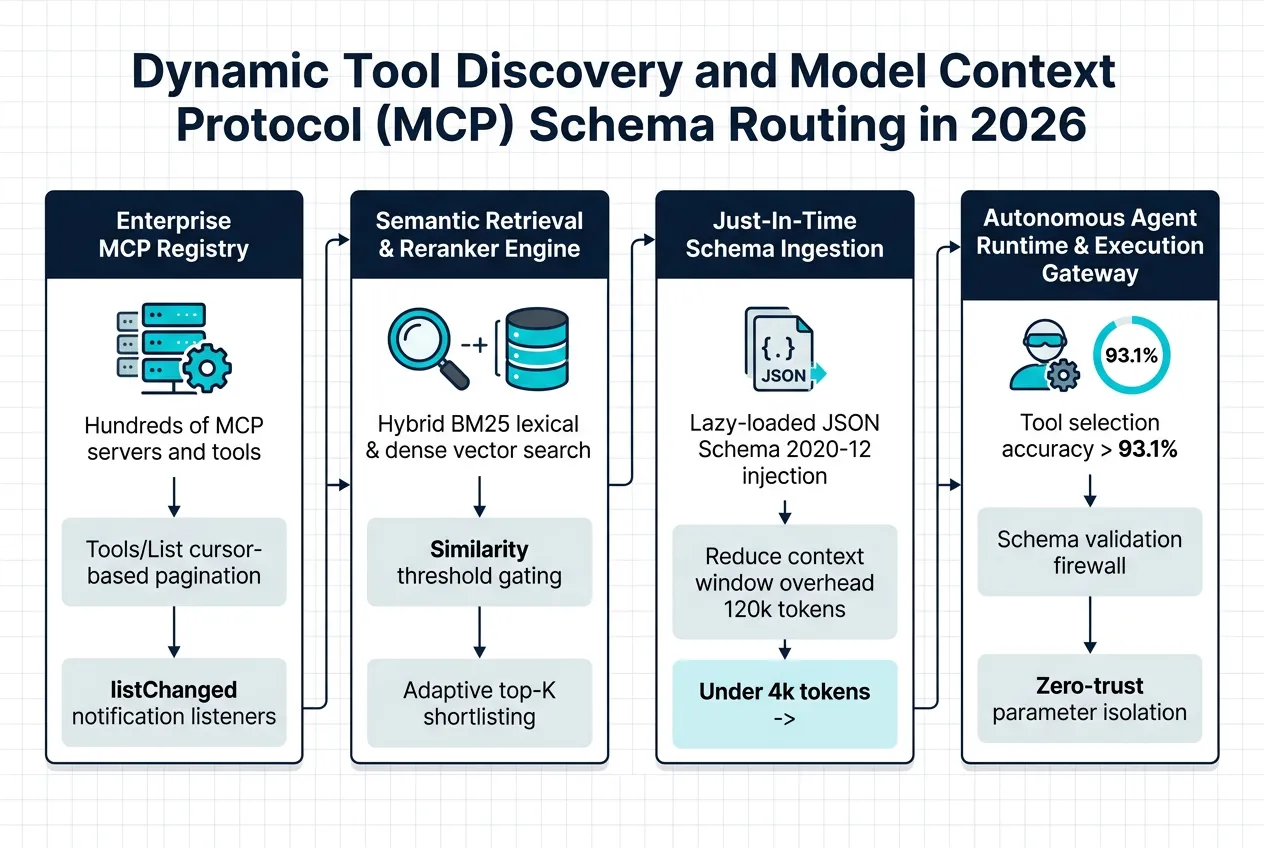
Production systems resolve the scale bottleneck by adopting a progressive discovery pattern: Discover → Filter & Rank → Inject Schema → Validate & Execute.
[ User Request / Trajectory State ]
                │
                ▼
┌──────────────────────────────────────────┐
│  Tier 1: Intent Analysis & Metadata Gate │
│  (Tenant ACLs, Domain Tags, Action Scope)│
└──────────────────────────────────────────┘
                │
                ▼
┌──────────────────────────────────────────┐
│  Tier 2: Hybrid Retrieval & Reranker     │
│  (Dense Embeddings + BM25 Lexical Index) │
│  Top-K Adaptive Shortlist (k = 3 to 7)   │
└──────────────────────────────────────────┘
                │
                ▼
┌──────────────────────────────────────────┐
│  Tier 3: Just-In-Time Schema Ingestion   │
│  (Hydrate JSON Schema 2020-12 into Context)
└──────────────────────────────────────────┘
                │
                ▼
┌──────────────────────────────────────────┐
│  Tier 4: Constrained Decoding & Execution │
│  (Strict Schema Verification & Sandbox)  │
└──────────────────────────────────────────┘
1. Catalog Indexing and Metadata Registration
At startup or upon receiving tools/list_changed notifications, the agent host queries connected MCP servers. The host extracts lightweight metadata records consisting of the tool name, single-sentence summary, category tags, and tenant access control list (ACL) identifiers. Full parameter schemas are kept off the model's active context and stored in a high-speed local cache or vector index.
2. Two-Stage Semantic Retrieval (ToolRAG)
When an agent encounters a reasoning step requiring external action, it invokes an internal semantic router or meta-tool (such as search_tools or discover_tools). A hybrid retrieval pipeline evaluates the agent's current task state:
- Lexical Matching (BM25): Matches exact API keywords, acronyms, and service codes (e.g.,
get_order_by_id,stripe_charge_refund). - Dense Vector Search: Employs cosine similarity over high-dimensional tool description embeddings to capture semantic intent (e.g., mapping "check customer account balance" to an internal ledger tool).
- Cross-Encoder Reranking: Re-scores the top candidate tools, producing an adaptive shortlist of three to seven high-confidence tools. Empirical evaluations on ToolBench show that adaptive shortlisting substantially improves tool selection precision compared to static embedding baselines.
3. Just-In-Time Schema Hydration
Once the reranker selects the candidate tools, the orchestrator retrieves their complete JSON Schema definitions from the registry cache and dynamically injects them into the model's active tool configuration for that specific inference turn. Context overhead drops from over one hundred thousand tokens to under four thousand tokens, preserving reasoning bandwidth and driving down latency.
4. Schema Validation and Sandboxed Execution
When the model outputs an invocation call, an inline schema validation firewall verifies that arguments strictly adhere to the declared schema constraints before dispatching the payload across the network to the target MCP server.
How Does Dynamic Tool Discovery Improve Security and Governance?
In enterprise environments, exposing every tool schema to an LLM poses substantial security vulnerabilities. Dynamic schema routing reinforces enterprise security across three core dimensions:
- Principle of Least Privilege and Role-Based Access Control (RBAC): Dynamic discovery engines filter tool catalogs against active caller credentials before retrieval. If an unprivileged user or agent lacks clearance for financial fund transfers, those tool schemas are excluded from retrieval candidates entirely. The agent cannot hallucinate or be prompted to invoke endpoints it cannot see.
- Mitigating Prompt Injection and Tool Spoofing: Attackers executing indirect prompt injection often attempt to trigger high-privilege tools. In a progressive discovery environment, high-privilege tool schemas are not loaded into context unless an authenticated step-up authorization token is explicitly attached to the agent trajectory.
- Audit Lineage and Schema Versioning: Every dynamic tool resolution event logs the exact schema hash, catalog version, and retrieval confidence score alongside distributed OpenTelemetry trace spans. Security teams maintain complete visibility into why a specific tool was recommended, loaded, and executed.
What Are the Operational Benchmarks and Implementation Trade-Offs?
Implementing dynamic tool discovery introduces trade-offs between architectural complexity, lookup latency, and invocation precision:
| Architecture Pattern | Catalog Scalability | Context Token Cost | Selection Accuracy | Runtime Latency Overhead |
|---|---|---|---|---|
| Static Manifest Injection | Low (under 50 tools) | High (dense prompt bloat) | Degraded on large catalogs | None (pre-loaded) |
Meta-Tool Pagination (tools/list) | Moderate (50 to 200 tools) | Moderate (accumulated pages) | Moderate (variable tool recall) | High (multiple LLM roundtrips) |
| Hybrid Retrieval + JIT Schema Hydration | High (tens of thousands) | Minimal (only active candidates) | High (isolated candidates) | Minimal (fast local cache lookup) |
To maximize system throughput, production deployments pair hybrid semantic routing with local schema caching, ensuring that retrieval overhead remains under thirty-five milliseconds—far lower than the latency of processing tens of thousands of redundant prompt tokens.
Frequently Asked Questions (FAQ)
What is dynamic tool discovery in autonomous AI agents?
Dynamic tool discovery is an architectural design pattern where an AI agent resolves and retrieves relevant tool schemas at runtime from an external catalog, rather than maintaining a hardcoded, static list of all available tools in its initial prompt context.
How does the Model Context Protocol (MCP) handle large tool catalogs?
MCP handles large tool inventories using cursor-based pagination on the tools/list endpoint, asynchronous notifications/tools/list_changed events when server capabilities update, and capability negotiation headers that allow enterprise gateways to route tool requests efficiently.
Why does loading all tool schemas into an LLM context cause errors?
Loading hundreds of tool schemas overwhelms model attention mechanisms with dense semantic noise. Research on ToolBench and the Berkeley Function-Calling Leaderboard demonstrates that excessive tool counts induce parameter hallucinations, incorrect tool selection, and severe performance degradation, even in models with large context windows.
How does just-in-time (JIT) schema injection reduce token costs?
JIT schema injection keeps complete parameter schemas in an external cache, passing only lightweight descriptions to a semantic search engine. Once three to five candidate tools are shortlisted, only their specific schemas are injected into the active prompt, cutting prompt overhead substantially.
What is ToolRAG?
ToolRAG is an implementation framework that treats tool definitions as retrievable documents. It indexes API descriptions using hybrid vector embeddings and lexical search, retrieving and ranking candidate tools based on the user's immediate query or the agent's current trajectory state.
Related Insights on Enterprise Agent Engineering
- Agent-to-Agent Handoff Protocols: Context Transfer in 2026 — Structuring deterministic state machine handoffs and capability discovery across distributed agent swarms.
- Agentic Tool-Calling Constrained Decoding: CFG Architectures in 2026 — Enforcing grammar-level schema adherence on model outputs using pushdown automata.
- Distributed Agent Tracing: OpenTelemetry Architectures for Production AI in 2026 — Instrumenting multi-tool execution pipelines with end-to-end W3C trace context propagation.