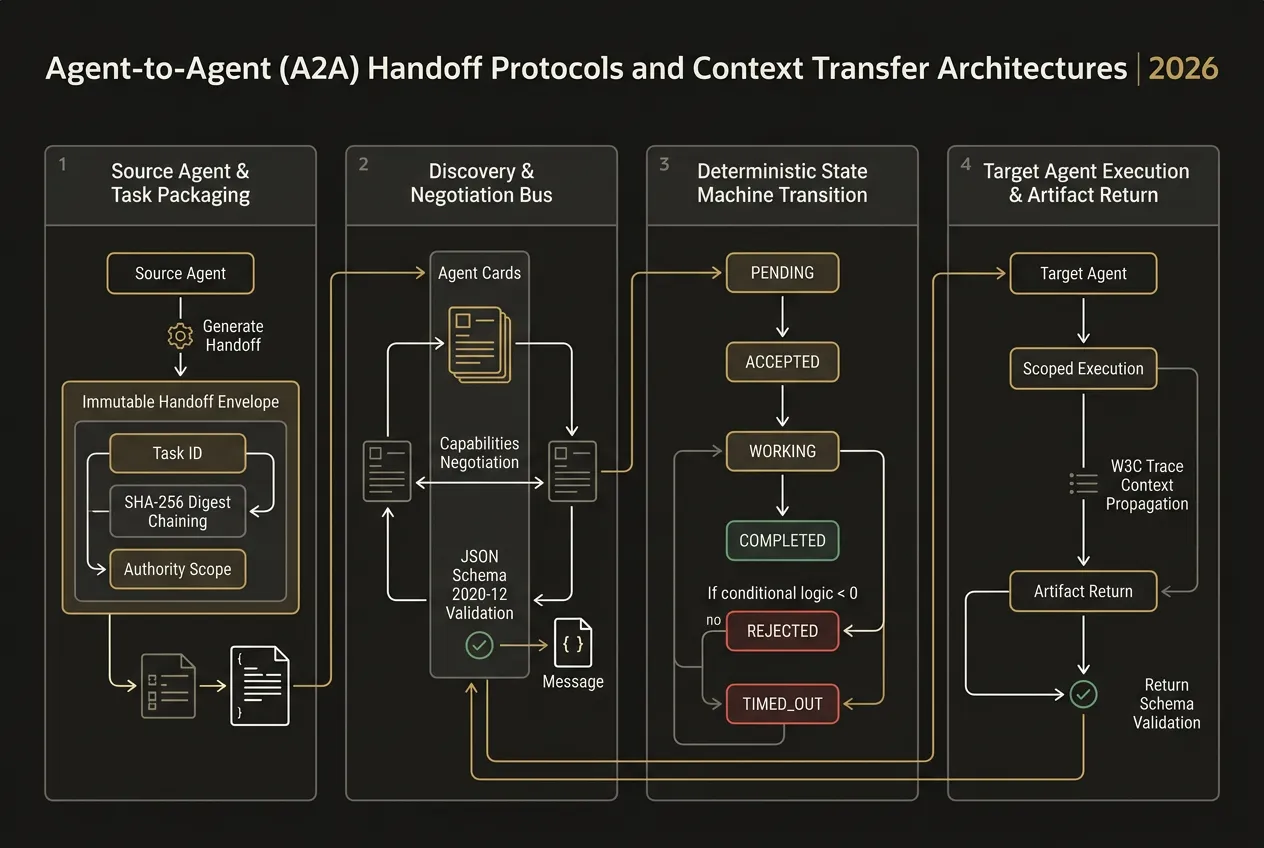
Agent-to-agent handoff protocols in 2026 standardize how autonomous AI agents transition task ownership, authority scopes, and conversational context across heterogeneous boundaries without prompt truncation or security degradation. By replacing unstructured natural language context dumping with typed, cryptographically bound handoff envelopes, deterministic state machines, and bidirectional contract schemas, multi-agent architectures achieve provable execution guarantees across distributed enterprise workflows.
Why did raw prompt dumping fail in production multi-agent systems?
Early multi-agent implementations relied on an intuitive but fundamentally brittle pattern: when Agent A finished a preliminary step, it serialized its entire conversation history and injected it verbatim into the system prompt of Agent B. In simple two-agent demonstrations, this approach appeared functional. In production enterprise architectures running multi-turn, multi-day trajectories across specialized workers, raw context dumping caused immediate operational failures:
- Context Window Saturation and Quadratic Latency: Ingesting unpruned trajectory tokens from upstream agents rapidly consumes target context windows, driving up inference latency and compute costs while diluting model attention over task-critical instructions.
- Context Poisoning and Prompt Injection Passthrough: When an upstream agent processes untrusted external data (such as web documents, incoming emails, or customer attachments) and dumps raw transcripts into downstream agents, any prompt injection or adversarial hallucination bypasses security filters and directly contaminates downstream execution environments.
- Loss of Deterministic Execution State: Unstructured natural language provides no formal contract regarding whether an upstream task was fully completed, partially satisfied, or blocked. Downstream agents are forced to perform fuzzy probabilistic inference to deduce their operational mandate.
- Authority Scope Creep: Without explicit permission boundaries, an agent inheriting an open context window frequently inherits ambiguous execution rights, violating least-privilege principles across sensitive database writes, API mutations, and external communications.
What are the core architectural layers of an Agent-to-Agent handoff protocol?
Modern enterprise multi-agent collaboration decouples agent discovery, task negotiation, and state transfer into formal, standardized architectural layers:
┌────────────────────────────────────────────────────────────────────────┐
│                        1. Discovery & Capability                        │
│         Signed Agent Cards (A2A Specification v1.0.0 / JSON Schema)    │
└───────────────────────────────────┬────────────────────────────────────┘
                                    │
┌───────────────────────────────────▼────────────────────────────────────┐
│                    2. Structured Handoff Envelope                      │
│        Typed Payloads · Authority Attenuation · Chained SHA-256 Digests│
└───────────────────────────────────┬────────────────────────────────────┘
                                    │
┌───────────────────────────────────▼────────────────────────────────────┐
│                  3. Deterministic Lifecycle FSM                        │
│   PENDING ──► ACCEPTED ──► WORKING ──► COMPLETED (or REJECTED/TIMEOUT)  │
└───────────────────────────────────┬────────────────────────────────────┘
                                    │
┌───────────────────────────────────▼────────────────────────────────────┐
│                 4. Distributed Telemetry & Auditing                    │
│      W3C Trace Context (traceparent) · OpenTelemetry GenAI Spans       │
└────────────────────────────────────────────────────────────────────────┘
1. Agent Discovery via Machine-Readable Agent Cards
Standardized under the Agent2Agent (A2A) Protocol v1.0.0—released as a production standard on March 12, 2026, and governed under the Agentic AI Foundation—remote and specialized agents publish structured Agent Cards. An Agent Card is a cryptographically signed JSON manifest defining:
- Agent Identity & Verification: Public key infrastructure (PKI) credentials and tenant namespace.
- Skill Endpoints & Input Schemas: OpenAPI and JSON Schema 2020-12 definitions of invocable capabilities.
- Security & Authentication Requirements: Supported OAuth 2.0 Token Exchange (RFC 8693) profiles and mutual TLS requirements.
- Service Level Guarantees: Target latency, timeout thresholds, and concurrent task limits.
2. The Structured Handoff Envelope
Rather than transferring conversational conversational transcripts, the initiating agent constructs an immutable Handoff Envelope. This envelope isolates the operational payload:
{
  "$schema": "https://specs.prest0.ai/schemas/2026/agent-handoff.json",
  "handoff_id": "hnd_8f12c9b4_4102_4b9a",
  "task_id": "tsk_019a3b82_77cd_4ef1",
  "context_id": "ctx_66b189d2_0219_4821",
  "traceparent": "00-4bf92f3577b34da6a3ce929d0e0e4736-00f067aa0ba902b7-01",
  "sender": {
    "agent_id": "agent_triage_orchestrator",
    "version": "2.4.1",
    "instance_uri": "urn:prest0:agent:triage:us-east-1"
  },
  "recipient": {
    "agent_id": "agent_legal_doc_drafter",
    "required_skill": "draft_commercial_contract"
  },
  "objective": "Draft California-compliant SaaS Master Services Agreement from negotiated redline terms.",
  "context_summary": "Intake completed; counterparty requested mutual indemnification cap at 2x annual contract value.",
  "artifacts": [
    {
      "artifact_id": "art_term_sheet_v3",
      "mime_type": "application/json",
      "digest_sha256": "e3b0c44298fc1c149afbf4c8996fb92427ae41e4649b934ca495991b7852b855",
      "uri": "vault://artifacts/2026/11/art_term_sheet_v3.json"
    }
  ],
  "authority_scope": {
    "allowed_tools": ["search_contract_clauses", "compile_docx"],
    "prohibited_actions": ["external_email_send", "database_mutation"],
    "max_compute_cost_pr0": 4.5,
    "timeout_seconds": 180
  },
  "return_contract": {
    "schema_uri": "https://specs.prest0.ai/schemas/2026/contracts/saas-msa-output.json",
    "delivery_mode": "async_callback",
    "callback_url": "https://api.prest0.ai/v1/agents/triage/callbacks/hnd_8f12c9b4_4102_4b9a"
  },
  "previous_handoff_digest": "3a7b8e192f0c8411d9426f8b22a019483321ef88421094ba1289cf01289b4182"
}
How does the deterministic handoff state machine operate?
Handoffs cannot remain stateless fire-and-forget events. In distributed multi-agent systems, network drops, worker crashes, and task rejections require an explicit, fault-tolerant finite state machine (FSM).
          ┌────────────────────────────────────────────────────────┐
          │                        PENDING                         │
          │         (Envelope validated against schema)            │
          └───────────┬────────────────────────────────┬───────────┘
                      │                                │
            [Target Accepts Task]              [Validation / Scope Fail]
                      │                                │
          ┌───────────▼────────────┐       ┌───────────▼───────────┐
          │        ACCEPTED        │       │       REJECTED        │
          │  (Worker allocated)    │       │ (Envelope bounced back│
          └───────────┬────────────┘       │  with error reason)   │
                      │                    └───────────────────────┘
            [Execution Initiated]
                      │
          ┌───────────▼────────────┐
          │        WORKING         │
          │ (Active tool execution)│
          └─────┬────────────┬─────┘
                │            │
       [Success]             [Execution Timeout / System Exception]
                │            │
┌───────────────▼────────┐ ┌─▼─────────────────────────────────────┐
│       COMPLETED        │ │                 FAILED                │
│ (Artifacts signed and  │ │      (Rollback / Saga compensation    │
│  returned via schema)  │ │       invoked by orchestrator)        │
└────────────────────────┘ └───────────────────────────────────────┘- PENDING: The initiating agent deposits the envelope onto the message broker or direct A2A task endpoint. The receiving agent validates the envelope against the agreed JSON Schema and verifies the
previous_handoff_digestsignature. - ACCEPTED: The receiving agent verifies that the requested
objectivefalls within its advertised Agent Card capabilities and that theauthority_scopeis sufficient to complete the task without requiring privilege escalation. It issues an explicit acknowledgment receipt. - WORKING: The receiving agent executes within an isolated sandbox. It binds the incoming W3C
traceparentto its internal OpenTelemetry spans, ensuring unbroken distributed observability across agent hops. - COMPLETED: The receiving agent validates its generated artifacts against the
return_contractschema, computes cryptographic hashes of all output files, signs the return envelope, and delivers the result via the designated callback or synchronous response. - REJECTED / FAILED / TIMED_OUT: If the recipient cannot fulfill the contract, the FSM transitions to terminal error states. The initiating agent or central orchestrator immediately triggers automated fallback routing or saga compensation without leaving orphaned system resources.
What security safeguards prevent privilege abuse and context poisoning?
Operating multi-agent handoffs in high-stakes enterprise and legal environments requires rigorous defensive boundaries:
Cryptographic Digest Chaining
As defined in emerging specifications like the IETF Signed Handoff Context framework, each sequential handoff envelope contains a cryptographic hash (SHA-256) of the prior handoff envelope. This creates an immutable, tamper-evident audit ledger of task delegation. If an intermediate agent alters instructions, fabricates completed work, or attempts unauthorized privilege escalation, downstream validation fails immediately.
Explicit Authority Scope Attenuation
Borrowing from capability-based security models, an initiating agent can never grant a recipient agent permissions exceeding its own authority. Furthermore, the handoff envelope enforces authority attenuation: the delegated permissions represent an intersection of the sender's scope, the recipient's advertised capabilities, and the minimal rights necessary for the subtask (Authority = Scope_Sender ∩ Scope_Recipient ∩ Task_Minimal).
Context Distillation Over History Forwarding
To eliminate prompt injection passthrough, enterprise handoff protocols mandate context distillation. Instead of forwarding unverified conversational turns, the initiating agent extracts structured key-value entities, verified database IDs, and sanitized artifact URIs. The receiving agent initializes its cognitive prompt strictly from validated schemas and trusted artifact storage vaults.
How does Agent-to-Agent (A2A) compare with Model Context Protocol (MCP)?
A frequent architectural question in 2026 is whether organizations should implement A2A handoffs or Anthropic's Model Context Protocol (MCP):
| Architectural Dimension | Model Context Protocol (MCP) | Agent-to-Agent Protocol (A2A) |
|---|---|---|
| Primary Focus | Agent-to-Tool / Agent-to-Data integration | Agent-to-Agent collaboration and delegation |
| Communication Topology | Client-to-Server (star architecture) | Peer-to-Peer or Hierarchical Agent Swarms |
| Payload Semantics | Tool calls, resource reads, prompt templates | Long-running tasks, state handoffs, artifacts |
| Execution Ownership | Client agent retains entire reasoning loop | Recipient agent assumes autonomous ownership |
| Lifecycle Model | Request / Response tool execution | Stateful FSM (Pending, Working, Completed) |
| Identity & Scope | Server authentication (API keys, OAuth) | Mutual Agent Cards, delegated authority scopes |
In production architectures, MCP and A2A operate in synergy. An orchestrator agent uses A2A protocols to hand off a complex legal review task to a specialized analysis agent. Once the specialized agent accepts the task envelope, it uses local MCP connections to query internal document repositories, invoke vector databases, and execute sandboxed code.
What are the key engineering metrics for evaluating handoff reliability?
Deploying multi-agent handoff architectures requires tracking core reliability indicators:
- Handoff Contract Adherence Rate: The percentage of handoff envelopes that successfully validate against target schemas on the first attempt without schema rejection.
- Context Distillation Compression Ratio: The reduction in token volume achieved by serializing structured artifacts and summaries compared to naive conversational context forwarding.
- End-to-End Trajectory Latency: Cumulative duration from initial delegation to completed artifact return, inclusive of queue wait and worker cold-start times.
- Schema Validation Retry Rate: Frequency with which an agent's returned artifact violates the output contract and requires an automated self-correction loop.
What happens if an agent crashes while in the WORKING state?
Production handoff architectures pair the state machine with durable message queues or event backplanes (such as Apache Kafka or Temporal-backed orchestrators). If an active worker stops emitting heartbeats before reaching COMPLETED, the task state machine transitions to TIMED_OUT. A dead-letter queue (DLQ) alerts the supervising orchestrator, which spins up a replica worker, passes the original immutable handoff envelope and checkpointed state, and replays execution without losing upstream progress.
Can an agent hand off a task to multiple agents simultaneously?
Yes. In fan-out or swarm patterns, an orchestrator constructs distinct handoff envelopes with identical context_id references but unique task_id values and tailored authority_scope limits. The orchestrator tracks each sub-agent's FSM independently and waits for all return contracts to satisfy a synchronization barrier before aggregating outputs.
Why should conversational history be omitted from handoff envelopes?
Unstructured conversational histories introduce severe context poisoning vulnerabilities, expand token overhead quadratically, and degrade model reasoning. Packaging handoffs as structured entities and verified artifact references guarantees that the receiving agent receives unambiguous, tamper-evident instructions optimized for immediate execution.
For additional architectural guidance on multi-agent synchronization and distributed tracing, see our analyses on Agentic Memory Wire Format: Interoperability in 2026, Event-Driven Agent Architectures: Asynchronous Choreography in 2026, and Distributed Agent Tracing: OpenTelemetry Architectures for Production AI in 2026.