California SB 574 establishes the nation's first comprehensive statutory framework governing attorneys' and arbitrators' professional use of generative artificial intelligence, taking effect January 1, 2027. Under SB 574, legal practitioners are expressly permitted to integrate generative AI tools into their legal operations, provided they maintain non-delegable personal professional judgment, enforce strict confidentiality controls safeguarding nonpublic and identifying client information, and conduct independent verification of all generated legal authorities, factual assertions, and case citations prior to submission or client reliance.
What Does California SB 574 Mandate for Legal Practitioners?
Signed into law on September 30, 2026, California Senate Bill 574 represents a milestone shift from informal state bar ethics advisories to formal statutory discipline under the California Business and Professions Code. While court systems previously relied on disparate local standing orders and ethics opinions—such as California State Bar Practical Guidance on Generative AI and Florida Rule 2.515—SB 574 establishes clear statutory boundaries governing how licensed attorneys and commercial arbitrators deploy algorithmic tools.
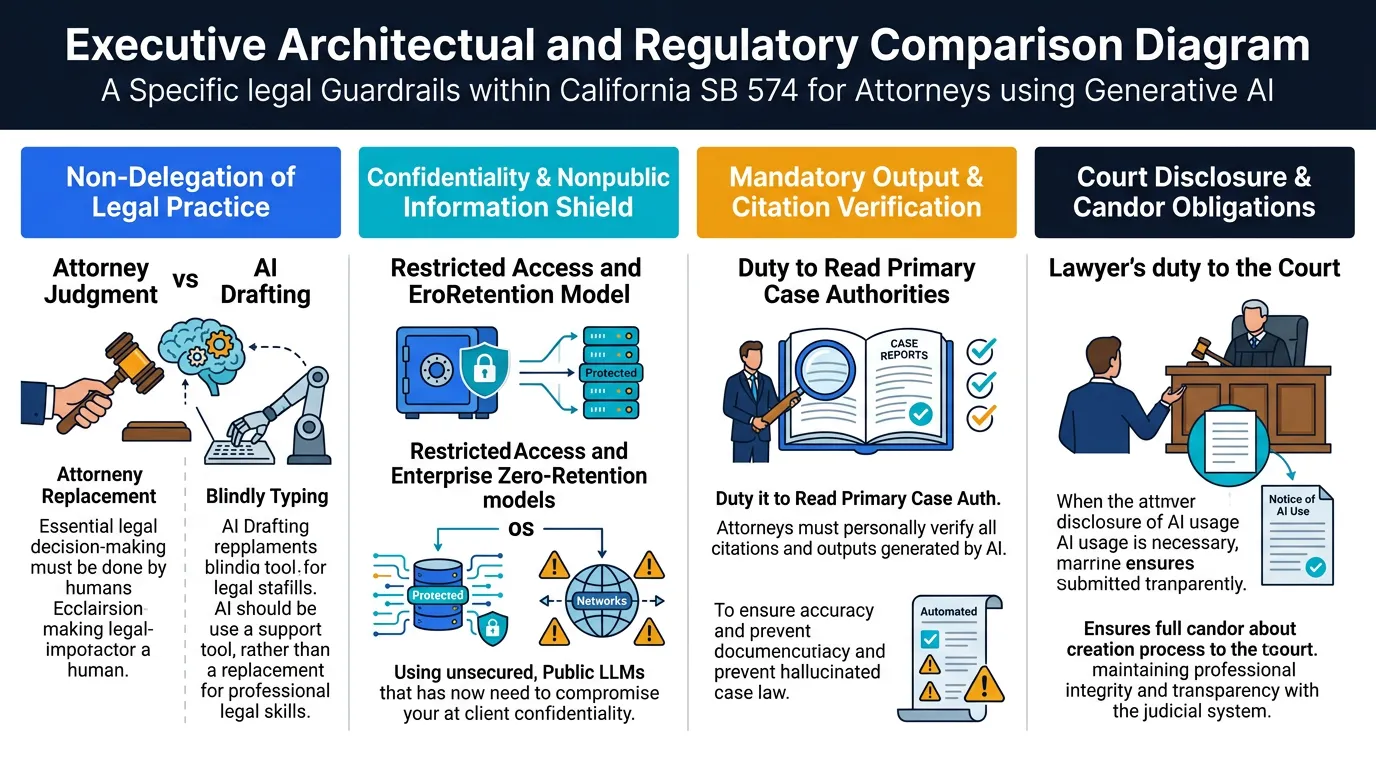
The statute's structural core rests on four immutable obligations:
- Non-Delegation of Core Legal Judgment: Attorneys may utilize generative models for research synthesis, document drafting, structural outlines, and factual extraction, but the ultimate exercise of legal analysis, case strategy, and client counsel remains non-delegable. The statute explicitly codifies that generative AI cannot act as counsel or provide unvetted legal determinations.
- Confidentiality and Data Protection Controls: Practitioners are legally prohibited from inputting confidential, personally identifying, or nonpublic client information into generative AI tools unless those systems operate under robust enterprise access controls and strict confidentiality agreements preventing external model training or secondary data ingestion.
- Mandatory Citation and Output Verification: SB 574 imposes an affirmative statutory duty on attorneys to independently verify all factual representations, legal reasoning, and case citations generated by AI systems against official primary sources prior to filing pleadings or advising clients.
- Candor and Compliance in Dispute Resolution: Arbitrators and attorneys in formal proceedings must adhere to strict conflict-of-interest standards and transparent technological competence benchmarks, preventing undisclosed algorithmic bias from tainting dispute resolution outcomes.
How Does SB 574 Enforce Client Confidentiality and Data Privacy?
Under California Business and Professions Code Section 6068(e), attorneys have long held an inviolable duty to preserve client confidences and secrets at every peril to themselves. SB 574 operationalizes this duty in the algorithmic era by establishing clear technical standards for what constitutes an acceptable AI deployment environment.
Consumer-grade AI interfaces—which routinely capture user prompts, session histories, and uploaded document attachments to fine-tune foundational base models or serve human review queues—are statutorily incompatible with client data protection under SB 574. To comply with the statute, law firms and enterprise legal departments must enforce rigorous infrastructure standards:
| Infrastructure Requirement | Non-Compliant Deployment (Consumer Tools) | Compliant Enterprise Standard (SB 574 Architecture) |
|---|---|---|
| Data Retention & Training | Vendor retains prompts/inputs for model training | Audited Zero Data Retention (ZDR) with training exclusion covenants |
| Access Control & Identity | Shared browser logins or consumer logins | Role-Based Access Control (RBAC) with OAuth delegation and MFA |
| Data Encryption | In-transit SSL with vendor-managed shared keys | Customer-Managed Encryption Keys (CMEK) and isolated virtual private clouds |
| Audit Logging | Ephemeral, vendor-controlled session history | Immutable administrative audit trails recording input provenance and user identity |
By requiring contractual guarantees and technical barriers against data leakage, SB 574 harmonizes statutory attorney obligations with modern Zero Trust architecture, ensuring that client secrets cannot inadvertently resurface in another user's prompt completions.
What Are the Mandatory Citation Verification Standards Under SB 574?
Hallucinated case law and phantom judicial citations have plagued federal and state dockets since 2023, drawing severe judicial sanctions under Rule 11 and state equivalents. SB 574 elevates citation verification from a discretionary court sanction into a direct statutory violation enforceable by the State Bar of California.
Under SB 574, an attorney who signs, files, or serves any court pleading, brief, motion, or discovery response containing unverified AI-generated legal authority cannot claim ignorance or technological error as an affirmative defense. The statute requires lawyers to demonstrate:
- Primary Source Cross-Checking: Every cited precedent must be verified directly against official appellate reporters, official court slip opinions, or certified commercial legal research databases.
- Shepardizing and KeyCiting: Practitioners must confirm that cited authorities remain good law, actively verifying that subsequent judicial history has not overruled, distinguished, or vacated the holding.
- Contextual Quote Validation: Quotations attributed to judicial opinions or statutory codes must be checked word-for-word against the primary text, eradicating fabricated judicial quotes synthesized by large language models.
How Does California SB 574 Compare to Judicial Standing Orders?
Prior to SB 574, trial attorneys navigated a chaotic jurisdictional patchwork of individual judicial standing orders across federal district courts and state superior courts. While individual judges in the Northern, Central, and Southern Districts of California implemented varying requirements—ranging from mandatory AI disclosure declarations to bans on specific commercial tools—SB 574 establishes uniform statewide baseline rules across all California legal practice.
For further analysis on jurisdictional variation and federal evidentiary gatekeeping, review our companion studies on California Court Rules for Artificial Intelligence, Federal Court AI Standing Orders: The 2026 Judicial Patchwork, and Federal Rule of Evidence 104: Preliminary Questions and Relevance Standards in 2026.
Frequently Asked Questions
Does California SB 574 require attorneys to disclose all AI usage to opposing counsel?
No. SB 574 does not impose a blanket mandatory disclosure requirement to opposing counsel simply because an attorney used generative AI for internal drafting, brainstorming, or research assistance. However, disclosure is strictly required when mandated by an individual trial judge's standing order, specific local court rules, or when the AI tool itself generates evidentiary material offered into the formal court record.
Can law firms use commercial consumer AI tools under SB 574?
Only if those tools provide verifiable contractual guarantees and technical configurations that prevent client inputs from being retained, viewed by third parties, or used for model training. Standard consumer-grade AI services with default telemetry and training retention violate SB 574's confidentiality mandates when exposed to nonpublic client information.
When does California SB 574 officially take effect?
California SB 574 was signed into law on September 30, 2026, and its statutory obligations governing attorneys and arbitrators officially take effect on January 1, 2027. Law firms and legal departments are currently executing compliance audits and vendor risk reviews ahead of the effective date.
How does SB 574 treat arbitrator use of generative AI in commercial disputes?
SB 574 imposes direct obligations on arbitrators, prohibiting them from delegating adjudicative reasoning, evidentiary weighing, or final award drafting to generative AI models. Arbitrators must maintain strict neutrality, prevent algorithmic bias, and ensure that dispute records and confidential trade secrets submitted during arbitration proceedings are fully protected against unauthorized data ingestion.