Federal courts in 2026 are actively dismantling the assumption that general professional conduct rules alone suffice for generative AI use. Across federal district courts and regional circuits, judges are codifying enforceable AI-specific standing orders and local rules. These mandates shift litigation teams from voluntary ethical guidelines to mandatory procedural obligations: formal certifications of independent human verification, strict zero data retention audits for criminal and civil discovery, and severe evidentiary sanctions for unverified citations or synthetic legal propositions.
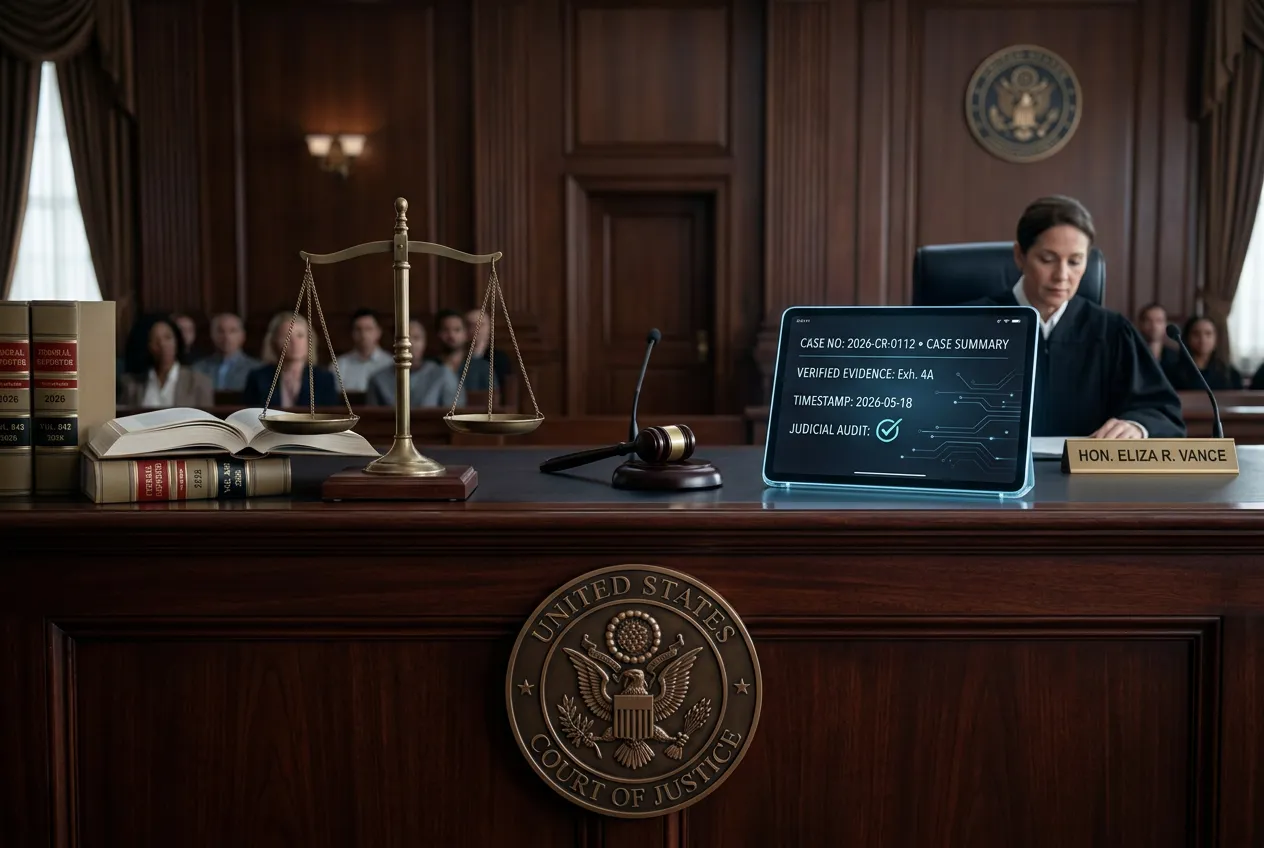
Litigation partners, general counsel, and enterprise compliance teams must recognize that there is no uniform national rule governing artificial intelligence in court filings. Instead, federal practice is characterized by a patchwork of district-wide local rules, division-level standing orders, and individual judicial chambers requirements that impose distinct legal burdens depending on where an action is filed.
How Are Federal Courts Structuring AI Standing Orders in 2026?
Federal judicial standing orders have evolved through three distinct regulatory architectures, each creating specific compliance hurdles for litigators:
- Mandatory Affirmative Certification (Filing-Level): Certain courts require every pleading, motion, or brief to carry an explicit certification regarding AI use, regardless of whether AI tools were employed in the drafting process.
- Conditional Usage Disclosure and Verification: Courts permit generative AI assistance only upon filing an affirmative "Certificate of Generative Artificial Intelligence Usage," attesting that every citation and quote was verified against official reporters by a licensed attorney.
- Strict Discovery Ingestion Prohibitions: Courts categorically restrict or condition the ingestion of sensitive evidentiary records into external AI software, penalizing unapproved data processing under federal protective orders.
| Jurisdiction & Authority | Regulatory Mechanism | Core Compliance Requirement | Non-Compliance Sanctions |
|---|---|---|---|
| E.D. Tex. (Beaumont Div.)<br>Standing Order MC-11 (July 20, 2026) | Certificate of Generative AI Usage | Mandatory filing disclosure when AI is used; certification of independent verification and non-disclosure of confidential/privileged information. | Striking of pleadings, Rule 11 monetary sanctions, disciplinary referral. |
| D. Colo. (Chambers Order)<br>Magistrate Judge Neureiter (Sept 22, 2026) | Universal Filing AI Certification | Every filing in consent cases must certify whether AI was used; requires human review of citations against official reporters. | Stricken filings without leave, show-cause orders, attorney fee shifting. |
| N.D.W. Va. (District-Wide)<br>Standing Order 1:26-MC-38 (June 16, 2026) | Criminal Discovery AI Ban | Strict prohibition on inputting sensitive criminal discovery into AI tools without government consent or court approval. | Evidentiary exclusion, contempt proceedings, disqualification of counsel. |
| D. Haw. (Judicial Guidance)<br>District AI Guidelines (2026) | Specific Tool Identification | Mandatory disclosure of exact tool/model version used and verified accuracy certification. | Document rejection, Rule 11 inquiry. |
What Does Eastern District of Texas Standing Order MC-11 Require?
On July 20, 2026, Judge Marcia A. Crone of the Beaumont Division of the Eastern District of Texas entered Standing Order MC-11, establishing a rigorous benchmark for federal litigators. Unlike district-wide Local Rule CV-11(g)—which took effect December 1, 2025, and mandates verification without requiring disclosure of the tool—MC-11 imposes an affirmative certification process for all civil and criminal cases.
Under MC-11, any party (including corporate entities, represented parties, and pro se litigants) submitting a pleading drafted or assisted by generative AI must attach a formal "Certificate of Generative Artificial Intelligence Usage." The certificate requires counsel to execute three binding attestations:
- Affirmative Disclosure: Express disclosure on the record that generative artificial intelligence was utilized in drafting or preparing the submission.
- Independent Primary Verification: Affirmative certification that every citation, factual proposition, statutory reference, and judicial quotation was verified against authoritative primary sources by human counsel.
- Privilege and Confidentiality Assurance: Affirmative certification that no client confidences, trade secrets, sealed discovery, or attorney work product were improperly disclosed or transmitted to third-party commercial model providers.
This structure bridges procedural integrity with evidentiary privilege, directly aligning with federal precedents such as United States v. Heppner, where unapproved disclosure to commercial AI systems resulted in complete waiver of attorney-client privilege.
Why Did the Northern District of West Virginia Restrict AI in Criminal Discovery?
On June 16, 2026, Chief Judge Thomas S. Kleeh issued Standing Order 1:26-MC-38 in the Northern District of West Virginia (In re Use of Generative Artificial Intelligence Tools to Review Criminal Discovery). The order addresses an acute vulnerability in modern trial practice: litigation teams batch-uploading sensitive government discovery into consumer or unvetted cloud AI engines.
Standing Order 1:26-MC-38 establishes that no defense team member—including attorneys of record, investigators, paralegals, retained experts, or technology consultants—may input, upload, or process "sensitive materials" through generative AI tools without prior written authorization from the government or an express order from the court.
The order defines sensitive materials expansively, encompassing:
- Unredacted grand jury transcripts and witness statements under 18 U.S.C. § 3500 (Jencks Act material).
- Wiretap recordings, intercepted electronic communications, and Title III surveillance summaries.
- Law enforcement reports disclosing confidential informant identities or uncharged co-conspirator data.
- Medical, psychiatric, tax, and personally identifiable financial records of third parties.
Even where authorization is granted, defense counsel must certify that the underlying AI platform operates under strict Zero Data Retention (ZDR) architecture, guarantees no human model-training review, and executes automated data purges upon session termination.
How Does Universal Certification Function in the District of Colorado?
In the District of Colorado, Magistrate Judge N. Reid Neureiter entered a landmark chambers order on September 22, 2026 (Standing Order Regarding the Use of Generative Artificial Intelligence in Court Filings). Unlike conditional rules that trigger only upon AI deployment, Judge Neureiter’s order institutes a Universal Certification requirement:
In every case where the parties have consented to magistrate judge jurisdiction, every filed motion, brief, or pleading must include an explicit AI Certification statement—stating either that no generative AI was used, or that human counsel independently read and validated every citation and legal premise against official reporters.
Filings submitted without the requisite certification block are summarily stricken without substantive review. Furthermore, the Tenth Circuit Court of Appeals has published proposed amendments to Tenth Circuit Rule 46.5 (targeted for effective implementation on January 1, 2027), which codifies appellate-level verification standards for AI-assisted briefs, signalling that chambers-specific orders are rapidly transitioning into circuit-wide rules.
What Standard of Care Does ABA Formal Opinion 512 Impose?
The proliferation of judicial standing orders reinforces the ethical baseline articulated by the American Bar Association in ABA Formal Opinion 512 (Generative Artificial Intelligence Tools, July 2024). Formal Opinion 512 establishes that relying on unverified synthetic legal analysis violates core duties under the Model Rules of Professional Conduct:
- Competence (Model Rule 1.1): Counsel must maintain technological competence, understanding the risk of hallucinated citations, synthetic quotes, and algorithmic bias before incorporating AI into client deliverables.
- Confidentiality (Model Rule 1.6): Submitting non-public client facts into consumer AI models without explicit informed client consent constitutes an impermissible disclosure under Model Rule 1.6(a).
- Candor Toward the Tribunal (Model Rule 3.3): Filing synthetic authority, inaccurate syllabus notes, or mischaracterized holdings violates the fundamental duty of candor, exposing counsel to mandatory Rule 11 sanctions, as detailed in our analysis of Rule 11 AI Verification Sanctions.
- Supervisory Duties (Model Rules 5.1 & 5.3): Law firm partners and corporate legal departments must establish reasonable institutional safeguards governing how associate attorneys, paralegals, and outside vendors utilize generative AI.
Frequently Asked Questions (FAQ)
Is there a single federal court rule governing AI in 2026?
No. As of October 2026, there is no single nationwide Federal Rule of Civil Procedure or Federal Rule of Appellate Procedure governing artificial intelligence. Requirements vary widely across circuits, districts, and individual judicial chambers, ranging from universal certification to total criminal discovery bans.
What happens if an attorney fails to attach an AI certification where required?
Filings that omit mandatory certifications are routinely stricken from the docket by clerk offices or judicial orders. In egregious cases involving unverified or fabricated citations, federal courts impose monetary Rule 11 sanctions, award opposing counsel attorney fees, issue show-cause directives, or refer attorneys to state disciplinary grievance committees.
Can law firms use enterprise AI platforms that guarantee Zero Data Retention?
Yes, provided the platform satisfies the specific court’s standing order. While consumer-grade LLMs that disclaim confidentiality routinely violate standing orders, enterprise legal AI architectures that enforce private tenancy, zero data retention, and cryptographic access controls satisfy both Model Rule 1.6 confidentiality and federal discovery protective orders.
Key Strategic Takeaways for Litigators in 2026
- Audit Judge-Specific Standing Orders at Case Inception: Never rely solely on national or local district rules. At the moment an action is assigned, litigation counsel must review the presiding judge's chambers rules for AI certification mandates.
- Implement Mandatory Human Primary-Source Verification: Establish an immutable firm-wide protocol: every citation, statutory section, and quotation extracted or generated by an AI assistant must be verified against official print reporters or validated legal databases by a human lawyer before filing.
- Isolate Sensitive Discovery from Consumer AI: Strictly prohibit personnel from uploading confidential commercial discovery or sensitive criminal material into general-purpose AI platforms lacking verified zero data retention guarantees.
This article is for general informational and educational purposes only and does not constitute formal legal advice. Litigators must consult local rules, individual chambers standing orders, and ethical opinions applicable to their specific jurisdiction.