Under evolving federal discovery jurisprudence in 2026, AI legal privilege and work product protection does not apply to consumer chatbot interactions, meaning unconstrained use of public artificial intelligence waives attorney-client privilege while litigation-directed prompts may qualify as protected work product under Federal Rule of Civil Procedure 26(b)(3) only when executed under strict contractual data isolation.
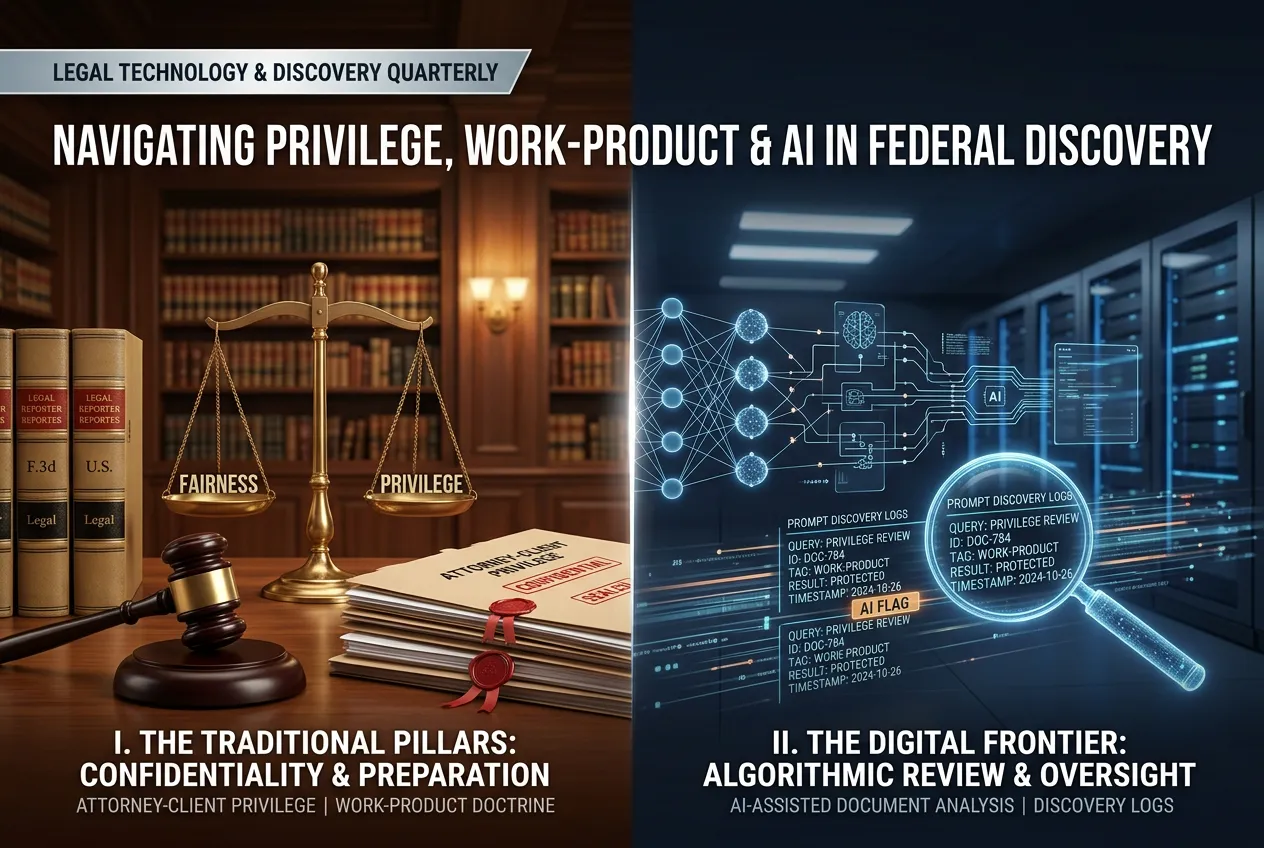
Why Is the Discovery of AI Prompts and Outputs Splitting Federal Courts?
The integration of generative artificial intelligence into legal research, case strategy, and drafting has precipitated an evidentiary crisis in federal litigation. Opposing counsel increasingly demand the production of prompt histories, document uploads, and synthetic work product generated by adverse parties during investigation and trial preparation.
Federal courts resolving motions to compel in 2026 have refused to recognize any novel "AI privilege." Instead, judges are strictly applying traditional common-law evidentiary doctrines to algorithmic interactions, creating a stark dichotomy between the attorney-client privilege and the work-product doctrine.
| Doctrine | Application to AI Interactions | Primary Risk Factor | Key 2026 Authority |
|---|---|---|---|
| Attorney-Client Privilege | No protection. AI is a technological tool, not a licensed attorney; third-party disclosure waives confidentiality. | Consumer Terms of Service permitting model training or employee review. | United States v. Heppner (S.D.N.Y. 2026) |
| Work-Product Doctrine | Conditional protection under FRCP 26(b)(3) if prepared in anticipation of litigation by or for counsel. | Failure to demonstrate counsel's mental impressions or using unvetted public systems. | Warner v. Gilbarco (E.D. Mich. 2026); Morgan v. V2X (D. Colo. 2026) |
| Protective Orders | Mandatory containment. Courts restrict uploading confidential discovery materials into non-enterprise AI. | Inadvertent waiver of trade secrets or statutory confidentiality. | Morgan v. V2X (D. Colo. 2026) |
What Did the S.D.N.Y. Hold in United States v. Heppner?
In United States v. Heppner (S.D.N.Y. Feb. 17, 2026), a criminal defendant represented by retained counsel independently accessed the commercial consumer tier of Anthropic's Claude to analyze his potential defenses, evaluate sentencing exposure, and draft trial narratives. When the Department of Justice subpoenaed and obtained the user's prompt transcripts and model responses, defense counsel moved to suppress the evidence, asserting both attorney-client privilege and work-product protection.
The Southern District of New York denied the motion in full, establishing three critical precedents:
- AI Cannot Form an Attorney-Client Relationship: The court held that an LLM is a technological utility, not a member of any bar. Communications directed to software cannot constitute confidential communications made for the purpose of obtaining legal advice from a lawyer.
- Standard Cloud Terms Defeat Reasonable Expectations of Confidentiality: The court closely scrutinized the commercial vendor's privacy policy and standard terms of service. Because the consumer terms reserved the right to use submitted data for system operation, security review, and potential human auditing, the defendant had no reasonable expectation of confidentiality. Submitting facts to the tool constituted voluntary disclosure to a third party.
- No Unilateral Work Product for Represented Litigants: The court held that the defendant's independent AI queries were not prepared "by or at the behest of counsel" and did not reflect trial counsel's core strategic mental impressions.
How Did Warner v. Gilbarco and Morgan v. V2X Protect AI Work Product?
In contrast to the total waiver found in Heppner, subsequent civil decisions in the Eastern District of Michigan and the District of Colorado carved out essential protections for litigation work product under Rule 26(b)(3).
Warner v. Gilbarco Inc. (E.D. Mich. Feb. 10, 2026)
In Warner v. Gilbarco Inc., a pro se plaintiff used ChatGPT to synthesize evidentiary records and outline deposition questions. The defendant moved to compel her entire prompt archive, arguing that disclosure to OpenAI waived any possible immunity.
Magistrate Judge Elizabeth Stafford rejected the defendant's motion, ruling that:
- AI is an analytical instrument, not an adverse third party.
- The work-product doctrine exists to protect the adversarial process and prevent free-riding on an opponent's trial preparation.
- Disclosing thoughts to software does not waive work-product protection unless the disclosure substantially increases the likelihood that an adversary will obtain the information. Because standard interactions do not publish records directly to opponents, opinion work product remains shielded.
Morgan v. V2X, Inc. (D. Colo. Mar. 30, 2026)
In Morgan v. V2X, Inc., the District of Colorado affirmed that using AI to assist in trial preparation does not forfeit work-product status. However, the court established strict guardrails, entering an evidentiary protective order that prohibited counsel and litigants from inputting designated "Confidential" discovery materials into any AI platform unless:
- The platform operates under an enterprise agreement contractually prohibiting model training on customer inputs.
- The environment guarantees zero data retention and eliminates third-party human review.
This analysis complements our broader examination of Rule 11 and Ethical Verification Requirements and Agentic Memory Security and Privilege Isolation.
What Are the Required Protocols for Law Firms and Corporate Legal Departments?
To safeguard evidentiary privileges while leveraging advanced AI operations, legal organizations must implement four foundational controls:
- Enterprise Zero-Retention Agreements: Ban all use of consumer-grade chatbots for firm or client matters. Enforce contractual provisions ensuring that model providers maintain zero data retention, disclaim training rights, and employ dedicated virtual isolation.
- Counsel Direction and Supervision: Ensure that all substantive AI research, analysis, and document review is performed directly by or under the explicit documented direction of counsel, anchoring the material firmly within Rule 26(b)(3) work-product doctrine and ABA Model Rule 5.3.
- Standard Protective Order Carve-Outs: Incorporate explicit provisions in Rule 26(f) discovery planning conferences and model protective orders addressing the secure use of enterprise AI tools for document review, synthesis, and trial preparation without waiver of privilege.
- Segregation of Direct Client Disclosures: Instruct clients never to conduct independent factual queries or case evaluations in public consumer AI tools without counsel coordination, preventing disastrous third-party waivers of the kind seen in Heppner.
Does typing confidential case facts into ChatGPT or Claude waive attorney-client privilege?
Yes. Under the doctrine articulated in United States v. Heppner and international rulings like Munir v Secretary of State, disclosing confidential client information to an AI platform operating under standard consumer terms that permit logging, human review, or model training constitutes a voluntary third-party disclosure that extinguishes attorney-client privilege.
Can opposing counsel subpoena a lawyer's prompt logs in discovery?
Generally no, provided the prompts were drafted by or at the behest of counsel in anticipation of litigation within an enterprise environment. Under Warner v. Gilbarco and Federal Rule of Civil Procedure 26(b)(3), attorney prompt logs reflect legal theories, case strategy, and mental impressions, qualifying as protected opinion work product that requires a showing of substantial need and undue hardship to discover.
How does enterprise zero-retention AI protect against waiver?
Enterprise architectures operating under zero data retention and strict confidentiality agreements satisfy the common-law standard for maintaining a reasonable expectation of confidentiality, analogous to using secure cloud document management or digital transcription services.
This analysis is prepared for educational and operational review and does not constitute formal legal advice. Application of evidentiary privileges is jurisdiction-specific and requires independent evaluation by licensed counsel.