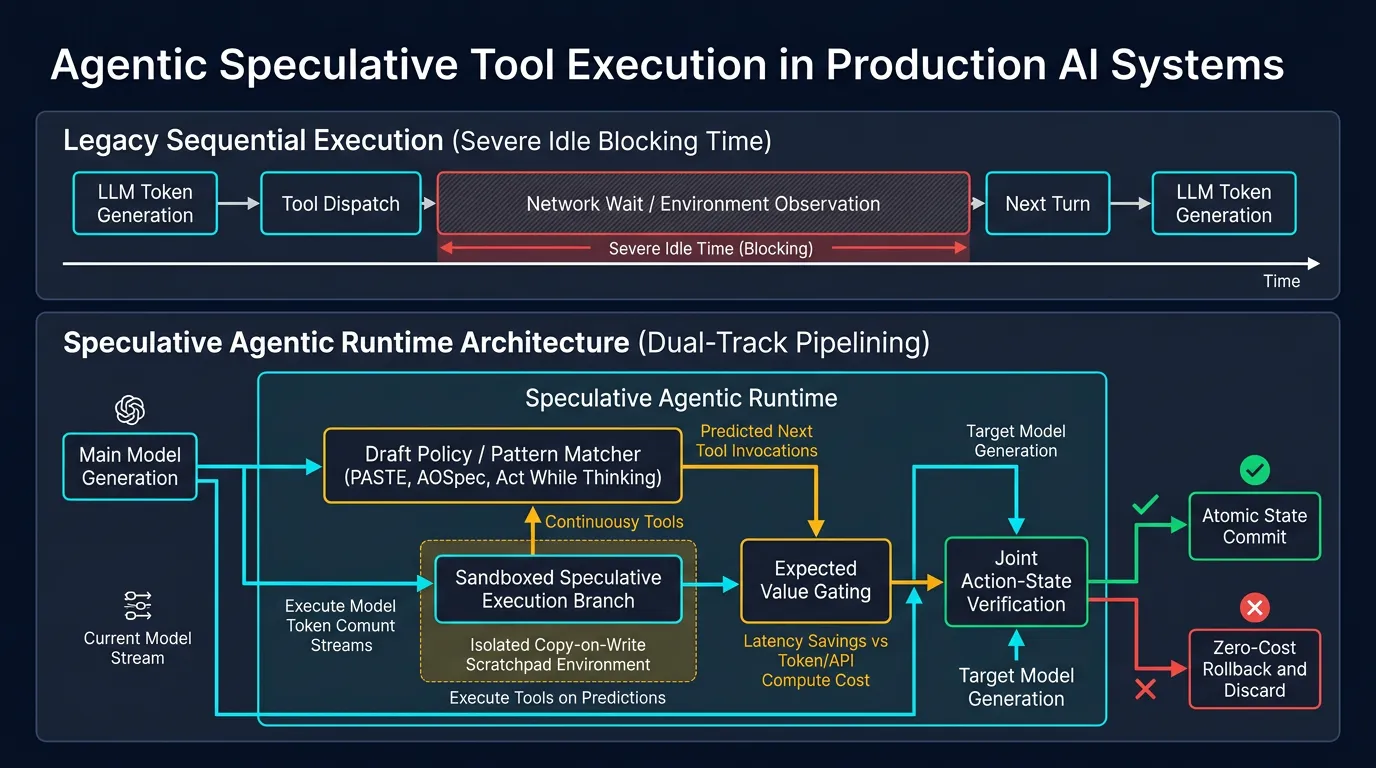
Agentic speculative tool execution is an advanced systems architecture that eliminates multi-turn latency in autonomous AI agents by pre-executing predicted downstream tool invocations and environment queries asynchronously while the primary model is still generating thought tokens. Rather than forcing agents into stop-and-wait sequential bottlenecks where tool execution blocks token generation, speculative runtimes mine workflow patterns to execute read-only API calls inside copy-on-write sandboxes. By verifying speculative tool inputs against the model's finalized generation, verified results commit immediately while mispredictions rollback with zero side effects, cutting end-to-end task completion latency dramatically.
Why Does Sequential Tool Execution Create Severe Production Latency Bottlenecks?
Traditional autonomous agent architectures treat tool invocation as a strict synchronous loop: an agent generates a plan, outputs a structured tool call schema, halts generation, dispatches the HTTP payload across the network, awaits the target environment's response, injects the observation into context, and resumes decoding. In production workflows requiring multi-hop research, code synthesis, or external database queries, network round-trips and tool compute latency dominate total execution time, leaving GPU inference clusters idle and driving human-facing turnaround times past acceptable service-level agreements.
In complex agentic benchmarks such as Terminal-Bench, SWE-bench, and multi-turn deep research environments, an agent frequently spends the majority of its total wall-clock time waiting on external system responses rather than performing active inference.
Sequential execution suffers from three compounding structural inefficiencies:
- GPU Underutilization During I/O Blocking: When an LLM triggers an external database query, REST API call, or code execution container, inference threads stall. Token generation hardware sits idle while waiting for network packets to return across external boundaries.
- Context Latency Accumulation: In multi-step trajectories spanning ten to thirty tool calls, cumulative tool latency grows linearly. Tool execution overhead repeated across twenty turns adds massive idle waiting time, entirely separate from model prefill and decode latency.
- Premature Context Flushing: Because traditional runtimes cannot anticipate tool responses, they cannot overlap the prefill computation of incoming tool results with ongoing reasoning, exacerbating Time-to-First-Token (TTFT) on subsequent turns.
How Do Pattern-Aware Runtimes Predict and Pre-Execute Tool Calls?
Modern speculative runtimes such as PASTE (Pattern-Aware Speculative Tool Execution, arXiv:2603.18897) introduce draft policies that operate alongside the target language model. Instead of waiting for token generation to terminate at an end-of-turn delimiter, the runtime monitors intermediate decoding states and semantic trajectory graphs.
When an agent begins generating intermediate reasoning—such as searching for specific documentation or analyzing a repository file—the pattern-aware speculative execution engine identifies high-confidence recurring action tuples $(A_{t}, P(T_{t+1}|H_t))$. The runtime drafts the tool parameters and dispatches the execution call to an asynchronous execution worker thread before the model finishes typing the closing JSON bracket.
+----------------------------------------------------------------------------+
|               SPECULATIVE AGENTIC RUNTIME PIPELINE (2026)                  |
+----------------------------------------------------------------------------+
|                                                                            |
|   Target LLM Generation:  [Thought Tokens...] -> [Draft Tool Schema...]    |
|                                     |                                      |
|                                     v (Early Trigger)                      |
|   Speculative Draft Engine: [Parameter Prediction]                         |
|                                     |                                      |
|                                     v (Asynchronous Dispatch)              |
|   Sandboxed Scratchpad:     [Speculative Tool Execution (Isolated)]        |
|                                     |                                      |
|   Target Generation Ends:   [Final Validated Tool Call]                    |
|                                     |                                      |
|   Verification Gateway:     [Parameter Exact Match / Hash Match?]          |
|                                  /     \                                   |
|                      YES (Hit)  /       \  NO (Miss)                       |
|                                v         v                                 |
|            [Commit Cache Observation]   [Discard & Zero-Cost Rollback]     |
|            [Zero Wall-Clock Latency]    [Execute Normal Sequential Path]   |
+----------------------------------------------------------------------------+
Empirical evaluations across distributed research agents show that PASTE substantially reduces average task completion latency while accelerating overall tool throughput, effectively hiding network latency behind concurrent token generation.
How Does Action and Observation Co-Speculation Work in AOSpec?
While token-level speculative decoding relies on small draft models to guess future text tokens, agentic execution must address non-deterministic external environments. The AOSpec framework (Action and Observation Co-Speculation, arXiv:2608.00881) extends speculation across both sides of the agent-environment boundary.
AOSpec operates across three interconnected systems:
- Expected Value Decoding: Uses lightweight task-specific trajectory models to predict both the agent's upcoming tool action and the likely distribution of the environment's observation payload.
- Isolated Scratchpad Sandboxing: Speculative mutations execute within copy-on-write transient memory or virtualized file systems. Read operations (such as search queries, data lookups, and static file inspection) run freely, while side-effecting state mutations are isolated in speculative buffer branches.
- Joint Action-State Verification: Once the primary model completes its generation cycle, the runtime compares the actual generated tool call and target state against the speculative branch. If parameters match, the pre-fetched observation is instantly committed into the KV cache and agent context, delivering substantial reductions in mean task latency and p99 tail latency on Terminal-Bench.
How Do Decision-Theoretic Cost Gates Prevent Runaway API Spend?
Speculation is not free. Every speculative tool call consumes external API quotas, compute cycles, and potential network bandwidth. If an agent speculates aggressively on branches that are later rejected, enterprise operating costs escalate rapidly.
To govern speculative waste, production architectures implement decision-theoretic cost gating as formalized in Cost-Aware Speculative Execution for LLM-Agent Workflows (arXiv:2606.07846). Rather than speculating on every token sequence, the scheduler evaluates a formal expected value decision threshold:
$\mathbb{E}[\Delta U] = P_{\text{accept}} \cdot U(\Delta T) - C_{\text{compute}} - C_{\text{api}}$
Where:
- $P_{\text{accept}}$ represents the Bayesian Beta-Binomial calibrated probability that the speculative tool parameters will match the model's finalized output.
- $U(\Delta T)$ quantifies the dollar-denominated utility of the wall-clock latency saved.
- $C_{\text{compute}}$ and $C_{\text{api}}$ account for the exact token verification and downstream API endpoint invocation costs.
When the calibrated acceptance probability drops below the cost-utility threshold—such as during highly divergent branching logic or ambiguous user queries—the runtime automatically throttles speculative branching and falls back to standard sequential execution.
What Are the State Isolation and Rollback Rules for Side-Effecting Tools?
A critical engineering vulnerability in speculative execution is state pollution. If an agent speculates that it should write to a production database, delete an S3 object, or dispatch an email, a mispredicted branch could trigger irreversible external actions.
Production architectures enforce strict classification and isolation tiers:
| Tool Category | Speculation Policy | Execution Environment | Rollback Mechanism |
|---|---|---|---|
| Idempotent Read (Tier 1) | Fully Speculative | Direct Network / Cache | Cache Eviction (Zero Overhead) |
| Simulated Write (Tier 2) | Speculative in Sandbox | Copy-on-Write Memory | Branch Pointer Invalidation |
| Non-Idempotent Mutation (Tier 3) | Speculation Prohibited | Production Environment | Compensating Saga Log / Two-Phase Commit |
| Irreversible External I/O (Tier 4) | Strict Sequential Only | Gated Production Gateway | Manual Human-in-the-Loop Confirmation |
By restricting live speculative dispatch strictly to idempotent queries and copy-on-write file buffers, enterprise agent runtimes eliminate side-effect leaks while maximizing concurrency for read-heavy analytical, coding, and research workflows.
To explore how these architectures deploy in production, read our analyses on agentic tool-calling constrained decoding, event-driven asynchronous agent choreography, and production admission control and backpressure.
Frequently Asked Questions
How does speculative tool execution differ from speculative decoding?
Speculative decoding uses a smaller draft model to guess future text tokens on the GPU, verifying them in parallel with the target model. Speculative tool execution operates at the systems layer: it predicts upcoming tool calls and pre-executes external API, database, or sandbox operations across the network while the primary model is still generating thought tokens.
What happens if the primary LLM changes its tool parameters at the last token?
If the finalized tool parameters generated by the primary model fail exact-match verification against the speculative call, the speculative branch is discarded immediately via zero-cost rollback. The runtime then executes the finalized tool call along the standard sequential path without corrupting agent state.
Does speculative execution increase enterprise API billing?
Uncontrolled speculation can increase API usage if prediction accuracy is low. However, production runtimes implement Bayesian expected-value cost gates (such as arXiv:2606.07846) that evaluate prediction confidence against endpoint costs, initiating speculation only when the expected latency savings justify the marginal invocation cost.
Can speculative execution be safely used with write operations or databases?
Production systems strictly forbid unisolated speculation on mutating actions. Destructive or state-changing operations (database inserts, file deletions, payment processing) either run inside isolated copy-on-write scratchpad sandboxes or remain restricted to sequential execution pipelines.
Explore related agent infrastructure on Prest0: