An agentic memory wire format is an open, vendor-neutral specification that standardizes how autonomous artificial intelligence agents persist, query, synchronize, and expire state across heterogeneous storage backends. By decoupling memory operations from proprietary SDKs through a schema-validated protocol, enterprises eliminate vendor lock-in, enable cross-agent context sharing, and enforce uniform governance and audit policies across distributed multi-agent systems in 2026.
Production deployments of autonomous AI agents have reached an architectural bottleneck: bespoke, proprietary memory layers. While frontier LLMs operate seamlessly across standardized tool-calling interfaces, their state persistence remains fragmented across incompatible databases, custom vector stores, and closed vendor APIs. Standardized agentic memory wire formats solve this fragmentation by establishing a universal operational protocol.
Why Do Proprietary Agent Memory Layers Fail at Enterprise Scale?
Early autonomous agent frameworks embedded state directly into specialized vector indices or local file systems. While sufficient for single-turn prototypes and isolated copilots, this architecture breaks down in multi-agent enterprise environments for three fundamental reasons:
- Vendor Lock-In and Protocol Incompatibility: Every memory framework exposes divergent SDK interfaces, bespoke schema definitions, and incompatible serialization formats. Migrating an agent cluster from one vector or relational provider to another requires rewriting core prompt templates and data ingestion pipelines.
- Context Siloing Across Specialized Agent Frameworks: An enterprise rarely runs a single agent framework. Orchestrators built on disparate runtimes cannot exchange persistent state or learned facts because their memory serialization structures share no semantic interoperability.
- Absence of Centralized Data Governance: When agents directly manipulate raw vector stores or unstructured key-value caches, compliance teams cannot enforce data retention limits, cryptographic provenance tracking, or regulatory "right-to-be-forgotten" mandates across distributed systems.
Standardizing the operational wire format decouples the agent's cognitive runtime from the underlying storage infrastructure, transforming memory from a closed vendor feature into an enterprise data utility.
What Are the Core Operations of a Standardized Memory Wire Format?
To provide universal interoperability without restricting backend database capabilities, a standardized agentic memory wire format defines five fundamental primitives modeled in strict JSON Schema (such as JSON Schema 2020-12):
| Memory Operation | Wire Payload Signature | Architectural Execution and Invariant |
|---|---|---|
remember | payload: { id, content, memory_type, ttl, metadata } | Ingests a new fact, observation, or episodic trace. Validates schema constraints, extracts semantic entities, and assigns a cryptographic hash. |
recall | query: { semantic_query, filter, limit, threshold } | Executes hybrid vector similarity, keyword filtering, or graph traversal across registered backends to return scored memory fragments. |
forget | target: { memory_id, filter, cascade_purge } | Cryptographically tomb-stones or physically deletes records across all replicated stores, guaranteeing verifiable right-to-be-forgotten compliance. |
merge | entities: { source_ids, consolidated_content } | Resolves conflicting assertions, deduplicates redundant facts, and updates temporal validity windows across evolving agent knowledge graphs. |
expire | criteria: { max_age, idle_threshold, scope } | Automatically purges transient scratchpad buffers and stale episodic traces based on explicit time-to-live (TTL) and context relevance policies. |
By expressing these five primitives as language-agnostic wire payloads, any autonomous agent can communicate with any compliant memory store over standard gRPC, WebSockets, or HTTP/3 connections.
How Does a Memory Wire Format Structure Multi-Tiered State?
State persistence in biological and artificial intelligence is not homogeneous. A production memory wire format must distinguish between distinct cognitive persistence categories, routing each to an optimal storage and indexing engine:
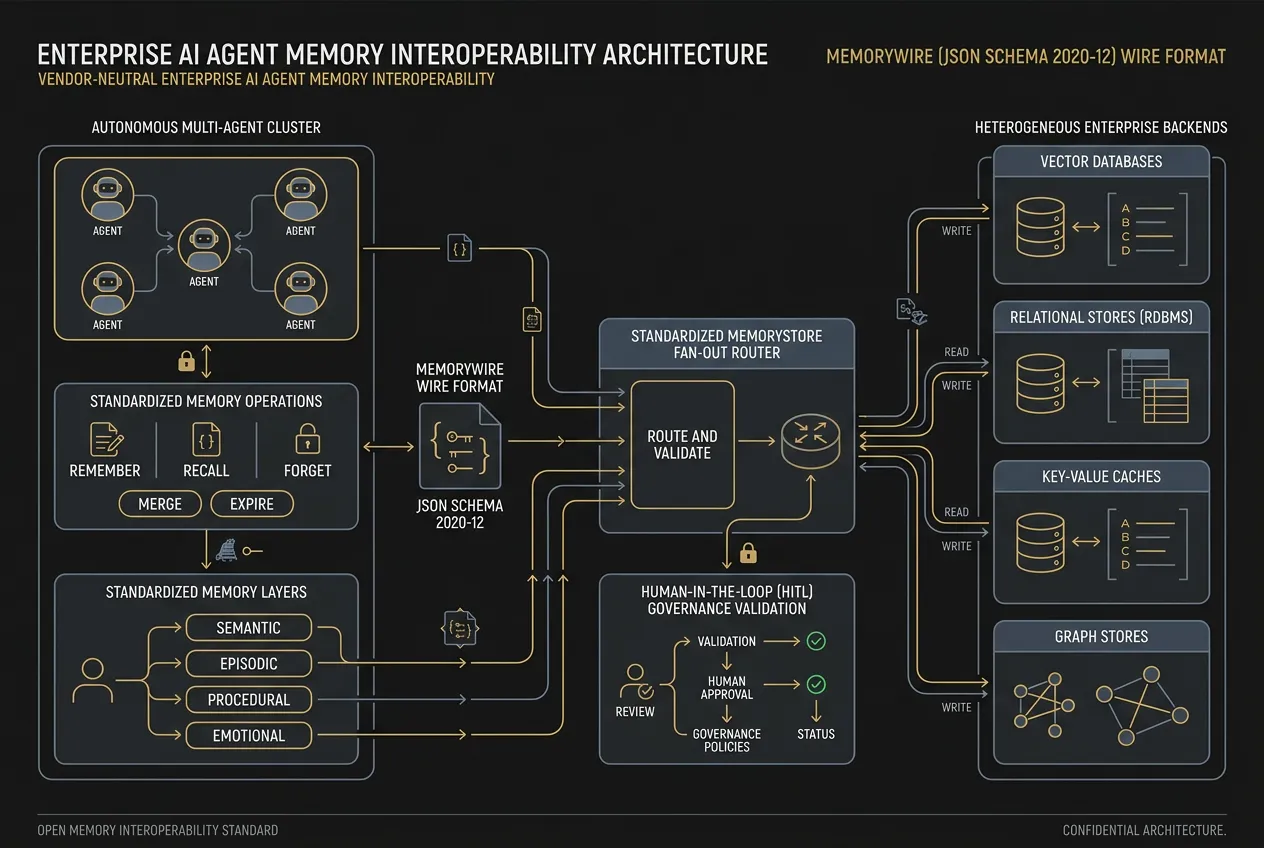
1. Semantic Memory
Semantic memory represents factual, context-independent knowledge about users, business rules, enterprise entities, and domain ontologies.
- Storage Target: Hybrid vector databases and property graph stores.
- Wire Representation: Subject-predicate-object triples, normalized embeddings, and categorical entity metadata.
2. Episodic Memory
Episodic memory captures historical sequences of past agent actions, user conversations, tool invocation outcomes, and intermediate execution steps.
- Storage Target: Append-only event logs, partitioned time-series stores, and object storage tiers.
- Wire Representation: Chronologically ordered trajectory records with W3C distributed trace context headers (
traceparent).
3. Procedural Memory
Procedural memory codifies operational workflows, tool execution guidelines, few-shot prompt demonstrations, and learned decision heuristics.
- Storage Target: Version-controlled document registries and relational configuration tables.
- Wire Representation: Structured task graphs, execution schemas, and parameter constraints.
4. Emotional and Stance Context
In collaborative enterprise environments, agents maintain behavioral stance, user interaction preferences, communication tone, and domain-specific persona constraints.
- Storage Target: Low-latency key-value caches and session contexts.
- Wire Representation: Scored attribute dictionaries and explicit communication policy flags.
How Does a Fan-Out Router Enforce Governance and Human-in-the-Loop Validation?
In enterprise environments, autonomous agents cannot be granted unrestricted write access to shared persistent memory. A malicious prompt injection or an ungrounded hallucination could poison the shared memory pool, corrupting downstream agent workflows across the entire organization.
To prevent context poisoning, the standardized architecture introduces a Fan-Out Memory Router equipped with an inline governance verification channel:
[ Autonomous Agent Cluster ]
             │
             ▼  (remember / forget payload)
   [ Fan-Out Memory Router ]
             │
             ├──► [ Policy & Schema Validation ] (JSON Schema 2020-12)
             │
             ├──► [ PII & Secret Scrubbing ] (Zero-Retention Scrubber)
             │
             ├──► [ Human-in-the-Loop Governance Gate ] (High-Risk Operations)
             │
             ▼  (Dispatched Execution)
┌────────────────────┬────────────────────┬────────────────────┐
│   Vector Store     │   Graph Database   │   Relational DB    │
│  (Semantic Facts)  │ (Entity Relations) │ (Audit Logs / TTL) │
└────────────────────┴────────────────────┴────────────────────┘- Schema and Contract Conformance: The router validates incoming payloads against strict structural rules, immediately rejecting malformed or unauthorized state mutations.
- Deterministic Context Sanitization: Payloads are passed through automated redaction filters to scrub sensitive personal identifiers (PII), customer secrets, and confidential financial tokens before persistence.
- Adversarial Drift and Poisoning Firewalls: High-impact memory mutations (such as updating contractual terms or overriding security policies) trigger automated verification or asynchronous human-in-the-loop review.
- Multi-Backend Fan-Out: Once verified, the router fans out writes across specialized persistence backends, updating vector embeddings, graph edges, and relational audit tables in an idempotent transaction.
What Performance Benchmarks Do Standardized Memory Architectures Achieve?
Standardizing wire formats does not introduce latency penalties. Empirical evaluations of standardized agent memory protocols demonstrate measurable improvements in long-horizon reasoning and retrieval efficiency:
- Long-Horizon Context Retention: On long-context benchmarks such as BEAM (evaluating 100,000 to 1,000,000 token multi-turn interactions), dynamic self-optimizing memory systems utilizing structured operational tools outperform static compression and retrieval baselines by over 40% in task accuracy.
- Sub-10ms Routing Overhead: Native binary serialization (Protobuf) and streaming JSON Schema validation introduce less than 4 milliseconds of median processing latency at the fan-out router, preserving end-to-end interactive agent performance.
- Deterministic Purge Verifiability: Because memory mutations are tracked with cryptographic hashes and explicit foreign key relationships, enterprise compliance audits achieve 100% audit trail completeness across distributed data subject access requests (DSARs).
For organizations building scalable, compliant AI ecosystems, adopting a standardized memory wire format ensures agent intelligence remains durable, governed, and completely independent of any single underlying infrastructure provider.
Related Insights: Learn how multi-agent clusters maintain deterministic state synchronization in our breakdown of Multi-Agent State Synchronization Protocols: Mitigating Context Drift in Distributed LLM Systems, and explore zero-retention logging strategies in Distributed Agent Tracing: OpenTelemetry Architectures for Production AI in 2026.
What is an agentic memory wire format?
An agentic memory wire format is a standardized, vendor-neutral data protocol that defines how autonomous AI agents serialize, store, retrieve, update, and delete state across disparate storage backends.
Why is a standardized memory format necessary for multi-agent systems?
Without a standard format, agents running on different frameworks cannot share context or persistent knowledge, creating isolated data silos and locking organizations into specific vector database SDKs.
What operations are defined in a standard agent memory wire protocol?
Standard wire formats define five core operational primitives: remember (ingestion), recall (retrieval), forget (deletion/tombstoning), merge (consolidation), and expire (time-to-live eviction).
How does a memory wire format protect against prompt injection and context poisoning?
By routing all memory operations through a centralized validation layer, systems can validate schemas, scrub confidential data, and mandate policy review before state is committed to permanent enterprise storage.