Multi-agent Byzantine fault tolerance (BFT) is the distributed systems architecture that enables autonomous AI clusters to reach provable, deterministic consensus on shared state and high-stakes actions despite non-deterministic model drift, prompt injection attacks, or compromised rogue subagents. By enforcing cryptographic threshold quorum certificates ($2f+1$ valid approvals across $3f+1$ independent heterogeneous replicas), enterprise AI clusters eliminate single-point hallucinations, isolate adversarial prompt corruptions, and guarantee transactional safety before irreversible tool calls execute.
Why Do Autonomous Multi-Agent Swarms Require Byzantine Fault Tolerance?
When enterprise architectures transition from isolated single-prompt models to decentralized, multi-agent autonomous swarms, traditional consensus assumptions catastrophically collapse. Classical distributed systems protocols like standard Paxos or Raft assume fail-stop or crash-recovery fault models—meaning an unresponsive node simply halts execution or reboots cleanly.
In production AI agent clusters, however, failure modes are inherently Byzantine:
- Adversarial Prompt Injections: An agent exposed to external untrusted data (such as emails, PDF attachments, or third-party web pages) can suffer indirect prompt injection, leading it to actively broadcast malicious state changes or exfiltration tool calls while appearing online and responsive.
- Non-Deterministic Semantic Drift: Identical prompts processed across stochastic LLM inference endpoints can yield divergent reasoning paths, hallucinations, or malformed schema payloads that disagree with peer nodes.
- Sybil Subagent Collusion: Autonomous agents dynamically spinning up helper tasks or child processes can inadvertently overwhelm voting mechanisms if identity and cryptographic verification are not strictly anchored to root authority keys.
Under these conditions, a simple majority vote or uncoordinated pipeline fails. If an attacker or a hallucinated model corrupts a single agent within a workflow, unverified state transitions propagate downstream, triggering unauthorized database writes, fraudulent funds transfers, or leaked confidential records.
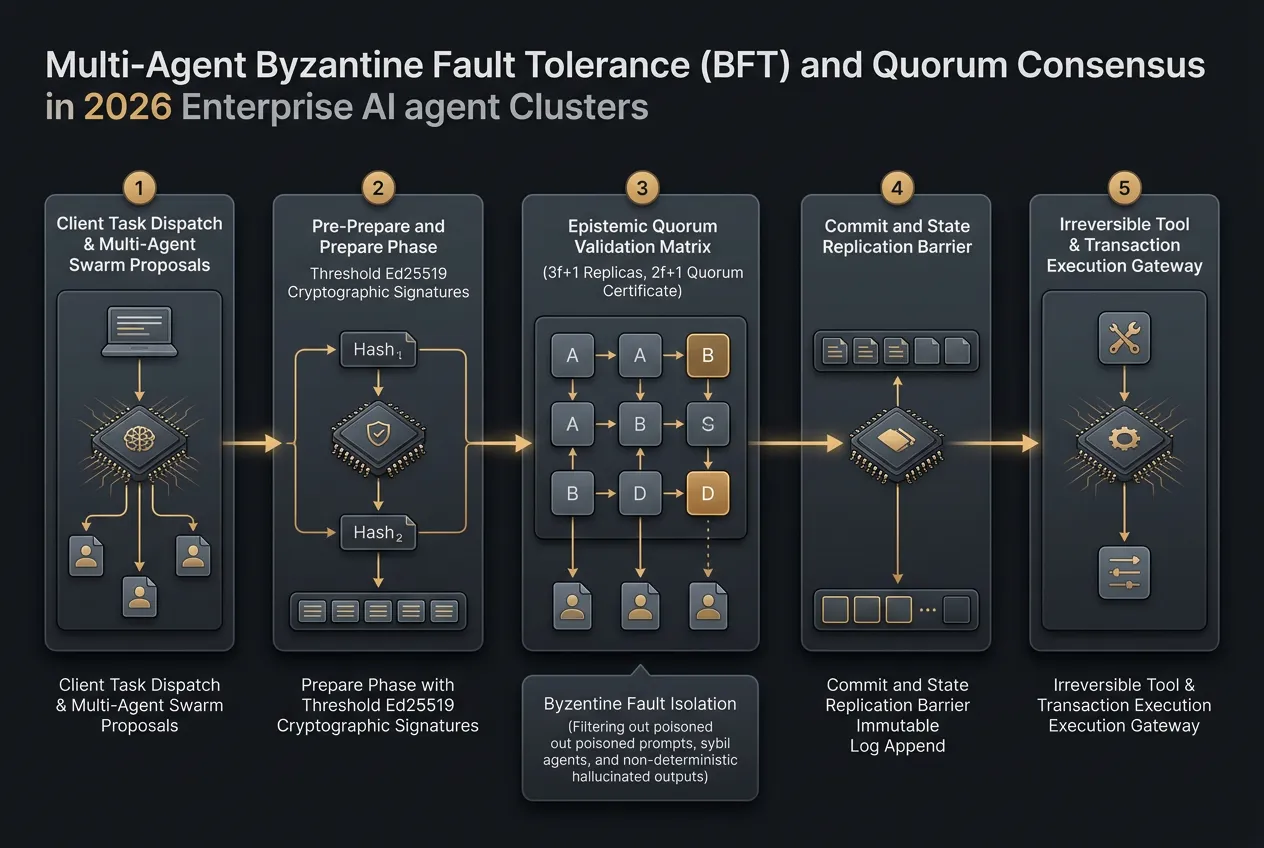
How Does Practical Byzantine Fault Tolerance (PBFT) Work for AI Agents?
To guarantee system-wide liveness and safety across autonomous agents, modern enterprise runtimes implement an adapted three-phase Practical Byzantine Fault Tolerance (PBFT) and Epistemic BFT pipeline. For a cluster designed to tolerate up to $f$ faulty, compromised, or hallucinating agents, the consensus network must maintain at least $N = 3f + 1$ independent agent nodes.
+-----------------------------------------------------------------------------------+
|                        MULTI-AGENT PBFT CONSENSUS PIPELINE                        |
+-----------------------------------------------------------------------------------+
  [Leader / Primary Agent]
             |
             | 1. PRE-PREPARE (Task Proposal + SHA-256 Digest + Sequence No.)
             v
+-----------------------------------------------------------------------------------+
| [Agent Replica 1]      [Agent Replica 2]      [Agent Replica 3]  ... [Agent 3f+1] |
+-----------------------------------------------------------------------------------+
             |
             | 2. PREPARE (Cross-Broadcast Threshold Ed25519 Signatures)
             v
+-----------------------------------------------------------------------------------+
|                QUORUM VERIFICATION MATRIX: (Requires 2f+1 Signatures)              |
+-----------------------------------------------------------------------------------+
             |
             | 3. COMMIT (Broadcast State Transition + Invariant Validation)
             v
+-----------------------------------------------------------------------------------+
|          TRANSACTION EXECUTION GATEWAY (Irreversible Tool Call / API Write)        |
+-----------------------------------------------------------------------------------+
1. Pre-Prepare Phase
The designated primary or coordinator agent receives an incoming client instruction and constructs a deterministic proposal containing:
- A monotonically increasing sequence number ($n$);
- An epoch/view identifier ($v$);
- The cryptographic SHA-256 digest of the task trajectory and target tool payload ($d = \text{SHA-256}(m)$). The primary signs this
PRE-PREPAREmessage and broadcasts it across all peer validator replicas.
2. Prepare Phase & Epistemic Verification
Each validator agent independently validates the proposal. In an AI agent cluster, validation extends beyond byte-level syntax to epistemic semantic validation:
- Schema & Invariant Verification: Does the proposed tool call conform strictly to the target Context-Free Grammar (CFG) and role-based permissions?
- Dual-Model Cross-Inference: Does the proposed reasoning step align with independent validator checks or local policy boundaries? Upon passing verification, each validator node signs a
PREPAREmessage containing $(v, n, d, i)$ using its private Ed25519 key and broadcasts it to the cluster. A node reaches the prepared state once it collects a Quorum Certificate (QC) consisting of $2f + 1$ valid signatures matching $(v, n, d)$.
3. Commit Phase & Irreversible Gateway Execution
Once a prepared certificate is assembled, nodes broadcast a COMMIT message across the network. When an agent accumulates $2f + 1$ commit signatures from distinct nodes, the proposal achieves definitive consensus. The transaction transitions to the execution gateway:
- The consensus log is appended immutably with the aggregated threshold signature;
- Downstream external tool calls (such as payment dispatch, contract generation, or production database mutations) are triggered;
- State rollbacks and saga compensations are prevented because state commits are mathematically finalized.
What Is the "Honest Quorum" Problem in Agentic Infrastructure?
In traditional distributed databases, node outputs are deterministic bitstreams. In multi-agent AI ecosystems, consensus encounters what researchers term the Honest Quorum Problem (The Honest Quorum Problem: Epistemic BFT, arXiv 2026).
Because LLM outputs exhibit natural semantic variance even across honest agents, simple string matching cannot serve as the consensus operator. Enterprise architectures solve this through tiered consensus aggregation:
| Consensus Layer | Mechanism | Fault Tolerance Target | Latency Impact |
|---|---|---|---|
| Syntactic & Schema Gate | CFG Constrained Pushdown Automata | Type mismatch, invalid parameters, schema hallucination | < 2 ms |
| Deterministic Tool Hash | Exact Canonical JSON Parameter Hashing | Parameter deviation, divergent query bounds | < 5 ms |
| Epistemic Invariant Gating | Independent Policy Checkers & Verifiers | Prompt injection, goal hijacking, policy breach | 45–120 ms |
| Byzantine Threshold Signature | BLS12-381 / Ed25519 Quorum Aggregation | Sybil nodes, rogue agents, network partitions | 10–25 ms |
By decoupling the semantic reasoning phase from the deterministic execution envelope, agents can explore diverse reasoning paths internally while converging on an identical, cryptographically provable action manifest before crossing external boundaries.
How Does SAGA-BFT Eliminate Runaway Tool Invocations?
In complex enterprise workflows spanning dozens of sequential tasks, executing every micro-step through a full $3f+1$ consensus cycle can introduce latency bottlenecks. SAGA-BFT architectures resolve this trade-off by establishing dynamic consensus checkpoints:
- Replicated Controller State: Controller nodes maintain a shared replicated log of active agent trajectories. If a worker agent crashes or exhibits anomalous reasoning during Step 4 of a 10-step workflow, the replicated controllers detect the deviation via heartbeat and quorum timeout.
- Byzantine Fault Isolation: The misbehaving node is instantly isolated; its temporary OAuth session and ephemeral encryption tokens are revoked through automated IAM token exchange barriers.
- Saga Recovery & View Change: The controller initiates an automated View Change protocol, electing a new coordinator, rolling back uncommitted working memory to the last signed checkpoint, and re-dispatching the task to healthy replicas without human intervention.
Key Enterprise Architectural Principles for 2026
When engineering Byzantine-resilient autonomous agent swarms, engineering teams must anchor their systems in four core controls:
- Heterogeneous Model Diversity: Never deploy a consensus cluster composed entirely of identical model weights from a single provider. A single adversarial jailbreak or latent prompt vulnerability could compromise all $3f+1$ nodes simultaneously. Pair diverse foundational models across distinct architectural families to ensure orthogonal failure modes.
- Cryptographic Identity per Agent: Every agent replica must hold a dedicated, hardware-secured or enclave-backed private key (Ed25519 or BLS12-381). Anonymous or shared service-account pooling invalidates Byzantine quorum proofs.
- Separation of Reasoning and Execution: Worker agents must never hold direct write credentials to external production APIs. Write credentials must reside exclusively behind a Byzantine-hardened execution gateway that requires a cryptographically verified Quorum Certificate ($2f+1$ signatures) before releasing external calls.
- Immutable Consensus Auditing: Stream all pre-prepare, prepare, and commit envelopes directly to Write-Once-Read-Many (WORM) storage backends instrumented with OpenTelemetry GenAI spans for post-incident forensic replay.
Why isn't a simple majority vote sufficient for multi-agent clusters?
Simple majority voting only tolerates benign crash faults where unresponsive nodes simply disappear. In Byzantine failure scenarios, compromised or hallucinating agents can actively lie, broadcast conflicting messages to different peers (split-brain attacks), or coordinate malicious payloads. Byzantine fault tolerance mathematically proves that in an asynchronous or partially synchronous network, at least $3f+1$ nodes and a $2f+1$ supermajority quorum are required to guarantee safety and prevent conflicting commitments.
Does multi-agent consensus add prohibitive latency to agent interactions?
No. By standardizing canonical tool parameter schemas and utilizing lightweight threshold signature schemes (such as Ed25519 or aggregated BLS12-381), signature collection and quorum validation execute in under 25 milliseconds. The consensus latency is dwarfed by LLM inference generation times (500–2000 ms), meaning enterprise clusters achieve Byzantine security with negligible total latency overhead.
How does Byzantine consensus interact with agent memory and RAG pipelines?
Multi-agent consensus acts as an admission firewall for long-term memory. Before any episodic summary or tool observation is committed to the shared vector store or knowledge graph, it must receive an epistemic quorum certificate. This prevents poisoned context or hallucinations from contaminating the cluster's permanent knowledge base.
Related reading: Explore our comprehensive technical breakdown on Agent State Checkpointing and Saga Rollback and Dynamic Tool Discovery and MCP Schema Routing.