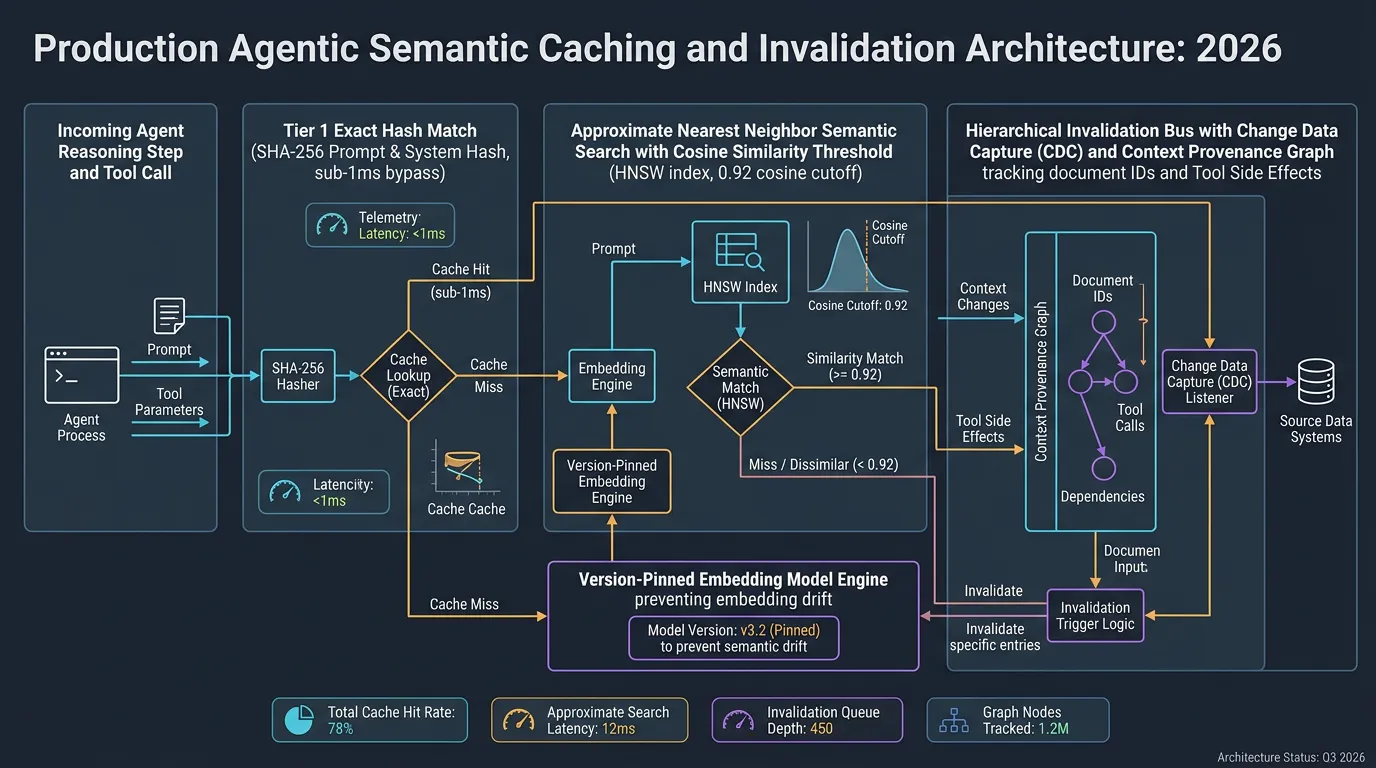
Agentic semantic caching and invalidation architectures in 2026 provide the critical deterministic infrastructure that enables autonomous multi-turn AI systems to cut inference compute expenses substantially while strictly preventing stale context propagation. In production multi-agent environments, naive vector caching causes severe silent hallucinations when underlying database records, tool definitions, or retrieved documents update mid-flight. By combining Tier 1 exact SHA-256 prompt hashing, Tier 2 approximate nearest neighbor (ANN) vector indexing with 0.92 cosine similarity gating, and event-driven Change Data Capture (CDC) dependency graphs, modern agent platforms guarantee sub-millisecond retrieval without sacrificing evidentiary freshness.
Why Does Traditional Vector Caching Fail in Autonomous Multi-Agent Loops?
Traditional generative AI caching was designed for stateless, single-turn query-response interfaces where user prompts were matched against pre-indexed vector stores. In autonomous multi-agent systems, this stateless paradigm collapses immediately across three operational failure modes:
- State Mutation Blindness: An agent executing a multi-step task frequently mutates external state via tools (for example, updating a CRM record, creating an e-filing document, or generating an invoice). If subsequent sub-agents consult a semantic cache that indexes the pre-mutation query, the agent acts upon obsolete realities, generating compounding downstream errors.
- Context Drift and Asymmetric Dependencies: Agent prompts contain dynamic context windows, system prompts, injected tool definitions, and intermediate scratchpad observations. Two queries with identical user intent ("Summarize the latest financial audit") require completely different outputs if the underlying document repository updated five seconds prior.
- Embedding Model Drift: Upgrades or fine-tuning runs on the underlying dense embedding model distort the topological vector space. Cached vectors generated under version 1.0 drift relative to incoming queries embedded under version 1.1, triggering sudden catastrophic drops in cache hit rates or false-positive semantic collisions.
To maintain production integrity, engineering teams have superseded basic vector caches with multi-tier, dependency-aware semantic caching architectures.
What Is the Multi-Tier Semantic Caching Topology for AI Agents?
Enterprise agent platforms in 2026 deploy a three-stage hierarchical caching pipeline designed to maximize cache hit rates while isolating mutating dependencies:
[ Incoming Agent Step / Tool Call ]
                 │
                 ▼
  [ Tier 1: Exact Hash Cache (L1) ] ──────── (Hit: <1ms) ───► Return Cached Result
                 │ (Miss)
                 ▼
 [ Tier 2: Semantic Vector Cache (L2) ]
  • Cosine Similarity Threshold ≥ 0.92
  • Version-Pinned Embedding Space
  • Tenant & Role Boundary Filtering
                 │
                 ├── (Hit & Provenance Valid) ──────────────► Return Cached Result
                 │
                 └── (Miss / Invalidated) ──────────────────► Execute LLM / Tool
                                                                    │
                                                                    ▼
                                                            Store with Dependency Tags
Tier 1: Normalized Exact Hash Caching (L1)
Before computing expensive dense vector embeddings, the incoming execution request passes through an in-memory key-value cache (such as Redis or Valkey). The cache key is computed as a composite cryptographic hash:
$\text{Key}_{\text{L1}} = \text{SHA-256}(\text{Tenant ID} \parallel \text{System Prompt Hash} \parallel \text{Tool Manifest Hash} \parallel \text{Normalized Prompt})$
This Tier 1 lookup executes in under 1 millisecond, absorbing repetitive deterministic subtasks (such as boilerplate data formatting, schema validation, and recurring parameter parsing) without invoking embedding inference models.
Tier 2: Approximate Nearest Neighbor (ANN) Semantic Caching (L2)
When Tier 1 misses, the request text is embedded using a version-pinned dense representation model and queried against an ANN vector index (utilizing Hierarchical Navigable Small World, or HNSW, graphs). Production systems enforce strict operational parameters:
- Similarity Cutoff Gating: Unlike consumer search where a 0.80 cosine similarity score yields acceptable results, production agent semantic caching enforces a strict similarity threshold between 0.90 and 0.94 (standardizing on 0.92). Any match below this boundary is treated as a cache miss to prevent subtle semantic distortions.
- Tenant and Role Isolation: Vector queries strictly filter on composite tenant identifiers and user authorization scopes (
TenantIDandRoleBoundary) to guarantee that one tenant's cached reasoning step is never accessible to another. - Payload Provenance Attribution: Every cached vector entry stores comprehensive dependency metadata: source document IDs, tool versions, system prompt fingerprints, and token cost metrics.
How Does Change Data Capture (CDC) Drive Real-Time Invalidation?
The primary operational breakthrough in 2026 agent infrastructure is provenance-based cache invalidation. Rather than relying solely on arbitrary time-to-live (TTL) expiration windows, production systems bind semantic cache entries to external data sources via distributed event buses.
| Invalidation Layer | Trigger Mechanism | Latency SLA | Operational Scope |
|---|---|---|---|
| CDC Event Bus | PostgreSQL WAL / Kafka stream events on source tables | < 50ms | Purges all cache entries tagged with modified EntityID |
| System Prompt Invalidation | Git commit / CI deployment updating agent instructions | Immediate (0ms) | Global cache partition rotation via SystemPromptHash |
| Tool Definition Invalidation | Schema modification or API parameter changes | Immediate (0ms) | Evicts tool-specific cached execution responses |
| Sliding Window TTL | Background timestamp decay for transient data | 1 hr – 24 hrs | Prevents accumulation of orphaned conversational vectors |
When an enterprise document repository, CRM record, or database row is updated, an event is emitted across the Change Data Capture (CDC) pipeline. An invalidation worker reads the modified entity_id and executes a secondary index lookup, evicting all semantic cache entries tagged with that document or tool dependency. This ensures that when an agent requests a summary or analysis milliseconds later, the outdated cache entry is unreachable, forcing a fresh, accurate retrieval step.
How Do Engineering Teams Mitigate Embedding Model Drift?
Embedding model evolution introduces vector drift: re-indexing an entire enterprise semantic cache of millions of entries whenever an embedding model is updated creates massive compute overhead. Production engineering teams prevent cache poisoning across upgrades using two strategies:
- Strict Version Partitioning: Every cache entry is indexed into a namespace prefixed with the exact model architecture and version tag (e.g.,
embed-v2.1:tenant_492). When model upgrades deploy, queries seamlessly target the new namespace, while the legacy namespace drains gracefully or transitions to background backfill. - Drift-Compensating Projection Adapters: For massive volatile corpora, teams implement learned linear projection matrices that map legacy embedding coordinates into the upgraded embedding manifold. This eliminates cold-start cache latency and maintains multi-tier efficiency across active deployment cycles.
For teams deploying autonomous agents at scale, pairing semantic caching with robust runtime telemetry is essential. Integrating distributed observability through distributed agent tracing and OpenTelemetry alongside inline AI agent circuit breakers ensures comprehensive resilience against cascading failure modes.
How does semantic caching differ from standard prompt caching?
Standard prompt caching (such as provider-level KV cache reuse) requires exact prefix token matches from the first token of the prompt. Semantic caching operates at the semantic embedding layer, recognizing that semantically identical prompts with slight phrasing variations can safely reuse verified reasoning outputs without invoking model inference.
What is the ideal similarity threshold for agent semantic caching?
Production benchmarks indicate that a cosine similarity threshold of 0.92 provides the optimal balance between cost efficiency and response accuracy. Lowering the threshold to 0.85 increases hit rates but introduces significant risk of hallucinating outdated or contextually mismatched agent actions.
How are tool side effects handled in semantic caching?
Read-only tool calls (e.g., searching a knowledge base or querying weather data) are eligible for semantic caching if tagged with dependency metadata. Mutating tool calls (e.g., executing payments, writing to databases, or sending emails) must bypass semantic caches entirely and execute idempotently through dedicated side-effect handlers.