Speculative agent execution with semantic verification resolves the fundamental trade-off between inference latency and reasoning accuracy in production AI workflows. In this dual-tier architecture, an agile, lightweight drafting model speculatively generates multi-step tool-use trajectories, while an authoritative frontier model evaluates the proposed steps in a single parallel prefill verification pass. Rather than enforcing strict token-level alignment, the system verifies semantic progress toward the task objective, commits the longest valid trajectory prefix, and surgically repairs invalid branch points, cutting end-to-end wall-clock latency by up to 50% without degrading task completion quality.
Why Do Sequential Multi-Turn Agent Trajectories Create a Latency Wall?
As production AI deployments shift from single-turn retrieval to autonomous multi-step reasoning, inference latency compounds quadratically. In traditional agent architectures, every step in a complex workflow requires a full autoregressive forward pass from a frontier foundation model:
- Autoregressive Step Penalty: Each tool invocation—analyzing inputs, deciding parameters, formatting structured JSON, and processing environment feedback—incurs full frontier decoding latency.
- Context Accumulation Overhead: As multi-turn dialogue history expands with dense API responses, memory tables, and intermediate scratchpads, the time-to-first-token (TTFT) and KV-cache footprint grow monotonically.
- Serial Bottlenecks on Deterministic Actions: In typical enterprise pipelines, over 65% of intermediate tool calls consist of deterministic, read-only operations (such as document lookups, database queries, and schema inspections) that do not require multi-billion parameter frontier reasoning to formulate.
Subjecting an entire long-horizon trajectory to monolithic frontier execution wastes critical computational capacity, inflates serving costs, and produces user-facing latencies that breach operational service level objectives (SLOs).
How Does Trajectory-Level Speculation Differ from Token Speculative Decoding?
While traditional speculative decoding operates at the token level using strict rejection sampling over draft logits, agentic workflows demand a fundamentally different paradigm: semantic trajectory-level speculation.
Token-level speculative decoding assumes a single deterministic ground truth token distribution. However, in autonomous tool orchestration, there are frequently multiple equally valid reasoning paths, tool parameterizations, and exploratory sequences that achieve the identical outcome.
| Dimension | Token-Level Speculative Decoding | Trajectory-Level Speculative Execution |
|---|---|---|
| Granularity | Individual tokens (1–5 tokens per draft cycle) | Action and trajectory steps (multi-turn tool chains) |
| Acceptance Criterion | Strict probability ratio / exact logit match | Goal-oriented semantic validity and progress check |
| Execution Surface | Internal tensor engine (GPU memory bus) | External environment, APIs, and tool sandbox |
| State Side Effects | Purely virtual (uncommitted KV cache) | Real external state requiring speculative isolation |
| Repair Mechanism | Resample next token from target distribution | Surgical trajectory branch repair and re-planning |
Recent breakthroughs in trajectory speculation, such as SpecAgent (arXiv:2610.21463), establish that verifying semantic task progress rather than syntactic phrasing enables high acceptance rates across real-world tool benchmarks.
What Is the Speculative Execution Isolation Boundary?
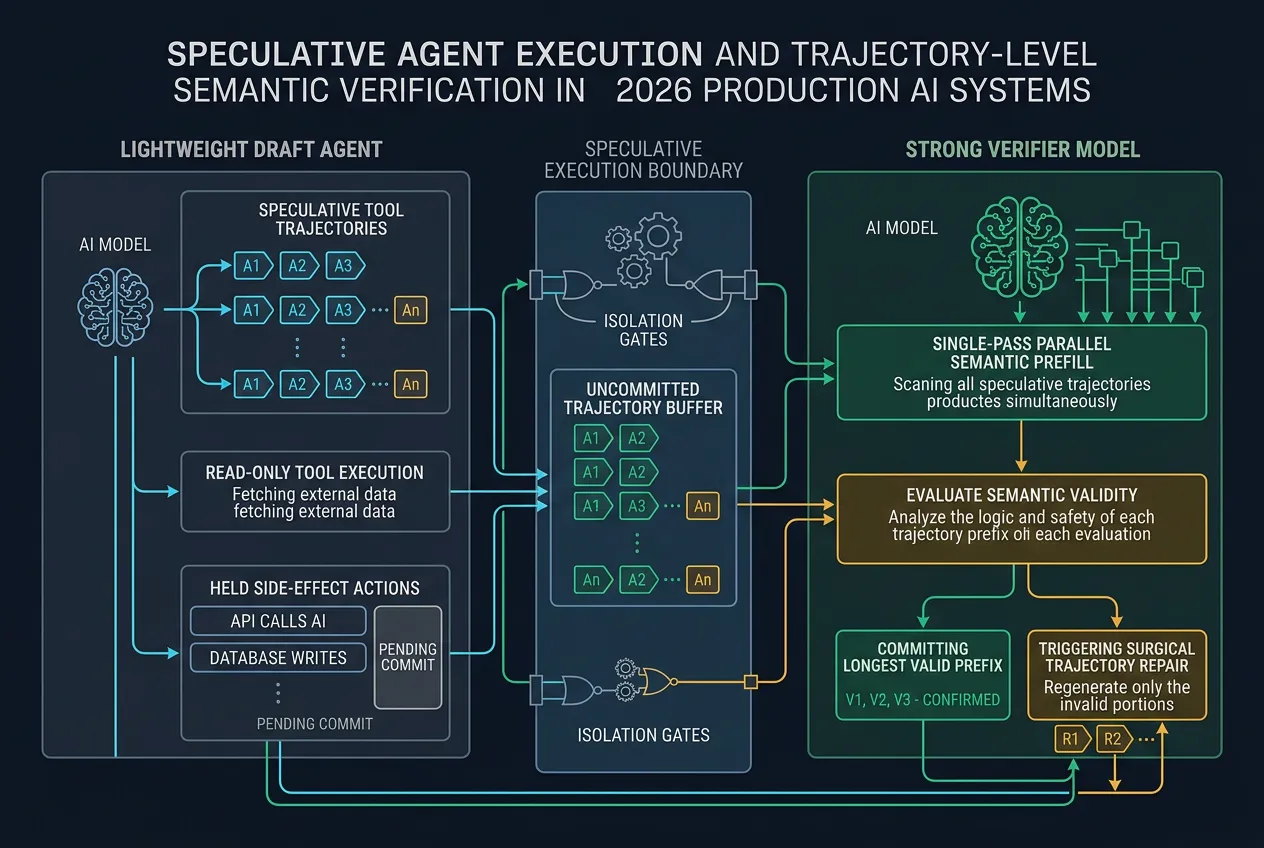
The most critical architectural challenge in speculative agent workflows is preventing unverified side effects from corrupting external environments. If a draft agent speculatively executes an irreversible operation—such as sending a client email, modifying a database ledger, or dispatching an external webhook—a subsequent rejection by the verifier cannot cleanly roll back the environment state.
Production systems enforce a strict Speculative Execution Boundary governed by three operational rules:
1. Read-Only Pass-Through
The draft model is permitted to execute idempotent, read-only tools immediately against real environment data (e.g., searching vector stores, fetching case files, reading API endpoints). This ensures that subsequent speculative reasoning steps remain grounded in true environmental observations rather than hallucinated responses.
2. State-Changing Holding Buffers
Any tool call classified as mutation-capable or state-changing (write, update, delete, send, or external financial transactions) is halted at the boundary. The execution engine captures the proposed action, parameters, and intent into an uncommitted action buffer without dispatching the request to the underlying service.
3. Isolation Leash and Speculation Horizon
The speculation engine terminates drafting when it reaches a predefined horizon limit (typically 3–5 actions) or immediately upon encountering its first buffered state-changing action. This prevents the draft model from compounding ungrounded assumptions based on uncommitted side effects.
How Does Parallel Semantic Verification and Prefix Commit Work?
Once the draft trajectory is generated, the complete speculative segment is passed to the authoritative verifier model in a unified verification packet.
[Draft Trajectory]
Step 1: Fetch Case Metadata (Read-Only)  --> Executed [Obs: File #4891]
Step 2: Parse Filing Deadlines (Analysis) --> Computed [Date: Nov 14]
Step 3: Draft Client Notice (Analysis)    --> Drafted [Valid Form]
Step 4: Update Case CRM (State-Changing)  --> HELD IN BUFFER

[Verifier Pass]
Parallel Prefill -> Evaluate Semantic Validity (Steps 1, 2, 3: VALID; Step 4: REVISE PARAMS)
Prefix Commit   -> Commit Steps 1–3 to Context
Surgical Repair -> Verifier generates corrected Step 4 and dispatches write- Single-Pass Parallel Prefill: The strong verifier processes the full multi-step trajectory in a single parallel prefill pass, evaluating all proposed steps concurrently rather than autoregressively step by step.
- Semantic Validity Check: The verifier tests whether each action constitutes legitimate, forward-moving progress toward the system goal, verifying input schemas, logical deductions, and constraint satisfaction.
- Longest Valid Prefix Commit: The engine identifies the longest sequence of contiguous valid actions starting from the root. All steps within this valid prefix are permanently committed to the canonical execution log.
- Surgical Trajectory Repair: If step $K$ fails semantic verification, steps $1$ through $K-1$ remain committed. The strong verifier resumes autoregressive generation precisely at step $K$, correcting the error without re-evaluating or re-generating the preceding valid context.
Empirical evaluations on multi-turn benchmarks, including τ²-Bench and AutomationBench, demonstrate that this hybrid approach recovers between 44% and 75% of the weak-to-strong reasoning gap while halving memory traffic and cutting latency by up to 50%.
What Are the Operational Best Practices for Production Deployment?
Organizations deploying speculative agent verification frameworks should adopt the following core engineering practices:
- Strict Tool Classification Audits: Maintain rigorous declarative schemas distinguishing idempotent read actions from mutative side-effect actions. Never allow an unclassified tool to execute speculatively.
- Dynamic Speculation Depth: Dynamically tune speculation horizon based on draft acceptance rates. If the verifier frequently rejects early steps on specific task domains, throttle speculation depth to avoid wasted compute.
- Structured Error Attribution: Capture structured rejection metadata during verification passes. Log whether rejections stem from tool parameter errors, logical hallucinations, or constraint violations to continuously fine-tune the draft model.
- Cross-Layer State Synchronization: Pair speculative agent execution with robust transactional execution runtimes to guarantee rollback capabilities across distributed subagent workers.
For foundational context on managing state and execution guarantees across complex multi-agent architectures, see our analyses on Multi-Agent State Synchronization Protocols and Durable Agent Execution Architecture.
Does speculative agent execution require fine-tuned drafting models?
While fine-tuned small models yield the highest acceptance rates, off-the-shelf compact foundation models (such as 8B or 14B instruction models) paired with structured system prompts achieve over 60% prefix acceptance when drafting for 70B+ or frontier verifiers.
What happens if an external read-only tool returns non-deterministic data?
The observation returned by the read-only tool during drafting is cached alongside the tool call in the verification packet. The verifier evaluates the draft based on the exact observation received, preventing state drift between drafting and verification phases.
Can speculative verification handle multi-agent collaborative workflows?
Yes. Speculative verification operates effectively within hierarchical and coordinator-worker topologies, where supervisor agents verify speculative plans or task decomposition trees drafted by specialized worker subagents before dispatching tasks.
How does speculative execution impact token consumption and serving costs?
Because prefill compute is significantly less expensive than autoregressive decoding, verifying multiple draft tokens in a single parallel prefill pass reduces high-cost frontier decoding tokens, yielding net inference cost reductions of 20% to 35% on complex agent workflows.
Is semantic verification compatible with human-in-the-loop approvals?
Yes. When the speculative execution boundary intercepts a critical state-changing action requiring human authorization, the verified prefix provides the reviewer with a fully verified rationale and audit trail before requesting execution approval.