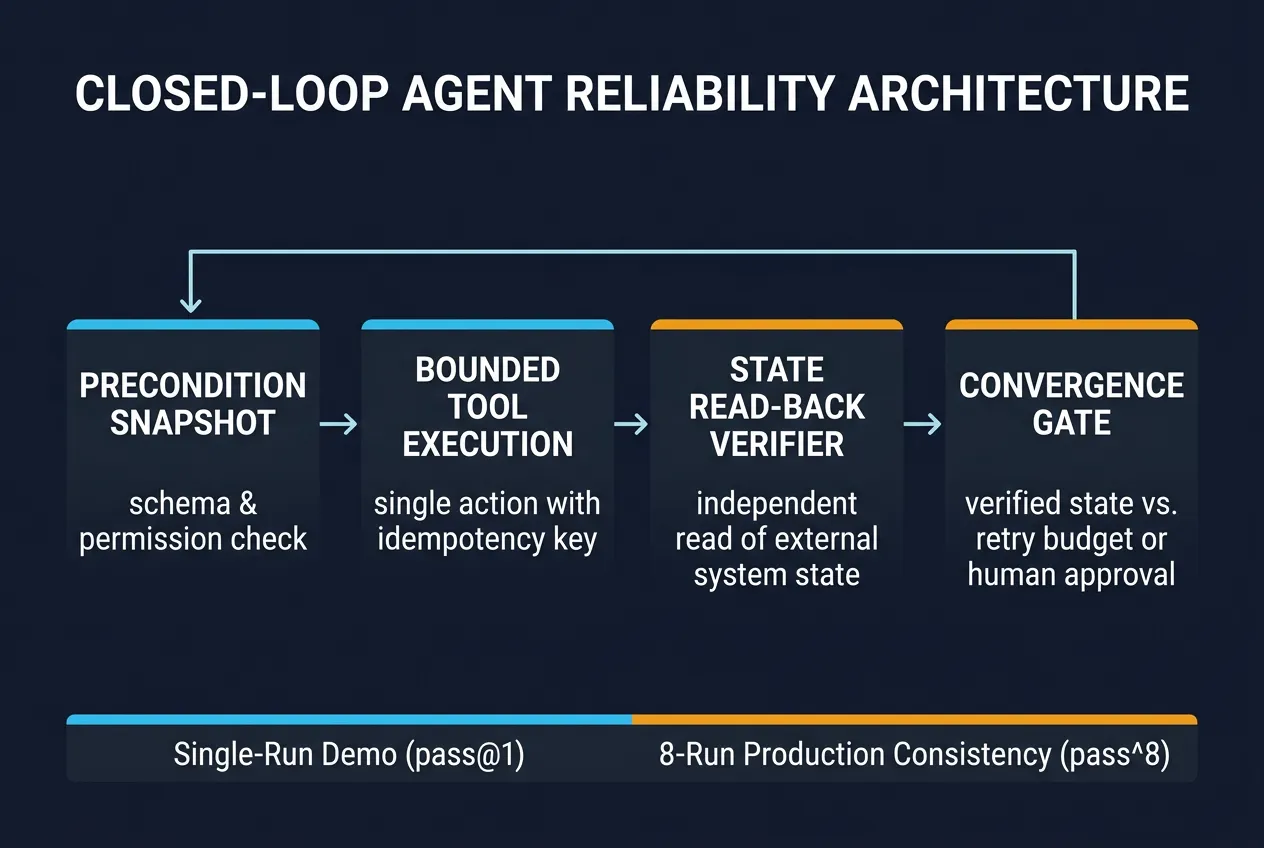
Direct Answer: Closed-loop verification for production AI agents solves the core reason enterprise automations fail: most agentic pipelines treat a tool call's return message—or the model's own summary—as proof that the real-world state actually changed. Engineering teams closing the gap between impressive single-run demos (pass@1) and repeatable production reliability (pass^k) use a four-stage architecture: capture a precondition snapshot, execute a bounded idempotent action, run an independent state read-back verifier against the target system, and pass a deterministic convergence gate before advancing or escalating to a human.
Why Single-Run Benchmarks Mislead Production Engineering Teams
In software engineering, an API endpoint that succeeds once during a live demo is not considered production-ready. Yet many enterprise agent evaluations still rely on single-try success metrics (pass@1): given a task, did the agent reach a plausible completion state on its first attempt?
Research on tool-using and computer-using agents demonstrates why pass@1 hides compounding operational risk. In the τ-bench evaluation paper by Shunyu Yao and colleagues, researchers introduced the pass^k metric—the probability that an agent succeeds on every single trial across k independent runs of the exact same task under realistic policy rules and user interactions. While frontier models scored nearly 50% on single-run retail workflows, their consistency across eight consecutive runs (pass^8) dropped below 25%.
The mathematical reality is unforgiving: even if an agent achieves a 0.95 probability of success on each individual step in a 10-step workflow, an unverified open-loop chain succeeds end-to-end only 0.95^10 (roughly 0.60 probability) on a single run. Across eight repeated daily runs of that same workflow, the probability of zero failures drops to 0.60^8—less than two in a hundred (0.017).
Open-Loop vs. Closed-Loop Agent Execution
Most early agent frameworks operate as open-loop controllers. The orchestrator sends a prompt and tool schemas to a model, executes whatever tool arguments come back, feeds the raw HTTP 200 status or text response into the context window, and lets the model declare the task complete.
In production environments—whether updating a CRM record, filing a document in cloud storage, editing a spreadsheet model, or navigating a browser portal—HTTP 200 rarely guarantees business-state convergence:
- Silent Partial Writes: A document or spreadsheet API accepts a batch payload but truncates a cell range, drops formatting, or writes to the wrong tab index.
- Eventual Consistency & Stale Reads: A file move or permission share returns accepted, but downstream readers still see the prior state for several seconds.
- UI Overlay & DOM Drift in Browser Agents: As documented in the OSWorld multimodal evaluation benchmark, desktop and web agents frequently click a coordinate covered by a modal dialog or toast banner, log the click action as completed, and hallucinate success without inspecting the resulting file or system state.
- Memory Poisoning from Unverified Claims: When an agent writes "Updated the client billing schedule" into long-term episodic memory without verifying the target file, every subsequent session inherits a false ground truth—a critical vector highlighted in our earlier analysis of why agent memory infrastructure unlocks your largest opportunity.
| Architectural Dimension | Open-Loop Agent (Demo Pattern) | Closed-Loop Agent (Production Pattern) |
|---|---|---|
| Definition of Done | Model emits a completion message after tool return | Independent read-back confirms target state matches goal specification |
| Primary Metric | Single-run task completion (pass@1) | Multi-run consistency (pass^k) + zero silent partial writes |
| Retry Strategy | Blind re-prompting on exception | State-diff inspection with bounded idempotency keys |
| Memory Hygiene | Logs model's narrative summary directly to memory | Commits state transition to memory only after verifier sign-off |
| Security Posture | Model chooses any connected tool in scope | Policy-enforced precondition gate aligned with OWASP Agentic Top 10 |
Closed-Loop Verification for Production AI Agents: The Four-Stage Architecture
To move from fragile chains to high-assurance autonomy, production agent platforms separate action generation from state verification. Every mutating step passes through four deterministic stages.
1. Precondition Snapshot & Policy Gate
Before any mutating tool or browser action runs, the runtime captures a lightweight snapshot of the target resource (current revision ID, row count, file hash, or permissions list) and validates the planned action against explicit policy rules.
In regulated sectors such as legal operations and financial services, this gate enforces hard boundaries in code rather than prompt instructions:
- Does the current user or routine hold permission to modify this resource?
- Does the target document's revision match the revision read during planning (
base_revisionoptimistic locking)? - Is the action outward-facing (sending an email, publishing a post, filing a record), which requires holding the payload in an approval queue rather than executing immediately?
2. Bounded Idempotent Execution
When the precondition gate passes, the runtime executes the tool call with an explicit operation identifier (op_id) or idempotency key. If a network timeout or rate limit interrupts the response, the orchestrator never blindly re-runs a mutating call that might create duplicate folders, double-post entries, or overwrite concurrent human edits.
3. Independent State Read-Back Verifier
Immediately after execution, the runtime invokes a read-back verifier that queries the external system's actual state—independent of the write response:
- Cloud Spreadsheets & Databases: Re-read the exact cell range or database row written and compare normalized values against the intended payload.
- Document & Presentation Edits: Re-read the document's section structure or slide element tree to confirm no text boxes overflowed, no placeholders remained unfilled, and the revision counter incremented.
- Browser & Computer-Use Runs: Follow the OSWorld evaluation paradigm by inspecting downloaded artifacts, file byte sizes, or post-action DOM state rather than trusting that a click coordinate succeeded.
4. Convergence Gate & Escalation Budget
The verifier outputs one of three explicit states—never a vague prose summary:
CONFIRMED: The read-back matches the goal invariants. The state transition is committed to the workflow ledger and long-term memory.NOT_WRITTEN: The precondition or write failed cleanly with zero side effects. The agent can safely adjust parameters within a strict retry budget (typically 1–2 retries).UNKNOWN/PARTIAL: The external state diverged or could not be re-read. The runtime halts further mutations on that resource, records the exact diff, and escalates to a human operator with a one-click remediation path.
Security and Governance: Preventing Cascading Agentic Failures
Reliability and security are two sides of the same architectural coin. The OWASP GenAI Security Project's Top 10 for Agentic Applications (2026) identifies Agent Goal Hijacking, Tool Misuse, Cascading Hallucinations, and Memory Poisoning as top operational threats when autonomous agents interact with live enterprise tools.
A closed-loop verifier neutralizes cascading hallucinations at the boundary where they cause damage. If an indirect prompt injection inside an untrusted email or document attempts to redirect an agent's tool call, a deterministic precondition check and outward-action hold prevent unauthorized external sends before they leave the workspace. Similarly, NIST's AI Risk Management Framework (AI RMF 1.0) emphasizes continuous measurement and manageability—standards that require auditable, machine-verifiable state logs rather than unverified LLM transcripts.
Practical Trade-Offs: Latency, Token Cost, and Where to Apply Verification
Engineering leaders rightly ask: Does reading back state after every write double our latency and API costs?
In practice, closed-loop verification introduces real trade-offs that should be managed by risk tiering:
- Read-Only Discovery (Zero Verification Overhead): Searching emails, listing calendar events, or querying public web sources requires no read-back verifier. Standard schema validation on the response suffices.
- Reversible Internal Workspace Edits (Lightweight Read-Back): Updating a Google Sheet range, editing a draft document, or organizing folders adds one fast read call (typically 150–400ms via REST API) and zero additional LLM reasoning tokens when the comparison is performed deterministically in code.
- High-Stakes or Irreversible External Actions (Full Closed-Loop + Human Hold): Sending client communications, publishing public content, modifying access roles, or submitting legal filings warrants both deterministic read-back verification and an explicit human-in-the-loop authorization card.
By implementing verification in the platform runtime layer (deterministic code) rather than asking a second LLM judge to read every transcript, teams avoid multiplying model inference costs while eliminating silent data corruption. For a broader look at how these infrastructure layers fit into the wider market, see our overview of The State of AI Agents and Current Trends and The Value of the Coming AI Agent Revolution.
Frequently Asked Questions (FAQ)
What is the difference between pass@k and pass^k in AI agent evaluation?
pass@k measures the probability that at least one run out of k attempts succeeds—useful when a developer can pick the best output from several tries. Introduced in the τ-bench paper, pass^k measures the probability that all k attempts succeed consistently. For production workflows that run autonomously every day, pass^k reflects real operational reliability.
How do you prevent AI agents from hallucinating that a tool call succeeded?
Never let the language model's prose response serve as the source of truth for a state change. Build the tool execution wrapper so that every mutating call automatically triggers an independent read-back of the modified record, cell range, or file metadata, and expose the verified status (CONFIRMED, NOT_WRITTEN, or UNKNOWN) directly to both the orchestrator and the user interface.
Does closed-loop verification require a second "Judge LLM" on every step?
No. For structured tool calls (databases, spreadsheets, cloud storage, calendars, and document APIs), state verification should be written as deterministic assertions in code (comparing revision IDs, cell values, or SHA-256 hashes). Reserve LLM-as-a-judge graders for evaluating open-ended prose quality, tone, and citation completeness.