Direct Answer: Enterprise AI adoption in corporate legal has crossed from individual experimentation to organizational deployment, with Thomson Reuters reporting active generative AI adoption climbing from 12% to 22% across professional services, led by 28% of law firms and 23% of corporate legal departments. However, because early adoption outpaced governance and performance tracking, leading organizations in 2026 are operationalizing AI through three structural pillars: deep workflow integration inside enterprise systems of record, deterministic fail-closed governance rails (zero data retention, primary-source verification, and human-in-the-loop gates), and rigorous value realization tracking against specific legal KPIs.
The Core Challenge: The Governance and KPI Measurement Gap
Across corporate counsel and enterprise leaders, surveys reveal a sharp operational contrast: adoption velocity has outpaced governance infrastructure and value measurement.
- Unmeasured Value and Budgetary Friction: While industry surveys report that over 80% of legal leaders recognize generative AI's transformative potential, fewer than one in five corporate legal departments track objective productivity or financial KPIs tied to their AI deployments. Without verifiable performance benchmarks, initiatives struggle to expand past small innovation pilots into enterprise-wide capital allocations.
- Outside Counsel Scrutiny: Corporate legal departments are actively auditing how outside law firms deploy automated systems. General Counsel are re-evaluating traditional billable-hour invoices when panel firms use AI-assisted research and document drafting, demanding transparency, auditable data boundaries, and value-based fee arrangements.
- Privilege and Confidentiality Exposure: Inputting unredacted commercial agreements, client work product, or trade secrets into public or shared frontier models creates severe risks of waiver and regulatory breach. Professional standards—including ABA Model Rule 1.6(c) and state confidentiality mandates—require affirmative, reasonable safeguards against unauthorized access.
Strategic Blueprint: The Three Pillars of Enterprise AI Implementation
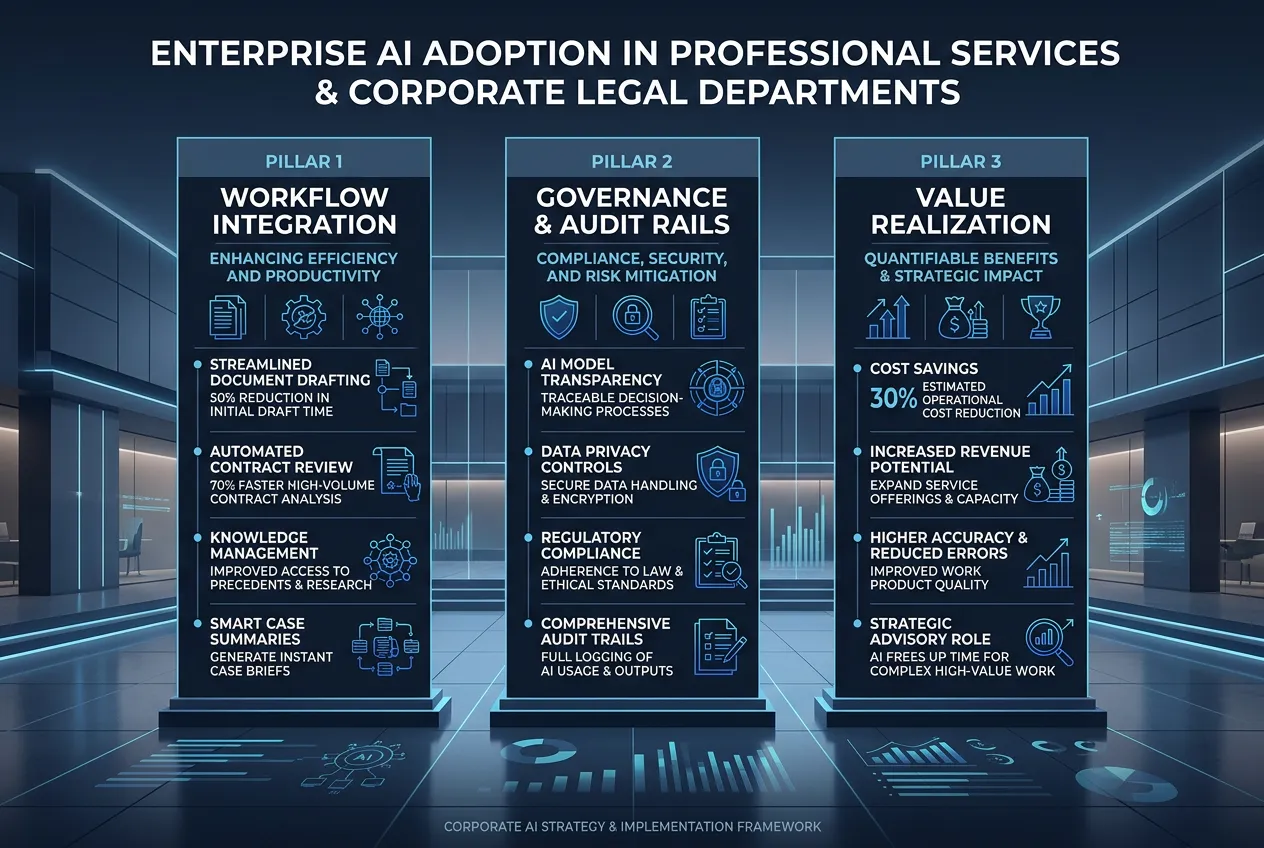
High-performing enterprise legal teams and professional services firms that successfully scale autonomous and semi-autonomous systems adhere to three foundational architectural principles:
1. Embedded Workflow Integration (Beyond Isolated Chat Prompts)
Standalone webchat windows create fragmented data silos, requiring staff to copy and paste sensitive files across browser tabs while severing audit trails. Real operational efficiency occurs when AI agents operate directly within existing enterprise environments—matter management repositories, cloud document storage, contract lifecycle management (CLM) platforms, and communication channels.
- System-Native Execution: Agents execute tasks directly within document storage and practice tools, conducting multi-file synthesis, contract variance audits, and statutory deadline calculations under strict role-based access control.
- Auditable Contextual Memory: Enterprise-grade systems maintain structured organizational memory, ensuring matter history, drafting standards, and client-specific guidelines persist across sessions without requiring continuous manual re-prompting. As explored in our technical deep-dive on why agent memory infrastructure unlocks your largest opportunity, persistent state transforms one-off language models into reliable enterprise collaborators.
2. Deterministic Governance and Fail-Closed Guardrails
In regulated corporate functions, an agent that is accurate 95% of the time represents significant liability if the remaining 5% produces an unverified case citation, an unnoticed regulatory filing deadline, or a privileged data exposure. Production systems enforce architectural guardrails in code rather than relying solely on probabilistic model outputs:
- Primary-Source Verification: Every cited legal rule, court decision, or statutory figure is retrieved and validated against primary regulatory authorities before being presented to practitioners.
- Closed-Loop Reliability: As detailed in our engineering analysis of closed-loop verification for production AI agents, enterprise workflows require deterministic read-back checks and idempotency keys to eliminate silent write errors.
- Human Authorization Gates: Non-negotiable professional floors—anchored in Model Rules 5.3 (supervision of nonlawyer assistance) and 5.5—require that substantive legal work products, outbound client correspondence, and formal regulatory filings remain subject to licensed attorney review and explicit human authorization.
3. Clear Value Realization and Economic Alignment
To justify enterprise adoption, organizations establish quantitative baselines across high-volume legal workflows:
| Legal Workflow Dimension | Traditional Baseline | Integrated AI Workflow | Measured Business Impact |
|---|---|---|---|
| First-Pass Commercial Contract Review | 4 to 8 hours per complex agreement | 20 to 30 minutes with clause variance flagging | 75%+ reduction in cycle time; accelerated transaction velocity |
| Multi-Jurisdiction Regulatory Investigation | 10 to 15 hours of manual database research | 1 to 2 hours of exhaustive, source-grounded synthesis | Complete issue preservation, reduced outside counsel spend |
| Routine Administrative Triage & Filing | Ongoing hourly interruptions across paralegals | Autonomous classification, routing, and staging | High-value staff reallocated to strategic legal advisory |
Staying Competitive: The Risk of Enterprise Hesitation
In enterprise strategy, technological inflection points penalize passive observation. The operational gap between firms integrating auditable AI workflows and competitors relying solely on manual billable hours is widening every quarter.
Firms establishing secure, auditable AI infrastructure today are not merely lowering administrative costs—they are fundamentally expanding their capacity to deliver rigorous, responsive, and cost-effective counsel on complex matters. For a broader perspective on market trends, review our analysis of The State of AI Agents and Current Trends.
Frequently Asked Questions (FAQ)
What distinguishes ad-hoc AI usage from an integrated enterprise legal platform?
Ad-hoc AI involves individual practitioners pasting matter text into public web prompts, creating confidentiality risks, lacking auditability, and offering no organizational memory. An integrated enterprise platform connects directly to firm workflows and repositories under zero data retention policies, with deterministic governance rails and human review gates.
How do corporate legal departments manage professional ethics when implementing AI?
Legal departments adhere to established professional responsibility rules—including ABA Model Rule 1.1 (technological competence), Rule 1.6 (client confidentiality), and Rule 5.3 (supervisory responsibility). Practical compliance requires verifying every citation and factual figure against primary sources, maintaining strict data isolation, and ensuring licensed attorneys retain final review and release authority.
How does enterprise AI adoption impact outside counsel billing?
Corporate clients increasingly mandate that outside law firms disclose whether and how AI tools are utilized on their matters. As automated workflows dramatically compress the hours necessary for research, review, and drafting, corporate clients are pushing away from standard hourly billing toward fixed-fee, tiered, and value-aligned pricing models.